
What do financial service leaders look for when choosing a banking platform?
28 November 2025
When financial services leaders evaluate technology, it can often feel like navigating an overwhelming maze of features, integrations and vendor claims. But beneath the noise, their decision-making is surprisingly consistent.
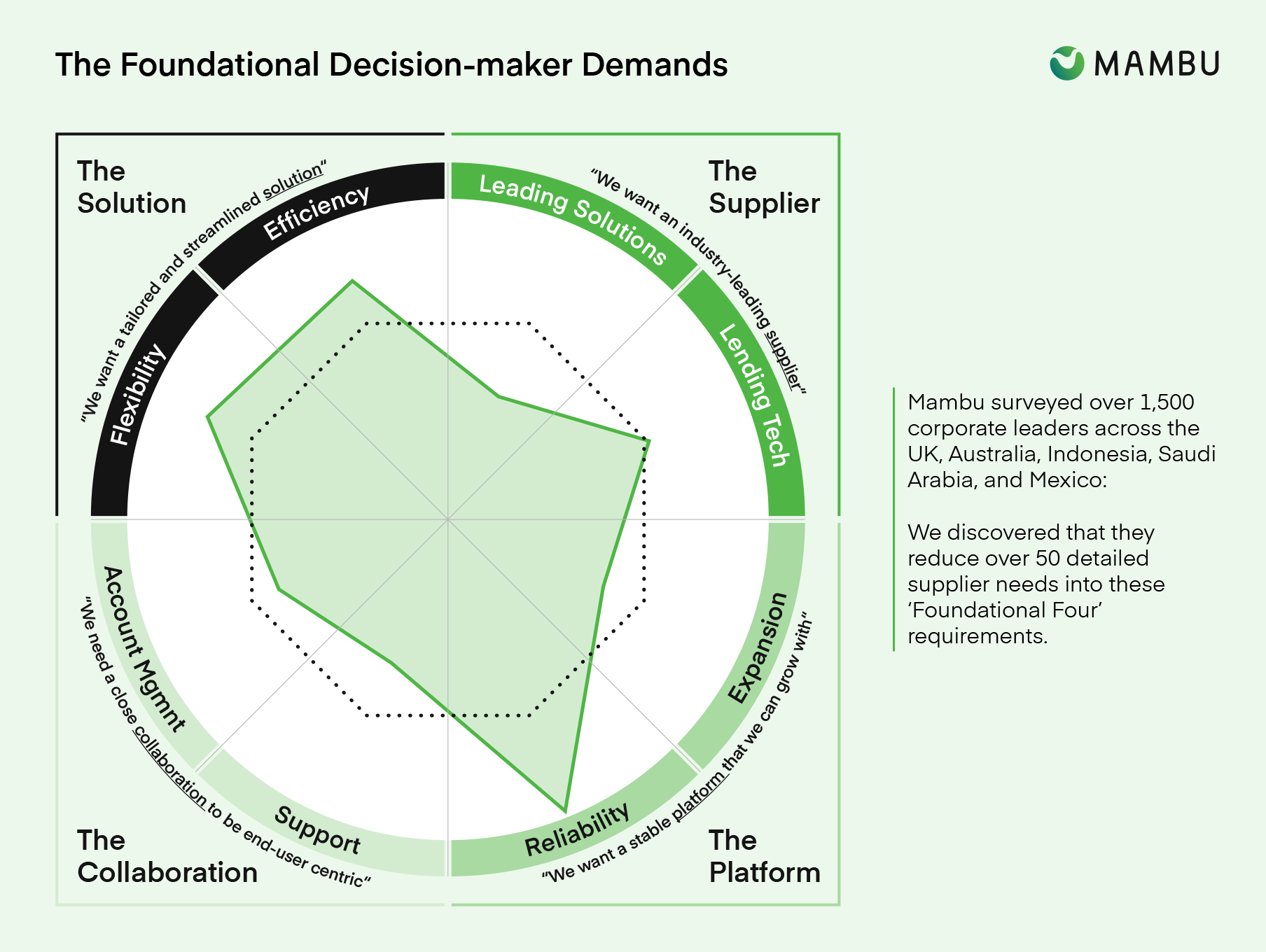
At Mambu, we stay close to the market to understand what institutions really expect from their technology partners. Our latest research shows that leaders distil more than 50 supplier expectations into four foundational needs that ultimately determine whether a partnership will succeed.
The first three are Reliability, Efficiency and Flexibility. These set the baseline for whether a platform can support day-to-day operations, scale effectively and deliver value quickly. The fourth, Supplier Leadership, only becomes relevant once those foundations are proven. It is the final factor that determines whether organisations will trust a provider to support long-term transformation.
These findings come from our study of more than 1,500 corporate leaders across the UK, Australia, Indonesia, Saudi Arabia and Mexico. Their collective insights reveal a clear hierarchy of needs and a precise view of what it takes to compete in an increasingly demanding technology landscape.
In this edition of the Mambu Insight Series, we explore the first three priorities, examining how institutions judge reliability, efficiency and flexibility. We then look at Supplier Leadership as the final gate, and show how Mambu’s composable core is designed to meet all four foundations.
Priority #1 Reliability: the non-negotiable
Understandably, everything begins with stability. When you buy a house, you want confidence that it is built for purpose and that the roof will not leak at the first sign of rain. Technology is no different. If it sits at the heart of day-to-day operations, it must be able to withstand the environment it is placed in.
This is why leaders will not progress to pricing, customisation or roadmap discussions until reliability is clearly established. But the definition of reliability has evolved. It is no longer validated through architecture diagrams alone. Today, reliability is experienced through responsiveness and trust.
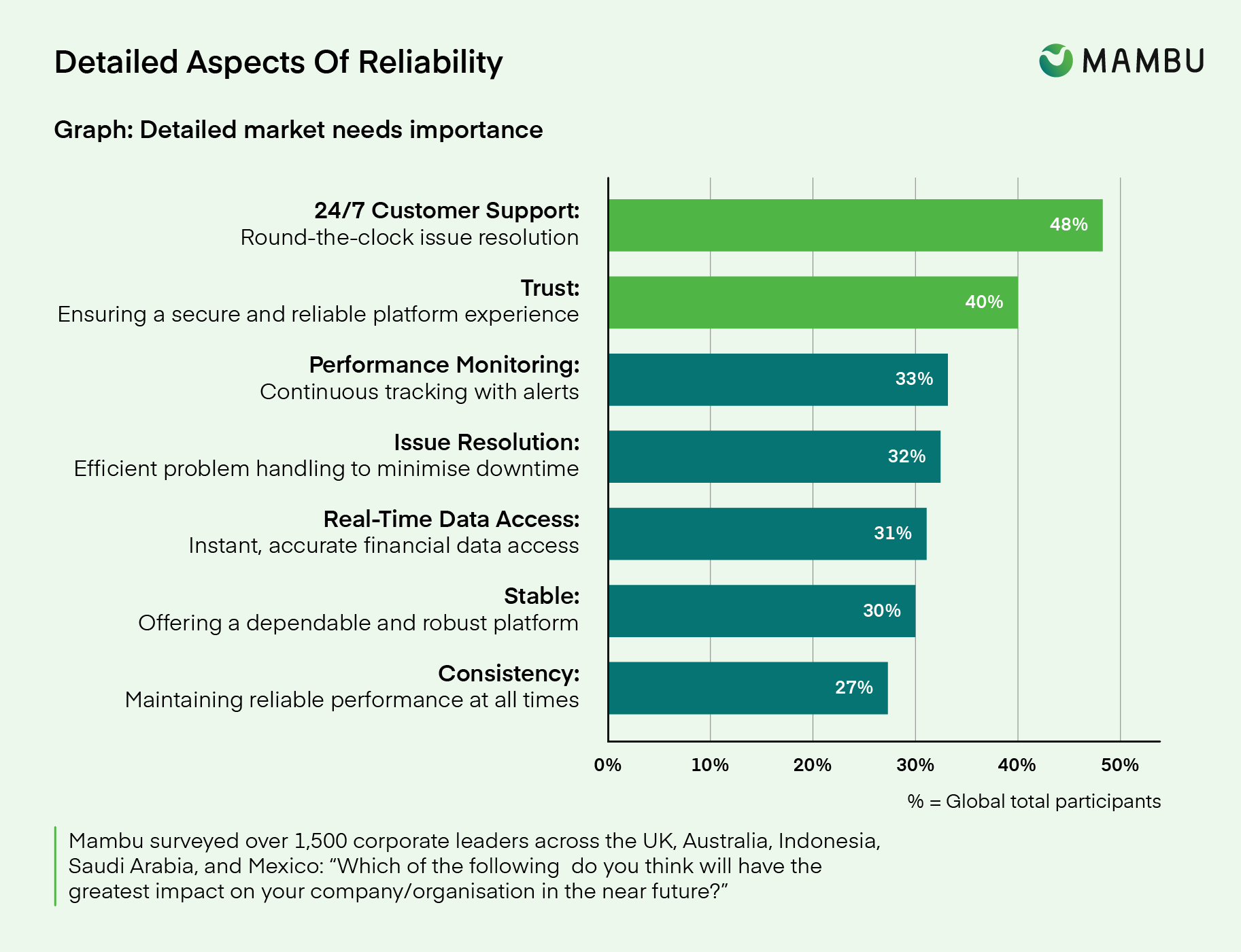
24/7 customer support is the strongest reliability driver for 48% of leaders. They view availability as inseparable from reliability itself. If they have questions or if something goes wrong, they expect immediate access to someone who can diagnose the issue and resolve it without delay. Reliability is therefore experienced not only in the stability of the platform but in the responsiveness of the partner standing behind it.
Confidence in security and resilience follows closely at 40%, highlighting how central cyber readiness has become to modern decision-making. Leaders want assurance that the platform is built on strong controls, that vulnerabilities are managed proactively and that both customer data and operational continuity are protected at all times. Security is no longer seen as an isolated technical feature. It is now a core component of reliability.
Real-time access to accurate financial data, selected by 31% of respondents, together with continuous performance monitoring at 33%, reinforces the industry’s shift from reactive firefighting to proactive engineering. Institutions expect systems to surface issues early, provide a consistent view of operational health and help teams understand behaviour before it affects customers. Visibility has become integral to the reliability contract.
Efficient issue resolution, highlighted by 32% of leaders, completes this picture. When incidents do occur, organisations expect clear ownership, transparent communication and a path to resolution that avoids additional operational burden. Reliability is measured as much by the quality of incident handling as by the number of incidents themselves.
In short, reliability today means fewer disruptions, faster recovery when they happen and uninterrupted access to trusted data. Without this foundation, no meaningful technology partnership can progress.
Priority #2 Efficiency: speed-to-value
Once decision makers are confident reliability is established, attention naturally shifts to efficiency, or more specifically, to the speed at which value can be realised. Leaders want technology that can be deployed quickly, integrated cleanly and operated with as little friction as possible.
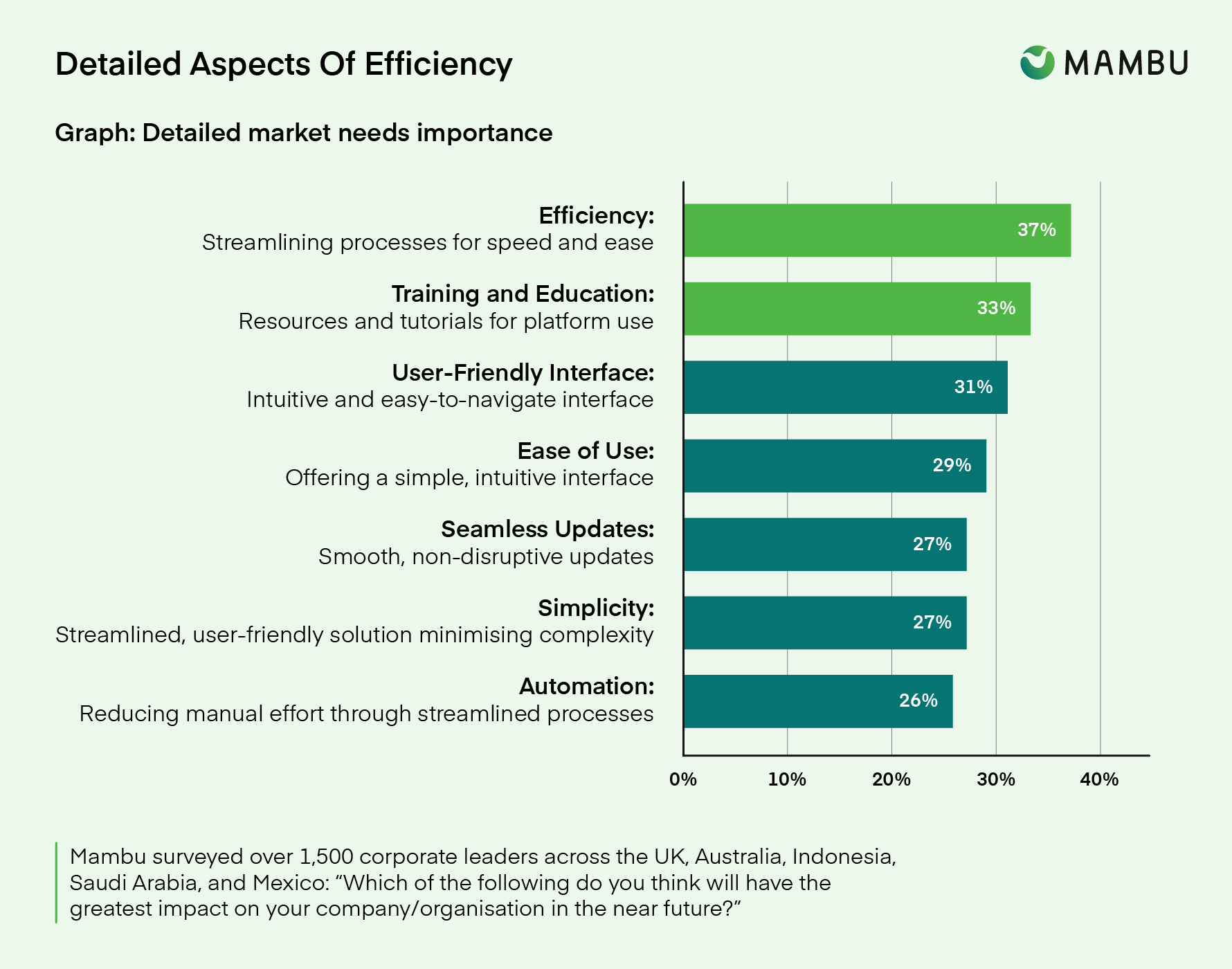
The research shows that compressing implementation timelines, selected by 37% of respondents, is the clearest expression of this. Organisations are looking for solutions that can be stood up fast and deliver measurable outcomes within a single quarter rather than over extended project cycles.
Simplifying and streamlining day-to-day operations, chosen by 33% of leaders, is another central requirement. Efficiency is not a theoretical concept. It is felt in the reduction of steps, the drop in exceptions and the fewer tickets that flow through support channels. When processes become lighter, the organisation moves faster, and teams can focus on higher-value work.
A further cluster of priorities reinforces this expectation. 31% of leaders want real-time visibility into how operations are performing, so they can understand what is working, what is not and where intervention is needed.
Close behind, 29% emphasise the importance of clean integrations that fit naturally within existing technology stacks. They expect systems to exchange data reliably, without relying on custom code or creating additional operational effort. When information moves smoothly between platforms, cycle times fall, and straight-through processing rises, outcomes that operators monitor closely.
Below these headline requirements sit additional enablement factors that remain materially important. Between 27% and 26% of leaders highlight the need for self-service configuration that does not create governance debt, predictable cost structures that avoid unexpected increases and tooling that improves the productivity of operational teams.
These elements may sit slightly lower in percentage terms, but they play a significant role in determining whether efficiency gains are sustained after go-live rather than slipping under day-to-day pressure.
Efficient technology removes manual touchpoints and creates a smoother, more predictable flow across the organisation.
Ultimately, efficiency is about helping the business move faster, from implementation to daily execution. It removes manual touchpoints and creates a smoother, more predictable flow across the organisation. Once this need is met, leaders can turn their attention to flexibility and long-term scalability.
Priority #3 Flexibility: future-proof agility
Only once reliability and efficiency are satisfied do leaders turn their attention to flexibility. This is where long-term value is assessed and where organisations decide whether a platform can carry them into new markets, new products and new regulatory environments without disruption. For decision-makers, flexibility is first and foremost about the ability to adapt services as requirements change.
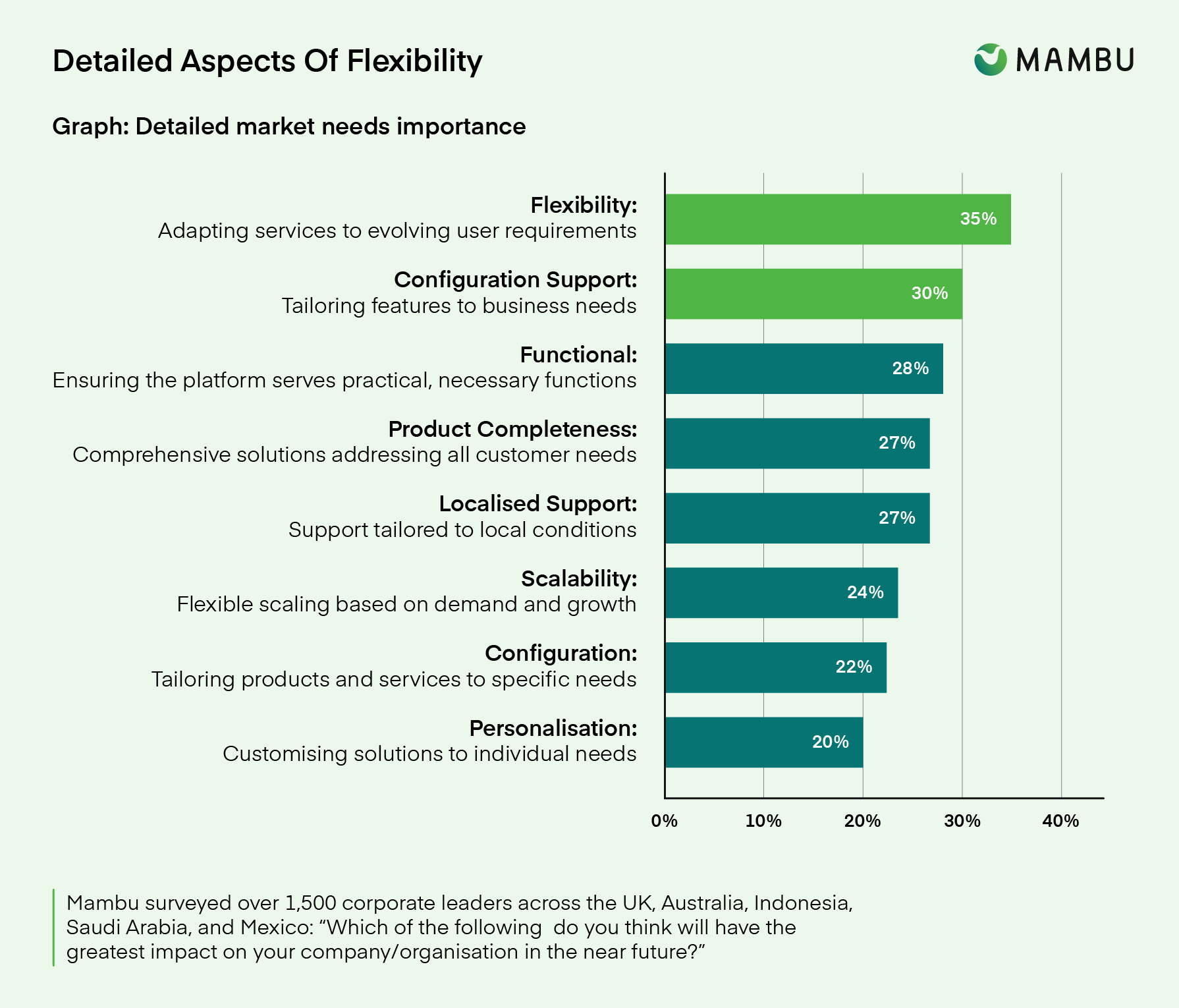
35% of leaders prioritise the capacity to evolve a product or proposition without the need to rewrite it. This sits at the core of modern flexibility. Institutions want to make changes without triggering engineering rework or introducing unnecessary complexity.
Close behind, 30% emphasise configuration support. Leaders distinguish between configuration and customisation. They want governed switches, templates and policy rules that allow them to tailor the platform to their operating model while avoiding the accumulation of technical debt. Adjustments should be controlled, auditable and aligned with business ownership rather than engineering dependency.
Once these two primary needs are credible, the conversation broadens to cover the practical foundations that make flexibility sustainable. 28% of leaders still want reassurance that the platform is functional for the core jobs that matter, and 27% expect enough product completeness to avoid stitching together point solutions. Flexibility must support the real-world tasks that teams perform every day.
For organisations operating across multiple regions, localised support becomes a determining factor. Another 27% of leaders prioritise regional capabilities such as language, compliance nuance, payment rails and established market practices. This reinforces the expectation that flexibility must work in practice, not just in theory.
Scalability then enters the picture. Twenty-four per cent of respondents want confidence that the system can scale up or down with demand, while 22% highlight the need for sustainable and auditable configuration as the organisation grows. Flexibility is not simply the ability to change but the ability to maintain those changes safely over time.
Finally, personalisation rounds out the picture at 20%. Leaders value the ability to tailor experiences, but only after they are confident that the platform can adapt, configure and scale reliably. Personalisation is seen as an enhancement once the fundamentals are secure.
In short, flexibility can be checked off when a supplier proves that the product can change quickly, be tailored safely, cover the practical bases, work locally and scale predictably, with personalisation added once the core is stable.
Priority #4: Supplier leadership: Mambu
The first three foundations in this research, namely reliability, efficiency and flexibility, describe what institutions need from any modern core platform. The fourth, supplier leadership, determines who they will trust to deliver it. When organisations reach this final stage, they are no longer evaluating features but assessing the strength, maturity and credibility of the partner standing behind the technology.
Mambu’s cloud-native, composable banking platform is designed to meet all three operational foundations with precision. Our multi-region SaaS architecture provides the stability, uptime and continuous monitoring that underpin reliability.
Secondly, our configuration-first delivery model shortens time-to-market and removes the heavy development cycles that slow transformation, driving measurable efficiency.
And finally, our composable, highly configurable product architecture enables institutions to adapt quickly to regulatory shifts, market change and new propositions, providing the flexibility required for long-term growth.
These capabilities have always set our platform baseline, and are what sparked the idea behind our technology solution almost 15 years ago, when we pioneered the composable banking model, which segues nicely into why Mambu satisfies the fourth foundation: supplier leadership.
Supplier leadership emerges when an institution asks the decisive question: “Is this the partner we can depend on to deliver predictable outcomes, adapt to market shifts and guide us through long-term transformation?”
Let’s break down how Mambu delivers on this:
Proven experience and credibility
Leaders look first for proof of execution in similar markets. Mambu has spent almost 15 years pioneering composable banking across 65+ countries, business models and regulatory environments, demonstrating consistent repeatable success rather than isolated wins.
A strong, future-ready roadmap
Leaders want a partner with a clear strategic direction. Mambu continues to invest in an API-first, cloud-native architecture and a roadmap aligned with the industry’s long-term shift toward modular, digital operating models.
A trusted partner ecosystem
Mambu’s extensive ecosystem of trusted partners, including fintech technology providers, system integrators, and consulting firms, allows institutions to assemble best-in-class solutions without stitching together brittle custom code.
Operational excellence at scale
Conclusion
This chapter from the Mambu Insight Series shows that beneath the market’s complexity, decision-makers apply a remarkably consistent lens, converging around four foundational needs: Reliability, Efficiency, Flexibility and Supplier Leadership.
Mambu meets all four with clarity and conviction. Our composable core provides the resilience, velocity and agility institutions need to stay ahead, supported by global leadership and a true SaaS operating model that delivers confidence, continuity and a future-proof foundation for growth.
Curious to learn more about our composable architecture and how it can benefit your institution? Contact us in the form below for any questions you may have. We’re happy to assist.
Alternatively, if you would like to see our platform in action, register for our next live demo.
Transform banking with us.
Ready to build the next generation of financial experiences? Fill out the form to connect with our team.
Loading Form

© Mambu 2026