
UK financial services:
from digital leadership to value optimisation
26 January 2026
After nearly a decade as a global reference point for open banking, fintech regulation and digital infrastructure, the UK’s financial sector is refocusing on how mature systems translate into lasting business value.
Britain has long been a standard-bearer for digital finance. It was among the first markets to legislate open banking, establish clear fintech licensing pathways and scale real-time payments infrastructure nationwide. That early momentum shaped one of the most technologically integrated financial ecosystems in the world.
The groundwork has certainly paid off. Today, UK banks and lenders operate in an environment where digital capabilities are no longer aspirational but fundamentally embedded.
As a result, recent momentum is beginning to reflect a market moving decisively from build-out towards optimisation, with institutions less focused on ‘catching up’ and more focused on refining, integrating and monetising what they have already built.
To better understand how the UK compares with its global peers, we surveyed more than 300 senior financial decision makers across the country and benchmarked their views against more than 1,500 leaders worldwide.
The results, part of the Mambu Insights Series, offer a cross-topic snapshot of a market refining its digital foundations, raising its expectations of suppliers and focusing on how maturity translates into measurable value.
UK portfolio coverage reflects market maturity
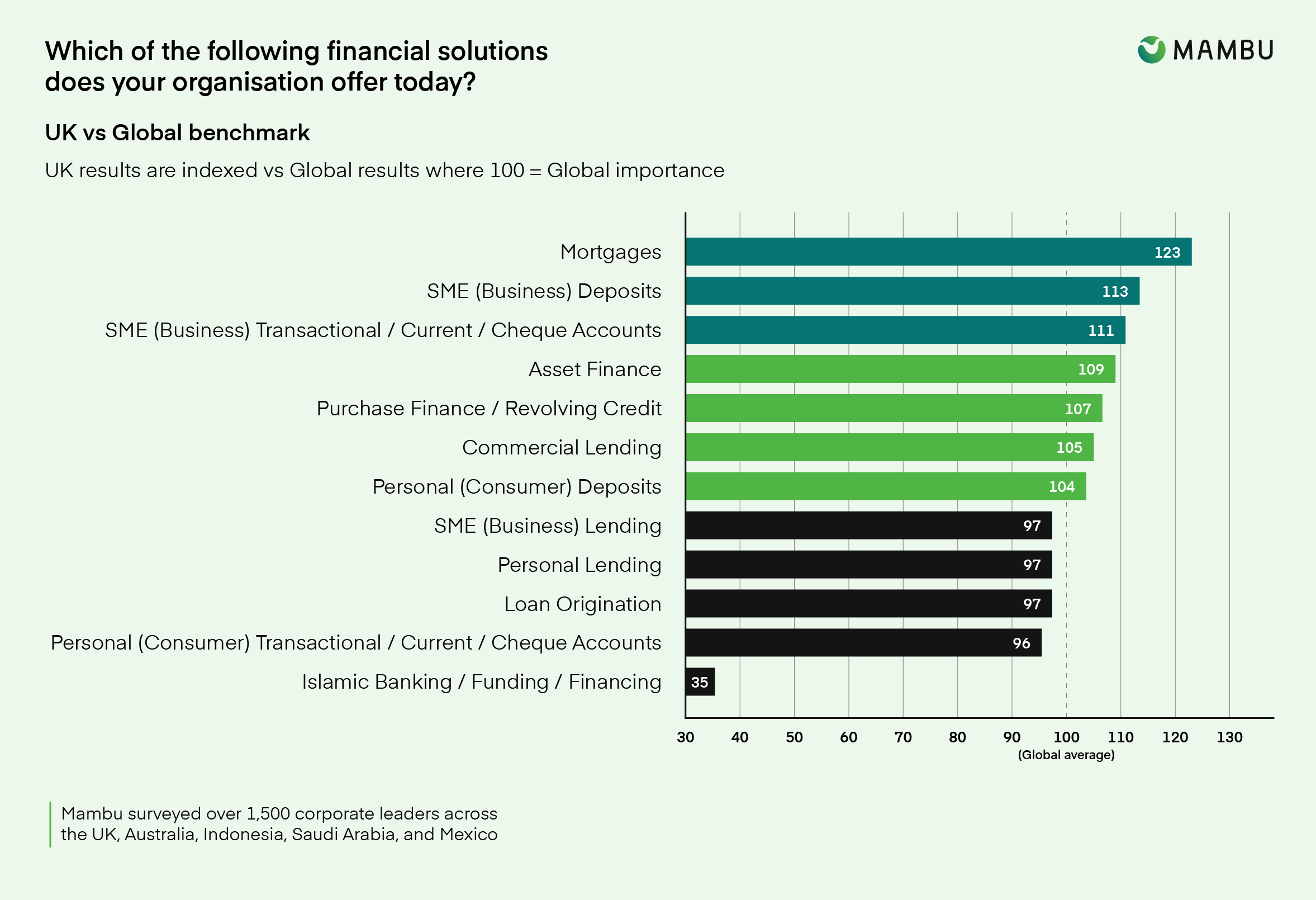
Looking at the products and services British institutions currently offer, the data reveals an exceptionally broad portfolio. Across mainstream retail and business banking, coverage in the UK is close to complete, underscoring the sector’s depth and sophistication.
Mortgages remain a central pillar of UK banking portfolios, reflecting both the scale of the housing market and the long-standing role banks play in household finance. High penetration in this category points to a market where institutions already manage complex, long-duration products at scale, often under close regulatory oversight.
SME deposits and transactional accounts are also firmly established. This reflects the UK’s dense small and medium-sized business landscape, where banks have traditionally supported day-to-day cash management, payments and liquidity needs. Strong coverage here signals deep integration into the operational fabric of the economy, rather than a narrow focus on lending alone.
Beyond core banking, asset finance and purchase finance stand out as well-represented parts of the UK catalogue. Their prominence highlights the breadth of commercial banking services already in place, supporting everything from business investment to consumer purchasing.
Taken together, these products show how UK institutions have built portfolios that span retail, SME and commercial use cases with considerable sophistication. This breadth is a sign of maturity rather than saturation. Most institutions have already launched digital-first products, tested new customer journeys and integrated multiple service lines.
As a result, digital banking is no longer discussed in the abstract. Decision making is grounded in what has already been built, how customers engage with it and how systems perform in practice. The growth challenge is now shifting toward margin performance, deeper customer engagement and greater efficiency across portfolios that are already well established.
UK supplier selection in a high-capability market
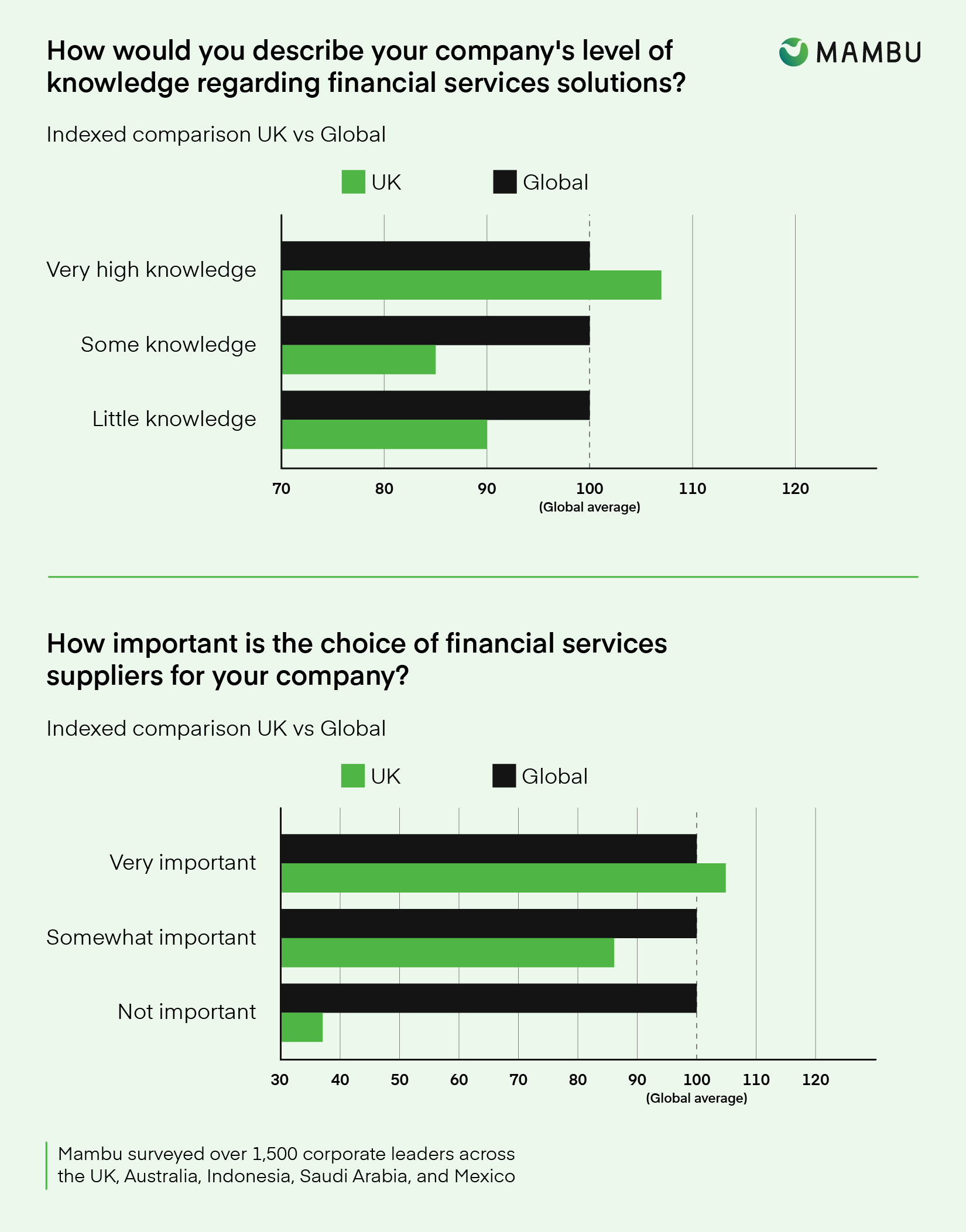
The breadth of the UK’s portfolios is matched by a high level of organisational capability. Nine out of ten decision makers rate their institution’s understanding of financial technology as high or very high, shaping how suppliers are evaluated.
That capability is reflected in a more exacting approach to vendor selection. Two-thirds of UK respondents describe supplier choice as “very important”, indicating a market where decisions are anchored in long-term resilience, regulatory alignment and proven integration performance. When systems sit at the heart of daily operations, the cost of misalignment compounds quickly.
UK institutions operate within environments shaped by complex legacy technology estates, regulatory scrutiny and high customer expectations.
These environments limit room for error and raise the stakes of change. As a result, supplier relationships tend to be treated as long-term commitments.
Once embedded, partners are expected to perform consistently over time, support evolution without disruption and adapt as requirements change, not simply deliver at the point of implementation.
Trust and competence in UK supplier selection
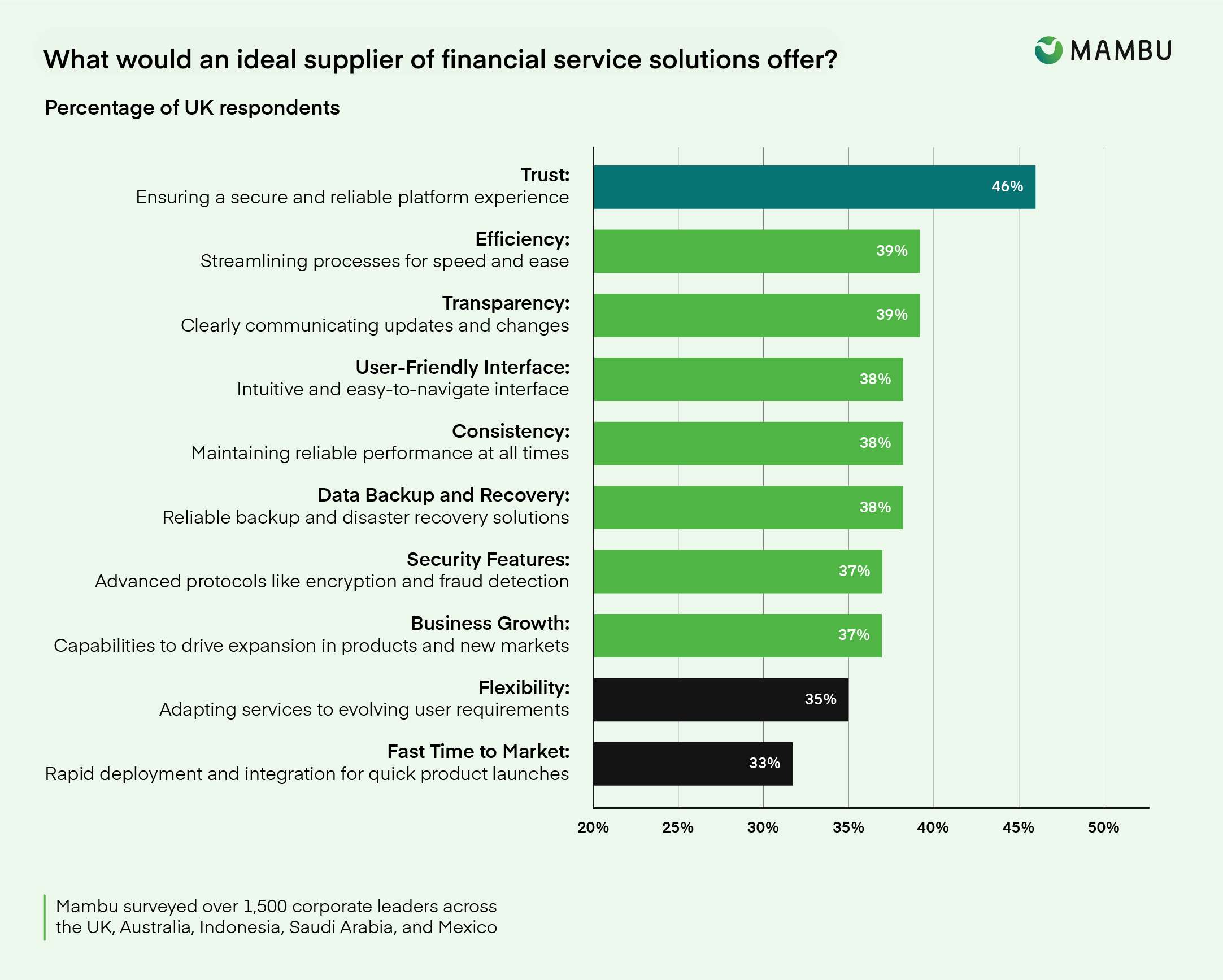
When UK decision makers describe their ideal supplier, trust stands out as the dominant attribute. Nearly half of respondents cite it as essential, well above the global average. In a market shaped by regulatory scrutiny and operational interdependence, reliability is understandably not a differentiator, but the first foot permitted through the door.
Efficiency and transparency follow closely, both emphasised by close to 40 percent of respondents and ranking higher than in most other regions. Together, they reflect a buyer mindset shaped by accountability. Institutions want suppliers who not only deliver robust systems but can also explain decisions, surface issues early and communicate clearly when regulatory, operational and reputational considerations intersect.
These priorities carry through to functional expectations. User-friendly design and strong data backup and recovery are consistently highlighted, underscoring the importance placed on resilience and usability. In a mature market, these capabilities are assumed. Their absence introduces friction, risk and operational drag that institutions are unwilling to absorb.
Taken together, the signals point to a clear set of expectations. UK institutions look for partners who can integrate into complex environments without compromising security or compliance, and who can be trusted to perform under scrutiny. Trust and technical competence are inseparable in a sector where even minor disruption can cascade quickly into regulatory attention and reputational impact.
This mindset distinguishes the UK from faster-growing markets. Where others prioritise speed and expansion, British institutions prioritise confidence in execution. For suppliers, the opportunity lies in showing that reliability, resilience and disciplined integration do more than reduce risk. They enable institutions to move forward with certainty in environments where there is little margin for error.
How UK institutions see the future taking shape
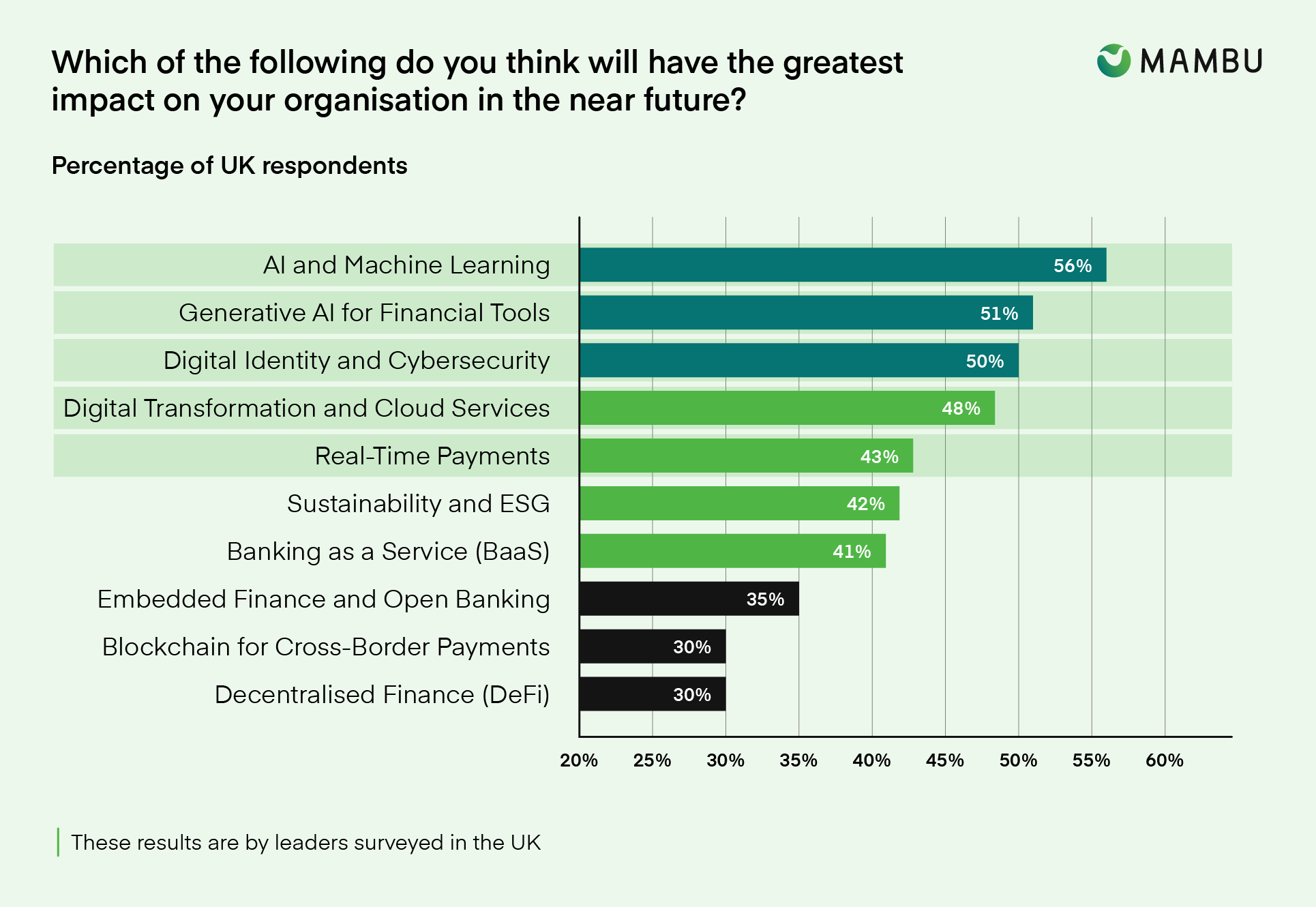
With digital foundations firmly in place, UK decision makers are becoming more selective about where they direct their attention. The question is no longer how to modernise core capabilities, but which areas will most meaningfully improve performance, resilience and decision quality over the next few years.
The survey responses point to a future shaped less by headline-grabbing innovation and more by targeted refinement. Several themes stand out in particular: the growing role of intelligence technologies in day-to-day operations, the continued importance of cybersecurity and identity, and a renewed focus on cloud transformation and real-time payment capability as systems become more interconnected.
Intelligence as an operational capability
Artificial intelligence is increasingly being treated as a core operational capability in the UK market. Rather than sitting at the edge of innovation programmes, it is being absorbed into day-to-day decision making, with an expectation that it improves performance within existing business models.
More than half of UK respondents identify AI and machine learning as having the greatest potential impact on their organisation. That interest shows up most clearly in areas where decision quality and speed carry immediate consequences. Fraud teams are using intelligence to sharpen detection, credit functions to improve assessment accuracy, and operations teams to prioritise activity more effectively across complex workflows.
The same pattern is emerging with generative AI. UK institutions are beginning to deploy these capabilities in customer service and documentation-heavy compliance environments, where volume, consistency and accuracy matter. Adoption is being shaped by questions of governance, explainability and control, reflecting a market that is careful about how new capabilities are introduced into regulated processes.
Taken together, this points to a clear orientation. Intelligence is being valued for its ability to enhance precision, reinforce consistency and support better judgement inside systems that already carry regulatory and operational weight. As complexity increases, its role is becoming less about transformation and more about maintaining control while improving outcomes.
Security and digital identity remain non-negotiable
Cybersecurity and digital identity remain central priorities for UK institutions, cited by half of respondents as shaping their near-term focus. This reflects the realities of operating in an environment where trust, compliance and continuity are embedded into everyday activity.
British institutions already function within strict data-protection regimes and long-established supervisory frameworks. As digital volumes grow and customer journeys become more complex, security requirements intensify rather than recede.
Data protection, authentication consistency and transaction integrity must scale together, without introducing friction or operational instability.
In this environment, security is inseparable from innovation. Institutions understand that trust underpins the entire ecosystem and that confidence is earned through systems that behave predictably under pressure as change accelerates.
Digital transformation and cloud services
Digital transformation and cloud services follow closely behind security and identity in near-term importance. That signal reflects a market where the foundational question is no longer whether cloud adoption will happen, but how far institutions can take it without introducing fragility.
In practice, this extends well beyond infrastructure migration. UK institutions are under pressure to simplify delivery, improve resilience and shorten the distance between change and outcome.
Cloud platforms can support this, but only when the surrounding architecture, operating model and governance are able to keep pace. In a highly regulated environment, cloud success depends on control as much as speed, particularly when change touches customer journeys, data handling and critical services.
This also explains why supplier expectations remain high. Institutions need partners that can integrate cleanly into existing estates, support modern delivery practices and maintain stability through continual change. Cloud transformation is as much about execution discipline as it is about technology choice.
Real-time payments
Real-time payments are also emerging as a prominent future priority. The UK already operates within a highly mature payments environment, and expectations have shifted from access to performance.
Institutions are now focused on how real-time capability can be used more effectively across customer experiences, operational workflows and partner ecosystems.
As payment flows become faster and more interconnected, the demands placed on systems rise. Availability, consistency and the ability to handle high transaction volumes become critical.
A real-time environment reduces tolerance for delay, reconciliation gaps and operational surprises. That pressure increases further as institutions connect payment services to broader propositions, including embedded finance, business banking journeys and platform-based distribution.
Real-time payments remove the buffer between action and consequence. As flows accelerate, institutions must rely on systems that behave predictably under pressure, where control, reliability and integration discipline are built in rather than managed after the fact.
UK investment behaviour in a mature market
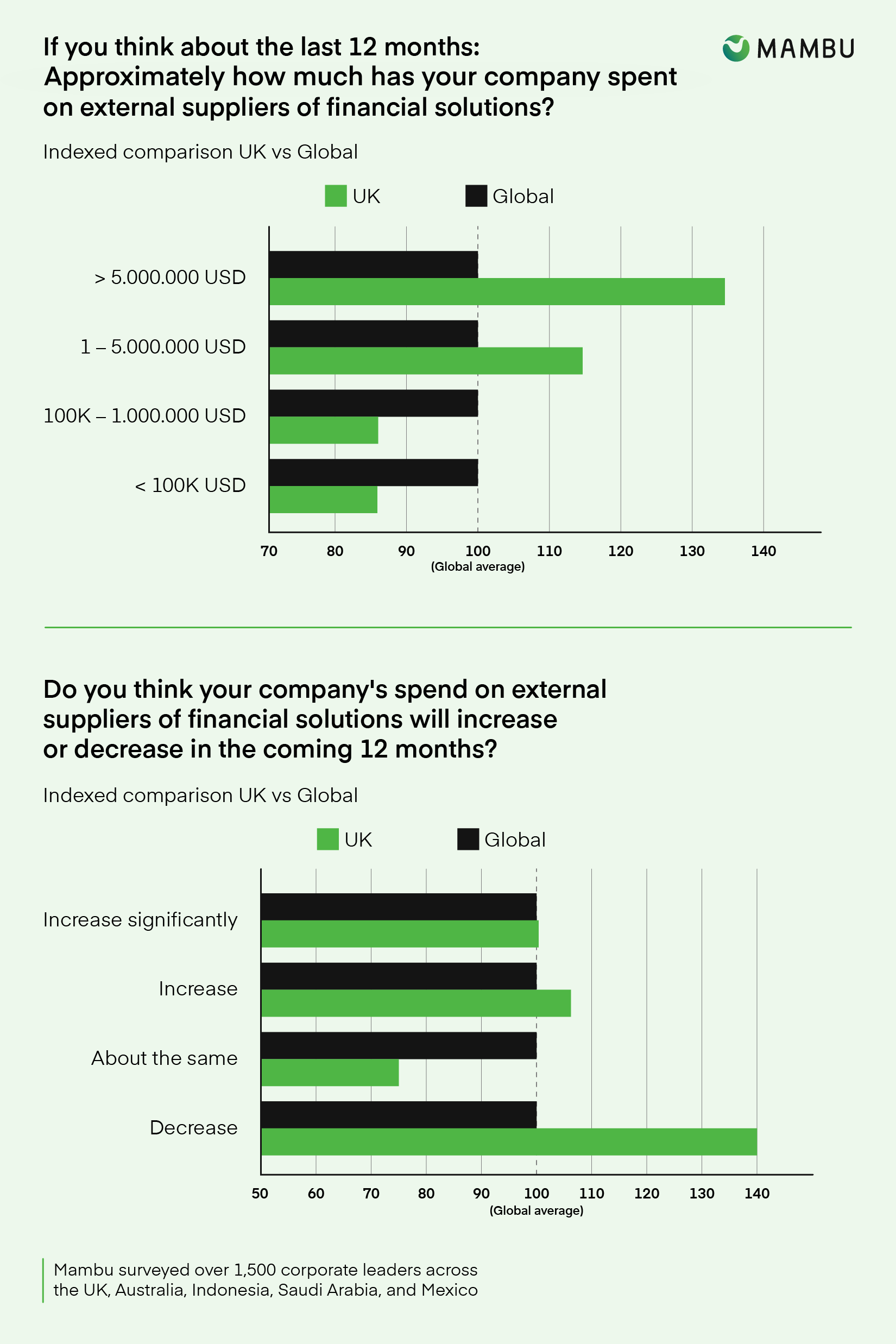
The way UK institutions think about the future is reflected clearly in how they allocate budgets. This is not a market preparing for wholesale reinvention, but one making deliberate investments to strengthen systems that are already central to day-to-day operations.
Looking at supplier spending over the past 12 months, the distribution tells a revealing story. At the lower end, around 18 percent of UK respondents report annual supplier spend below USD 100,000, equivalent to roughly £80,000.
A further 35 percent spend between USD 100,000 and USD 1 million (approximately £80,000 to £800,000). Combined, these lower spending bands account for just over half of the market, slightly below global averages. This suggests that small, exploratory budgets play a relatively limited role in the UK, where many foundational capabilities are already in place.
The picture shifts meaningfully at higher spend levels. Twenty percent of institutions report annual supplier spend between USD 1 million and USD 5 million (around £800,000 to £4 million), while a striking 27 percent exceed USD 5 million (roughly £4 million or more). Both figures sit well above global baselines and point to a market that is comfortable making large, long-term technology commitments.
This spending profile reflects the nature of transformation underway. UK institutions are not allocating budgets to short-lived pilots or isolated digital experiments. Instead, they are funding enterprise-scale initiatives such as cloud migration, data-architecture modernisation and resilience programmes that span multiple business lines and operational functions.
These investments are designed to strengthen core infrastructure and improve performance across existing portfolios, not to test unproven ideas.
Looking ahead, expectations remain positive but measured. A majority of UK decision makers expect supplier spending to increase over the next year, with a significant minority anticipating a more pronounced rise.
However, the tone is restrained rather than aggressive. Growth is expected to come through targeted reinforcement of existing programmes rather than acceleration into new ones.
Institutions are seeking to extract more value from what they have already built, not to outrun their current operating models.
For suppliers, this creates a very specific opportunity. The UK market is not driven by novelty or speed to market alone. Capital flows toward partners who can support complex environments over time, integrate into established estates and deliver reliably at scale. In this context, spending is less about buying technology and more about reinforcing confidence in execution.
Why Mambu is the perfect partner for the UK market
Like a British rose, confident growth is rooted in strength beneath the surface. Solid foundations enable institutions to evolve without losing their shape or stability, while still allowing them the flexibility to shift with the conditions of their environment.
UK institutions now operate in an environment where the cost of misalignment compounds quickly. Trust is assumed, supplier choice is strategic, and change must be delivered without disruption. That is the reality Mambu was built to serve.
Mambu is the founder of the composable banking model and the world’s only cloud-native, true SaaS core banking platform.
In practical terms, this gives institutions an alternative to rigid monolithic systems and the slow, high-risk change cycles that come with them.
Instead of forcing every requirement into a single core, banks and lenders can assemble best-in-class capabilities around a modern foundation, using APIs to integrate specialist partners and proven services while keeping the operating model disciplined and governable.
This approach aligns naturally with how UK institutions are evolving. As intelligence becomes embedded in daily operations, Mambu supports faster integration with data, analytics and AI services, helping institutions improve decisioning and automate workflows without introducing brittle complexity.
As cloud adoption deepens, Mambu’s SaaS delivery model enables continual improvement while preserving the stability, auditability and operational clarity that regulated environments demand.
The same principles apply as payment expectations shift. As real-time and connected payment services become more performance-driven, institutions face rising pressure on availability, reliability and operational control.
Mambu Payments provides a fully managed payments layer that allows banks and lenders to run payment operations, connect to schemes and partner banks, and scale volumes through a single, API-driven platform.
This enables institutions to extend payment propositions confidently, embedding them into broader customer journeys and partner ecosystems while keeping compliance, orchestration and reliability built in rather than managed manually. Composability reflects the UK market’s commercial reality. With established portfolios across mortgages, SME lending and business banking, competitive advantage increasingly comes from refining existing propositions rather than reinventing them.
Mambu allows institutions to evolve lending, deposit and business banking products quickly, respond to competitive pressure with precision, and work with partners without the friction of repeated platform rebuilds.
What makes this combination relevant in the UK is not speed for its own sake, but control at scale. Mambu helps institutions change without destabilising what already works, integrate without losing oversight, and grow without sacrificing trust. In a market defined by strong foundations and high expectations, that balance matters.
Conclusion
The UK’s financial sector is no longer defined by how far it has come, but by how deliberately it chooses its next steps. With mature portfolios, embedded digital capability and rising expectations, progress now depends on extracting more value from systems that are already deeply woven into daily operations.
Institutions are refining, not reinventing, and choosing partners who can evolve alongside them without destabilising what already works. In a market built on strong foundations, the next chapter belongs to those who can turn maturity into sustained commercial value.
Curious to learn more about our composable architecture and how it can benefit your institution? Contact us in the form below for any questions you may have. We’re happy to assist.
Alternatively, if you would like to see our platform in action, register for our next live demo.


© Mambu 2026