
ARTICLE
How instant payments will change insurance
The true value of insurance is realised at particular moments: when policyholders experience insured events. Ranging from a broken smartphone to a need for medical care or a burnt-down home, these moments are when policyholders experience the value of their insurance for the first time after paying for it for years. And when they need it most.
It is, therefore, understandable that 87% of policyholders see the claims experience as a leading indicator of whether they would remain with a provider or cancel their insurance policies.
During these events, whether unexpected annoyances or life-changing, tragic ones, the speed at which policyholders receive funds can be table stakes. 53% of consumers are willing to switch insurance company to receive claim payments instantly.
While instant claim payments allow insurance companies to meet righteously growing customer expectations and open many new use cases for the insurance industry, they don’t come without their own challenges. Let’s deep-dive.
Why instant claim payments matter for insurance companies
The last decade has seen the creation and growth of hundreds of new, digital-first insurance players that have reshaped most parts of the insurance customer experience, from subscription to distribution to claim management and payment. The rise of embedded insurance, through insurance-as-a-service providers, brought those new customer experiences into consumers’ everyday activities, such as buying electronic devices or concert tickets.
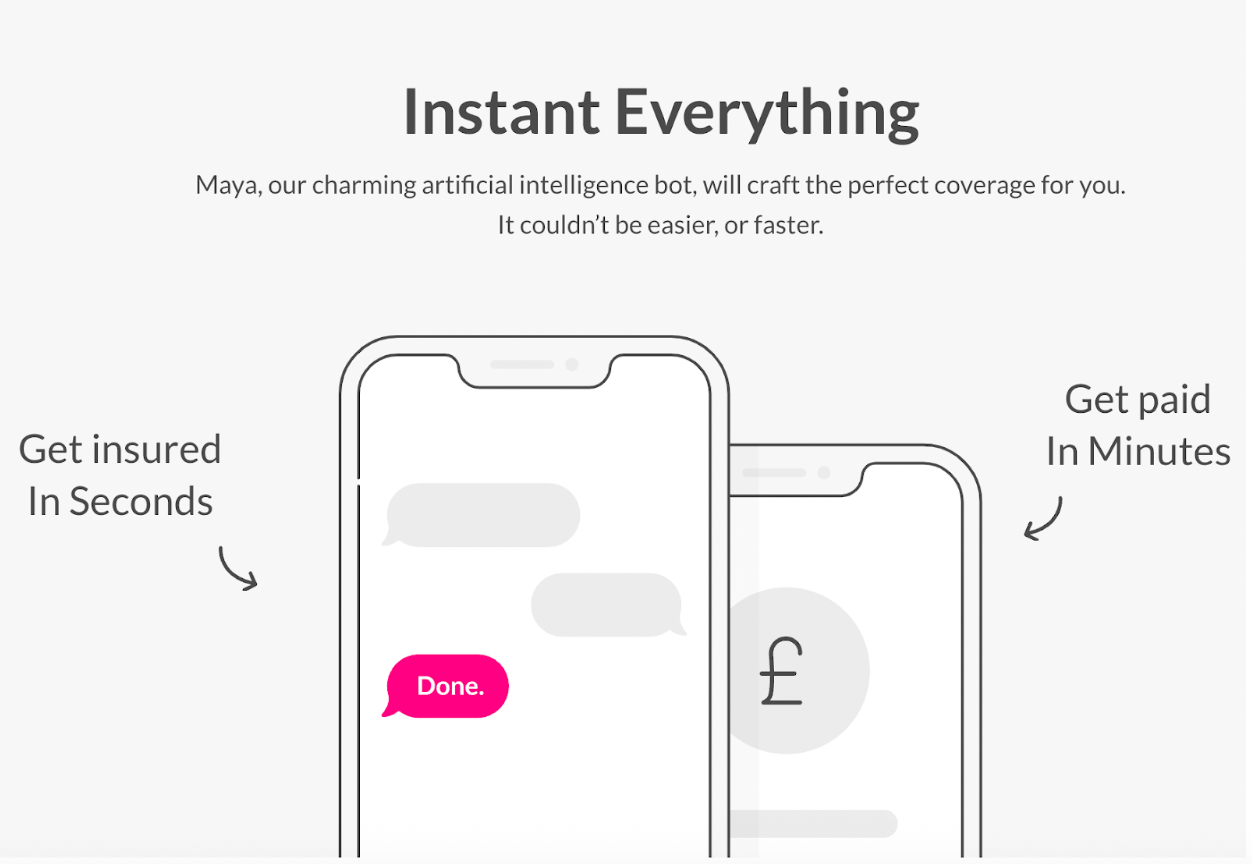
New players in all insurance verticals offer instant claim payments, sometimes making it front and centre of their value proposition, such as the generalist neo-insurer Lemonade or the leading health insurance Alan. Luko even signed a partnership with the payment app Lydia so that policyholders can receive their compensation in their Lydia app instantly.
Lemonade’s home page
Traditional players have noticed the trend and started to improve their claim experiences with instant payments, some quite early such as Natixis Assurances in 2018. In the travel insurance sector, Allianz Travel was one of the first to introduce instant claim payments, while Berkshire Hathaway Travel Protection touts their “Fastest travel claims payments in the industry.”

Berkshire Hathaway Travel Protection’s subscription page
Those new types of insurance customer experiences have become the new normal for consumers. Before, they accepted slow reimbursements because all insurance companies were equally slow. Today, as we’ve already seen, most consumers would switch insurers to benefit from instant claim payments. And insurance companies adopting real-time payments see the reward, with NPS scores soaring well above the industry average.
Insurers have no choice but to adapt. This is even more true for embedded insurance vendors, as travellers and shoppers expect the claim experience to be as easy and fast as the flight booking or smartphone buying experience.
But more than simply meeting customer expectations, insurance companies should see instant claim payments as an opportunity to differentiate in a crowded market and innovate with unique offers.
How instant payments unlock innovative insurance products
Home
For various incidents covered by home insurance, the speed at which the root cause is identified (e.g. water damage) or the damage is fixed (e.g. a broken window after a theft) is often crucial to preventing further damages and more significant compensation amounts. The ability for customers to quickly hire professionals or buy materials to fix the damages is therefore beneficial to both customers and insurance companies.
To do so, when a peril occurs in their home, customers receive an advance on the claim after sending pictures or videos of the damages to their insurance.
For more perilous events resulting in an uninhabitable home, such as fire or flooding, instant claim payments allow customers to find emergency housing when their insurers’ options don’t work for them.
Auto
Even minor accidents leading to mostly aesthetic damages such as a hanging bumper, or a broken window resulting from a theft, can prevent drivers from using their car. Instant claim payments from car insurance companies enable customers to go to the quickest and most convenient repair option, and therefore have the ability to reuse their car, in a matter of hours.
Travel
In travel insurance, faster claim payments often make a huge difference. Having money available in your bank account immediately when yxkirgou need to purchase emergency clothes abroad or last-minute accommodation is not just a convenience. Instant payment also enables insurance companies to provide customers with cash in no time when necessary by wiring funds to a local bank, insurer, or branch that would then directly give customers the corresponding cash.
On flights specifically, the Allianz Global Assistance program developed a product that monitors customers’ booked flights for delays, automatically files and instantly pays a claim when a covered delay occurs, depending on customers’ policy benefits.
Health
In health insurance, instant claim payments can mean no out-of-pocket expenses for patients when the third-party payer option isn’t available, effectively increasing access to healthcare for many.
After the patient sends their health insurer proof that a health professional provides care or delivers a prescription via a mobile app, for instance, the insurance company sends an instant payment to the patient, so they can, in turn, pay for the care or the medicines.
Pet insurance
Similarly to health insurance, instant claim payments for pet insurance improve pet owners experience, and takes the financial stress associated with pet health incidents out of their mind.
Instant payments will transform the insurance industry
More than new insurance products, new insurance models
Alongside other innovations such as IoT and AI, real-time payments enable insurance companies to rethink how they cover and support their customers completely.
Many insurtech players already help insurers expedite the claim management process, especially the damage estimation step. Beyond simply connecting customers with claim management agents over a video call, these solutions leverage computer vision to automatically assess damages on cars or homes and calculate repair estimates. Coupled with instant claim payments, they enable almost end-to-end automated and real-time customer claim resolution. But they still depend on customers to correctly capture the right images of the damages and cannot accurately assess damages that happened under the hood.

With the rise of IoT, sensors are becoming more common on everything, every component of your car, every room and element of your home. This could push claim management automation even further, as homes and vehicles could self-assess damages in seconds after damages happen — after making sure inhabitants or passengers are safe or warning rescuers when necessary, triggering a claim immediately that the insurance company would pay directly.
This could also apply to consumer electronics, where internal sensors could, for instance, detect a drop, resulting in damages, and automatically pay for the repair or replacement of insured devices.
Unlocking a genuine social impact that goes beyond covered perils
As we’ve seen, instant payments, especially combined with other innovations, have the potential to redefine insurance products to offer completely new and seamless experiences for customers.
But going back to what insurances are about — supporting people and organisations in events ranging from unexpected annoyances to life-changing, tragic ones, instant payments can be table stakes in both perception and actual, long-lasting consequences of covered events, even more so for households experiencing financial difficulties.
The fewer financial reserves you have, the more those events will impact you. Someone whose car breaks down might still have no choice but to go to work, even if the claim takes weeks to settle. And going to work without a car might imply renting another vehicle, taking cabs or public transportation and hiring a nanny. When financially tight, doing so can mean contracting micro-credit or overdraft fees, turning the originating event into long-lasting difficulties.
For the same reasons, some people might not get the healthcare they need because they cannot afford to pay upfront for their care, even though they’re covered by their insurance, leading to dramatic consequences down the line in some cases.
In transportation problems such as a cancelled flight when travelling for a significant family event, some families cannot pay for alternative transportation out of pocket and are unfairly separated for such events.
The examples are countless. Instant claim payments aren’t only a shiny new differentiator, a nice to have in insurance customer experiences. They often prevent insured parties, consumers, and organisations from long-lasting and damaging consequences of insured events, which is why we buy insurance in the first place.
The challenges of implementing real-time claim payments
While there is no doubt that instant claim payments will be the default for insurance products in the near future, making it a reality won’t happen overnight and comes with various challenges for insurance companies.
A new way of working
Instant claim payments lose most of their value if the claim management process before the payments takes days or weeks. Therefore, insurance players must adapt their tools, workflows, and organisation accordingly to accelerate claim filing, assessment, and payment.
To allow customers to easily and rapidly file claims, insurance companies must provide real-time channels such as live chats, phone calls, or video calls. It means that they need teams available to support these channels, as well as processes for those teams to validate a claim and send the funds. It might require a re-organisation as, in many cases, insurance companies depend on their financial departments to manage payouts. Working with a TPA (i.e. claims filing management) can also cause problems as they dilute the customer experience.
Another friction to the instant claim payment experience often is incorrect bank details, which means rejected instant payments and manual processes and back and forth with customers to get the correct ones. This can be mitigated by doing penny tests on policyholders’ bank details or using solutions such as SEPA Diamond.
Instant payments mean instant treasury needs
Real-time claim payments also come with specific financial requirements. The first one is that with most banks or payment service providers (PSPs), instant payments cost more than regular ones. This cost is sometimes charged to the end user.
Another requirement is that insurers lose the few days of visibility they had on treasury needs for claim payments. Instant claim payments mean having the possibility, and therefore the available funds, to pay large volumes and amounts of claims within seconds. Those funds cannot be used elsewhere and represent an increased need for working capital.
Technological upgrades
While most banks support instant payments, such as the SEPA instant credit transfer scheme in Europe, an insurance company cannot offer instant claim payments at scale if claim managers have to manually send the payment instructions to their bank, whether one by one in the bank’s web app or loading claims payments to a spreadsheet before uploading the payment instructions to their bank account.
Real-time claim payments mean payment automation, and all automatic payment solutions don’t support instant payments. Some PSPs don’t provide it and insurers who built their payment systems might not have planned for it.
How modern, API-first payment operations solutions enable instant claim payments
While they are not solving all organisational or working capital challenges, modern payment solutions such as Mambu Payments alleviate many instant claim payment challenges.
By providing forms to directly onboard counterparts within their platform and verifying their bank account information, modern solutions reduce the risk of sending funds to the wrong beneficiary or manually fixing bank details errors.
API-first solutions can be easily integrated within the claim management systems and their approval flows, enabling complete automation of the instant payment part. Doing so further reduces the delay between claim filing and payment.
Such solutions also come with real-time notification of claim payment lifecycle, which means insurance companies can easily get notified of payment errors and automatically manage them. They can also inform their customers if something goes wrong or when the payment has been executed.
Making instant claim payments a reality
Although they come with multiple challenges, real-time claim payments are becoming the new normal for customers’ immediate and long-term benefits. If they want to keep their customers, insurance companies have no choice but to offer it.
Mambu offers a payment operation platform that helps insurance companies provide a better customer experience through payments while streamlining their operations. If you are interested in learning more about Mambu Payments and how we could help you offer instant claim payments to your customers, do not hesitate to contact us.

© Mambu 2026