
Workflow series #6
Modern payouts
15 May 2024
In this article, we explore how Mambu Payments reinvents the payout process to make it failure-proof, scalable and value-added for customers.
Payouts at a turning point
For decades, the way businesses have been doing payouts hasn’t changed. Traditionally, organisations have relied on Enterprise Resource Planning (ERP) systems or legacy bank connectivity software to manage their payments, which typically process transactions by sending XML files to banks, which are then processed in batches at the end of the day.
A critical drawback of traditional payout systems is the lack of real-time visibility into payment statuses. Businesses today require immediate insights into their financial transactions to make informed decisions and manage cash flow effectively. Additionally, these older systems often suffer from rigidity in payment instruction formats, primarily relying on file-based inputs with limited support for API connectivity. This inflexibility hampers integration with more modern systems that leverage real-time data exchanges and can adapt more dynamically to changing business needs.
Furthermore, traditional payment solutions typically do not provide a comprehensive audit trail from initiating a payment to its final settlement in the account. This lack of end-to-end tracking makes it challenging to verify transactions and ensure compliance with regulatory requirements. The absence of detailed audit capabilities exposes businesses to potential risks of errors and fraud, making it imperative for organisations to adopt more advanced and secure payment technologies that offer complete transparency and traceability.
The changing paradigm of faster payments
With the development of instant schemes worldwide (FPS in the UK, SEPA Instant Credit Transfer in Europe, RIX-Instant in Sweden), the historical approach to managing payout operations has become increasingly inadequate for modern business needs. Both payments and the associated liquidity requirements must now be managed intra-day instead of D for D+1 in the traditional batch system.
Instant payments are also emerging for BtoB payouts to create value and become a competitive argument in commercial discussions with clients. From insurance companies offering instant disbursement to factoring companies offering real-time invoice liquidity to the treasury, the possibilities are endless to provide additional liquidity to finance teams.
Lastly, instant can also support a broader way of managing cash. Increasing opportunities in treasury yields and scrutiny of safeguarding institutions (for regulated companies) translate into higher expectations in the speed of liquidity management.
Instant payments - at the exact cost as traditional payments in the EU end of 2024 - will be the trigger for a new way of doing payouts
Building modern payout operations with Mambu Payments
At Mambu Payments, we reinvent the payment infrastructure for payouts to ensure finance, operations, and product teams can accelerate payouts across their banking partners through a single platform.
A modern payout infrastructure, to be 100% error and fraud-free, needs to include the following components
- Validating beneficiary accounts
- Initiating payouts from any systems
- Screening transactions for fraud
- Setting up 4-eye validation when relevant
- Tracking a payment’s execution and settlement status
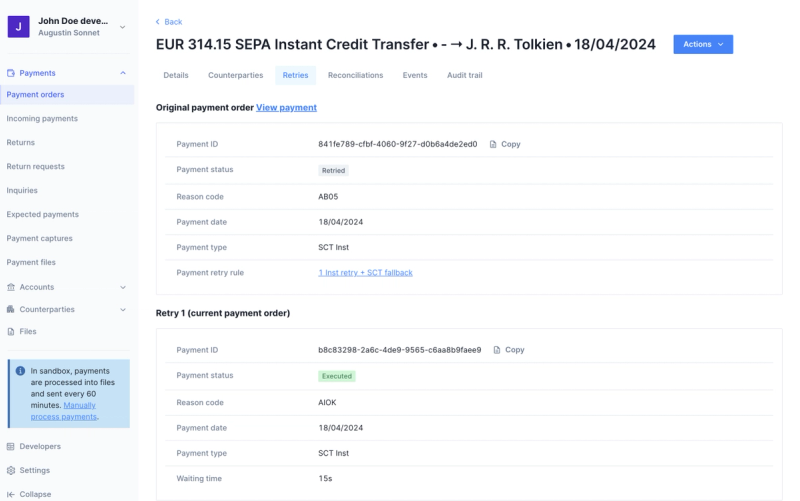
- Setting up custom retries and fallbacks
- Automating cash sweeps to support payouts
Let’s run through how all these steps can be implemented with Mambu Payments (API documentation here).
Validating beneficiary accounts
Most payout errors lie in account issues, namely accounts closed, migrated or wrong account numbers. Mambu Payments allows to conduct a thorough verification of those accounts, checking on:
- Account information technical correctness
Starting your payment modernisation
With Mambu Payments’ end-to-end payout platform, companies moving money can ensure 100% payment success and compliance at scale and with real-time data. Mambu Payments can integrate into any system through our API/webhooks, native core banking/TMS connectors or our universal file ingestion engine, making payment transformation projects fast and efficient.
If you are looking to start your payment modernisation journey today, do not hesitate to get in touch.

© Mambu 2026