
Why Saudi Arabia is setting the pace in financial services transformation
28 October 2025
Saudi Arabia’s financial services sector is undergoing one of the most ambitious transformations anywhere in the world. Under the banner of Vision 2030, the Kingdom is forging ahead ahead in digitisation, regulation, and financial innovation.
Already, nearly 80% of retail payments in the Kingdom are electronic, a milestone targeted initially for years in the future that was achieved well ahead of schedule.
With new digital-only banks already establishing a foothold in the market, regulators are rolling out detailed frameworks for open banking, cloud adoption, outsourcing, and cybersecurity.
Across the sector, financial institutions are investing heavily to meet rising customer expectations while staying compliant with Saudi Central Bank (SAMA) directives.
To understand how Saudi Arabia compares with global peers and what financial institutions demand of their technology partners, we surveyed over 300 senior decision-makers in the Kingdom and contrasted their views with those of over 1,500 peers worldwide.
The results, part of the Mambu Insight Series, reveal a market that is not only informed and confident but also prepared to outspend, outpace, and out-innovate many of its global counterparts.
Saudi Arabia: a market of informed buyers
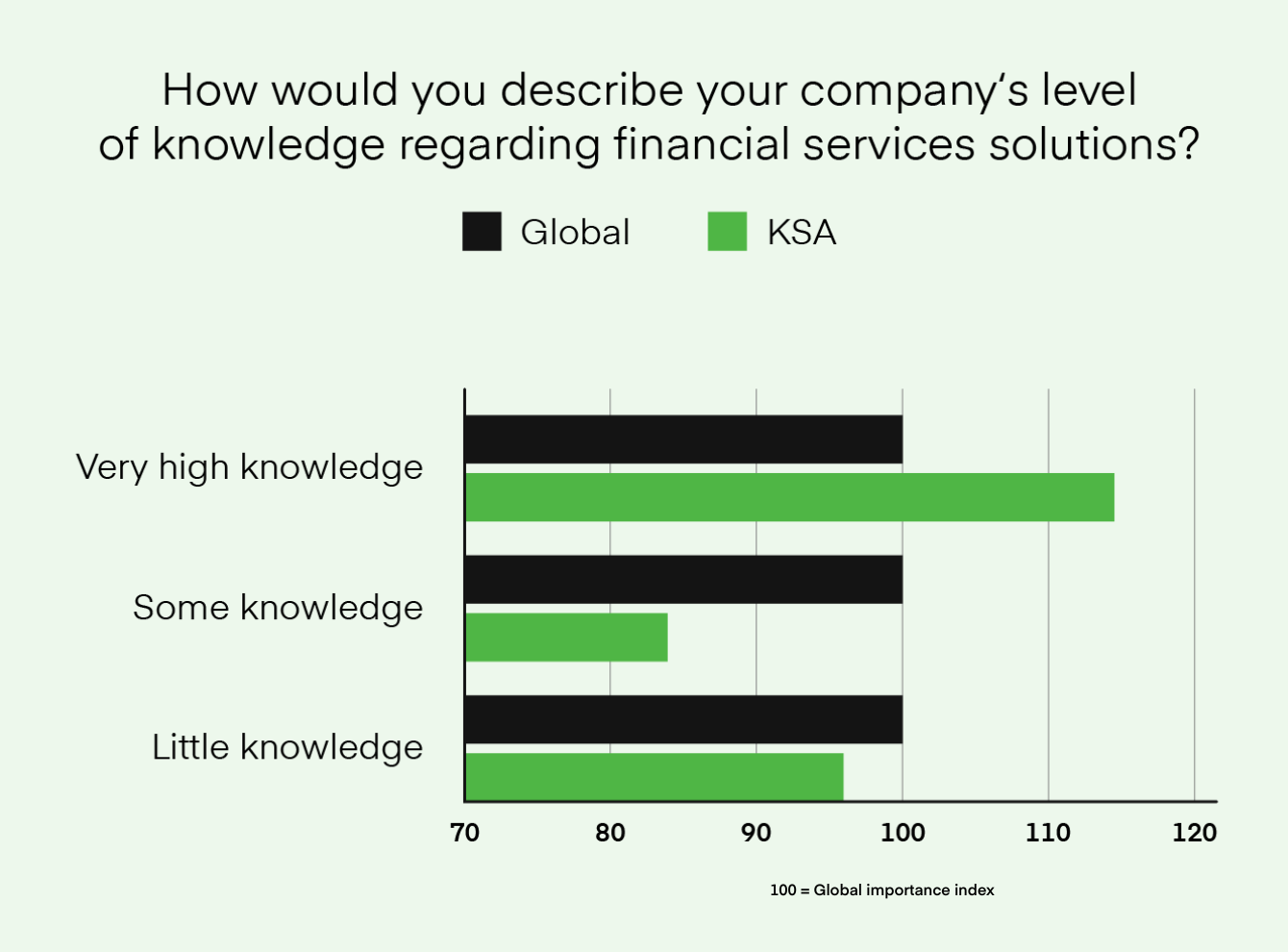
One of the standout findings from our survey is that Saudi respondents rated their institutions as more knowledgeable about financial services solutions than the global average.
This is not, objectively, without its merit. Over the past five years, the Saudi Central Bank (SAMA) has taken an unusually proactive stance in shaping the market. Rather than leaving financial institutions to interpret regulations on their own, it has issued detailed guidance on everything from open banking APIs to cloud and cybersecurity standards.
Saudi institutions have also been early to pilot digital-first products, meaning decision-makers are actively learning from direct hands-on experience rather than just theorising about digital transformation.
Such tangible investment in knowledge of the technology has ultimately resulted in a market of educated buyers.
When Saudi banks engage with suppliers, they know what works, what doesn’t, and what their regulatory environment demands. As a result, they are not looking to be sold generic solutions or those that rely on slick marketing and surface-level promises.
Institutions here will probe for real expertise, proven case studies, and the ability to deliver value in a highly regulatory environment. Suppliers entering this market must be ready to meet that higher bar.
Saudi Arabia: budgets for acceleration
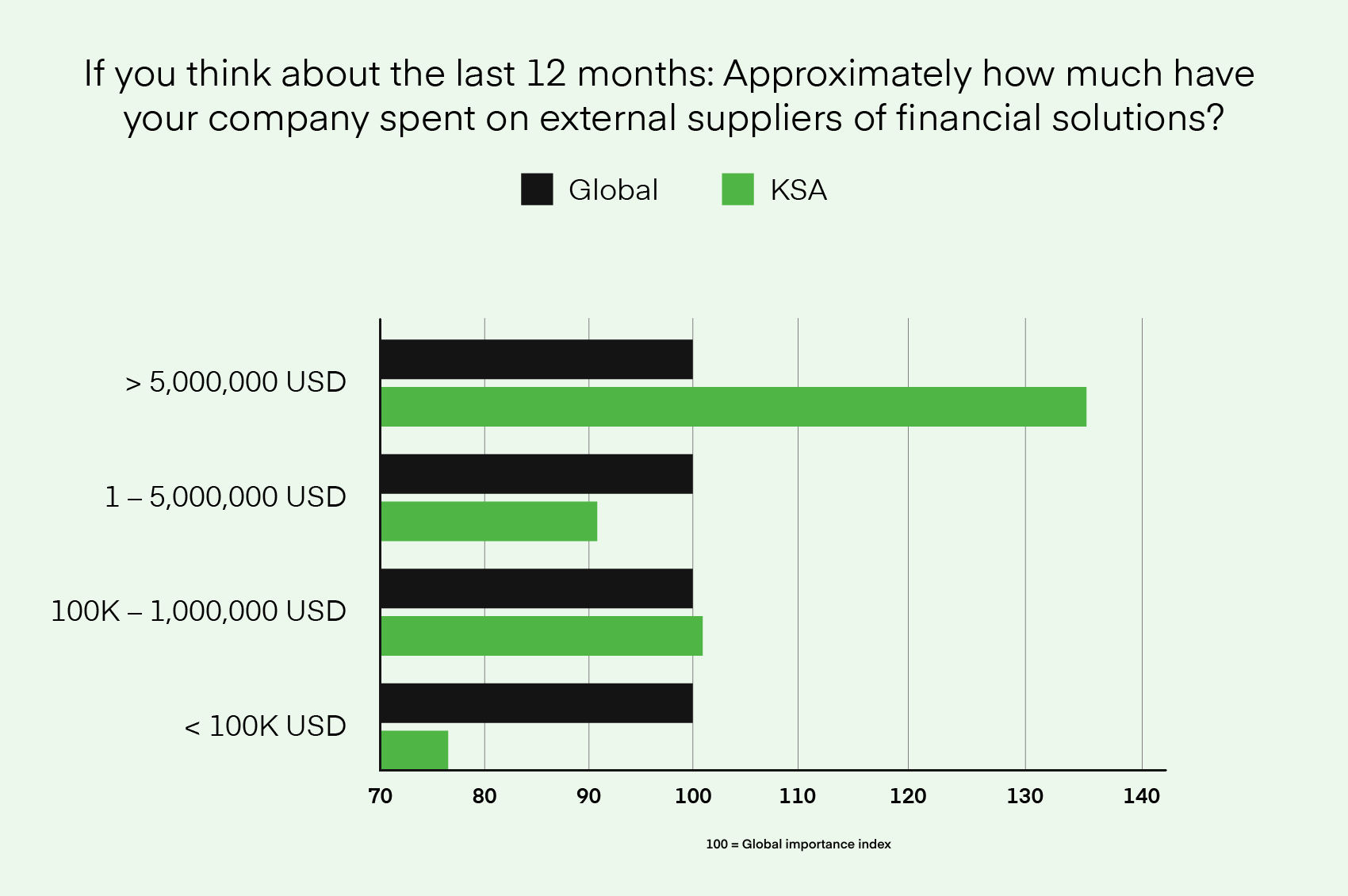
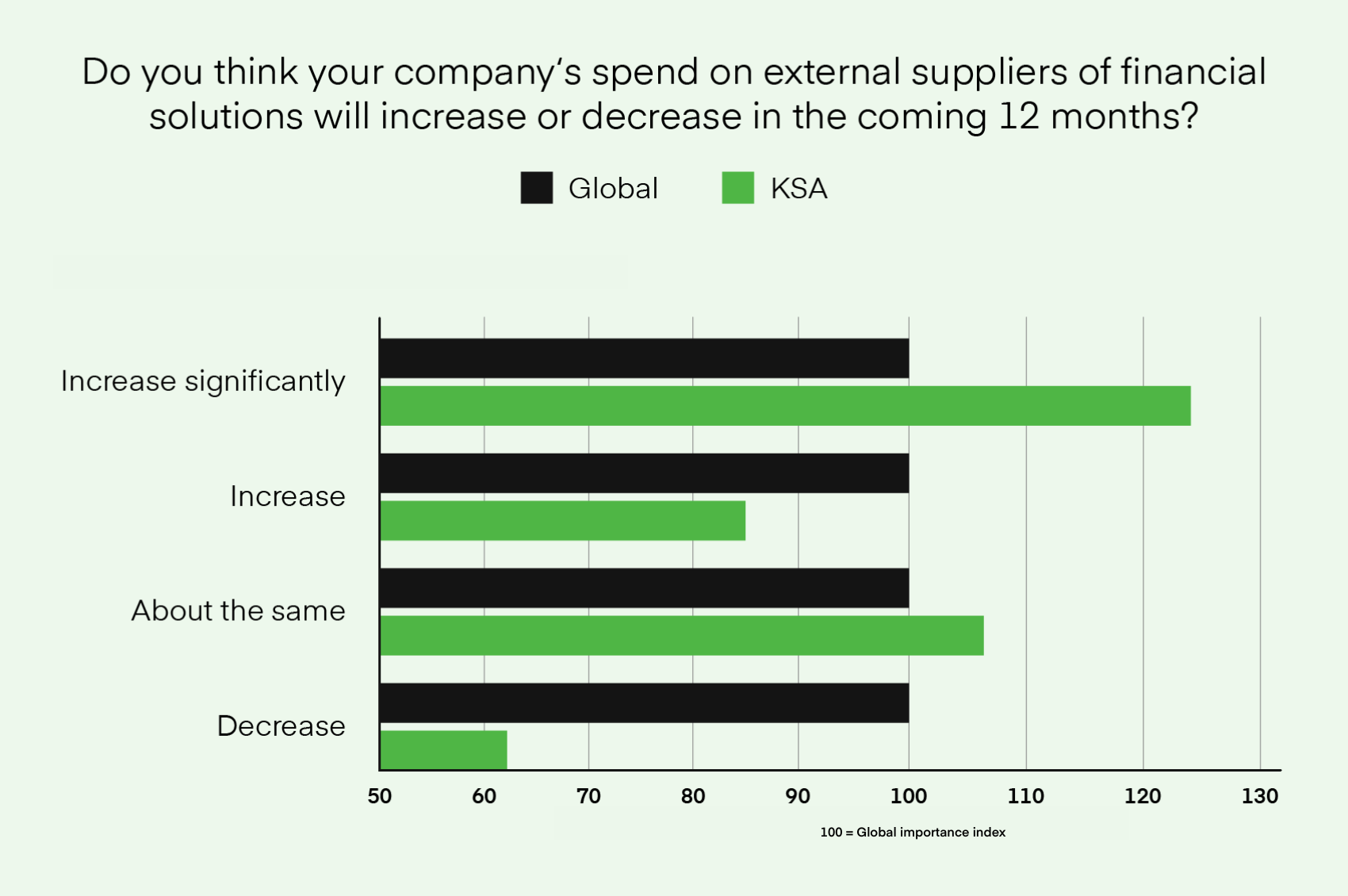
Knowledge alone is only part of the recipe for success. You can map out the perfect route for a road trip, but without fuel in the tank, you won’t get far. Saudi institutions know this, which is why they’re pairing vision with serious financial commitment.
Our survey shows that banks in the Kingdom are not holding back when it comes to investment. Over the past year, they’ve been spending at or above the global average on external suppliers, and, more importantly, a larger share of Saudi leaders say they plan to increase that spend in the coming year compared to peers in other markets.
Put simply, while many financial institutions around the world are tightening their purse strings and navigating cautiously through economic uncertainty, Saudi Arabia is leaning in and accelerating, with technology budgets firmly prioritised.
This appetite for investment reflects the twin pressures facing the market today. On one side, regulatory deadlines are firm and non-negotiable, with requirements like phased open banking adoption already underway.
On the other side, competitive disruption is intensifying, with digital challengers entering the market and raising consumer expectations.
With strong investment comes pressure to deliver. Institutions demanding tangible returns on spend, measured not just in compliance, but in speed, scalability, and above all, customer experience.
Saudi Arabia: the next wave of financial services
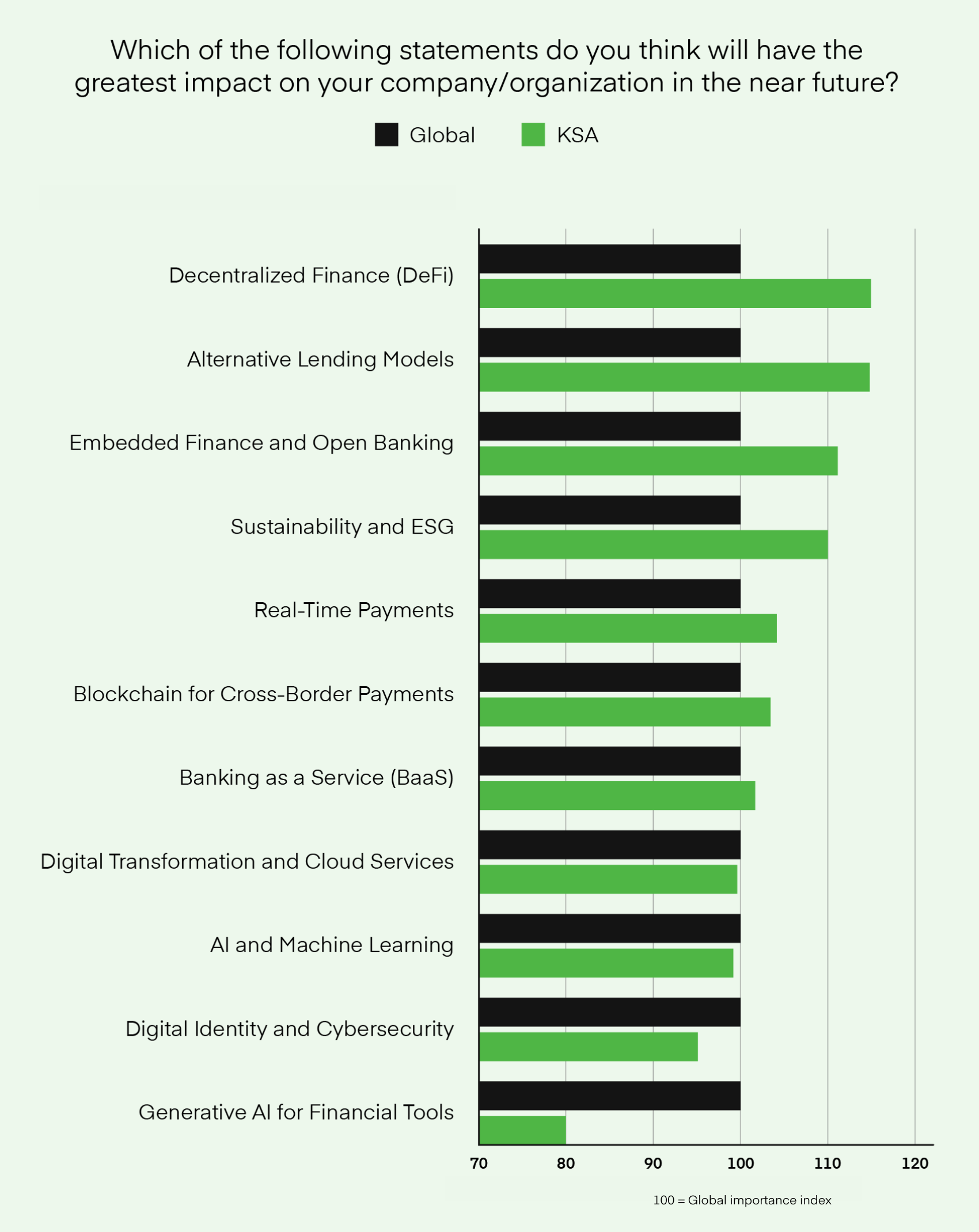
A significant finding from our survey is how Saudi leaders view the future of financial services. While many global peers are still focused on the basics of digitisation, Saudi decision-makers are already looking ahead to the next wave of disruption.
The top three themes that stood out;
Decentralised finance (DeFi)
Saudi leaders recognise that DeFi has the potential to transform how value is moved and stored. It goes far beyond cryptocurrencies; the real opportunity lies in the broader use of blockchain and tokenisation to deliver financial products that are faster, more transparent, and more secure.
Regulators are beginning to test these possibilities, a clear sign that DeFi is shifting from the edges of the conversation to something that could eventually underpin mainstream financial services in the Kingdom.
Alternative lending models
SMEs sit at the heart of Saudi Arabia’s Vision 2030 strategy, yet many have long faced challenges in securing financing through traditional banking channels.
Alternative lending models, such as peer-to-peer networks and digital-first credit platforms, are opening up new ways to close that gap. For Saudi institutions, embracing these models is not only about meeting regulatory goals around financial inclusion; it is also an opportunity to tap into one of the fastest-growing segments of the economy.
Embedded finance
Perhaps the clearest signal of what lies ahead is embedded finance. As telcos and super-apps expand their ecosystems across the region, financial services are being delivered directly at the point of need.
Payments are built into e-commerce checkouts, credit is offered seamlessly within retail journeys, and the association with banking itself fades into the background.
For consumers, this offers convenience and choice. For financial institutions, it creates urgency. To stay relevant, they must ensure their products and services can plug in effortlessly to these new platforms to meet consumers where they are.
Our survey shows that each of these trends is expected to have a greater impact in Saudi Arabia than in global benchmarks. Taken together, they reveal a market that is not content with simply digitising, and instead is preparing to leapfrog into a future where financial services are decentralised, embedded, and radically customer-centric.
Saudi Arabia: the role of suppliers for financial transformation
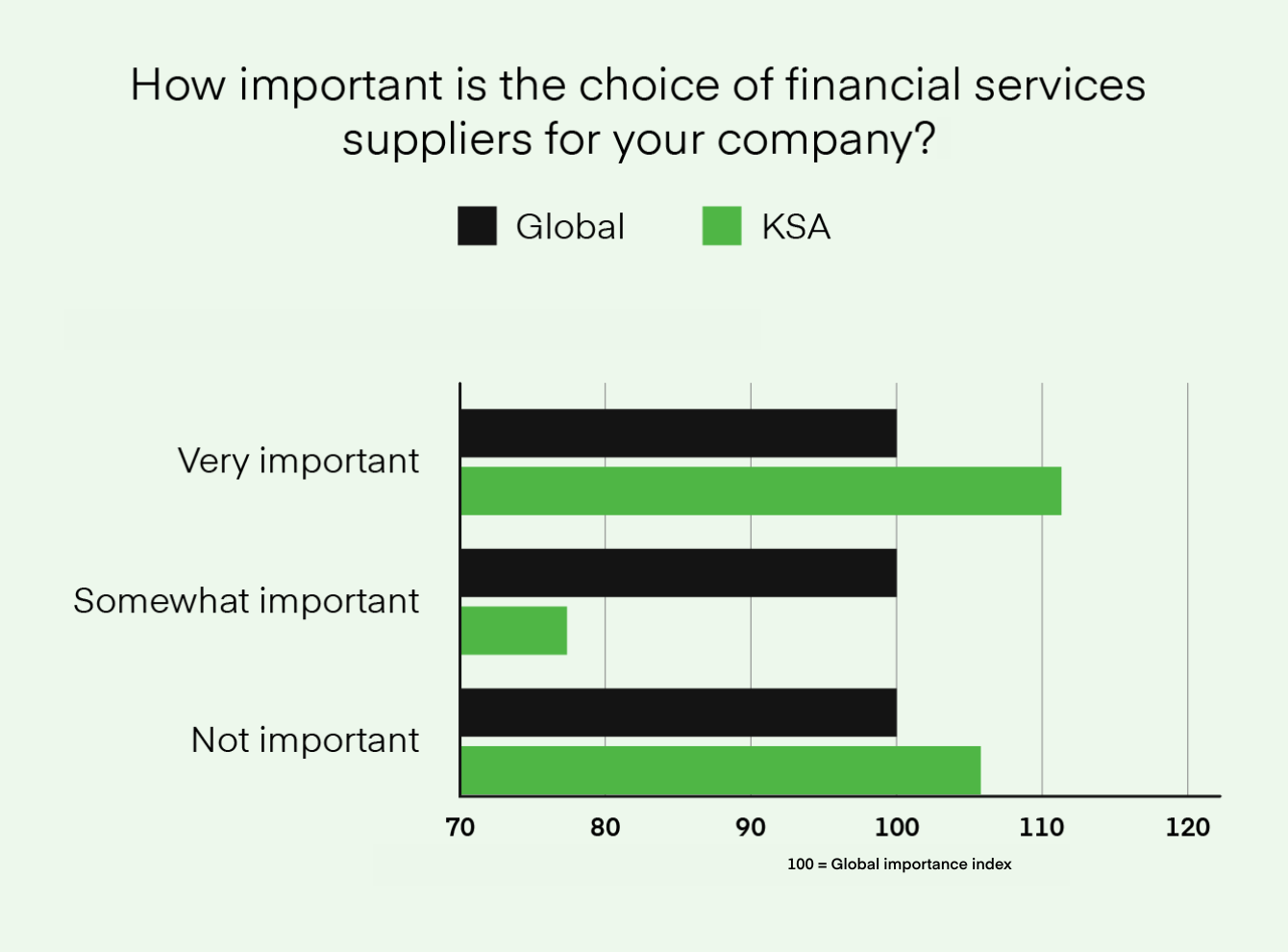
Given the pace of change in Saudi Arabia, the choice of supplier is of particular importance. More than in many other markets, supplier selection is treated as a strategic decision with direct consequences for an institution's ability to meet regulatory milestones and maintain competitive strength.
Vision 2030 ties the broader economy's success to the modernisation of financial services. At the same time, strict frameworks under the Personal Data Protection Law and SAMA's outsourcing rules mean that choosing the wrong partner can quickly lead to compliance failures, reputational risks, or missed deadlines.
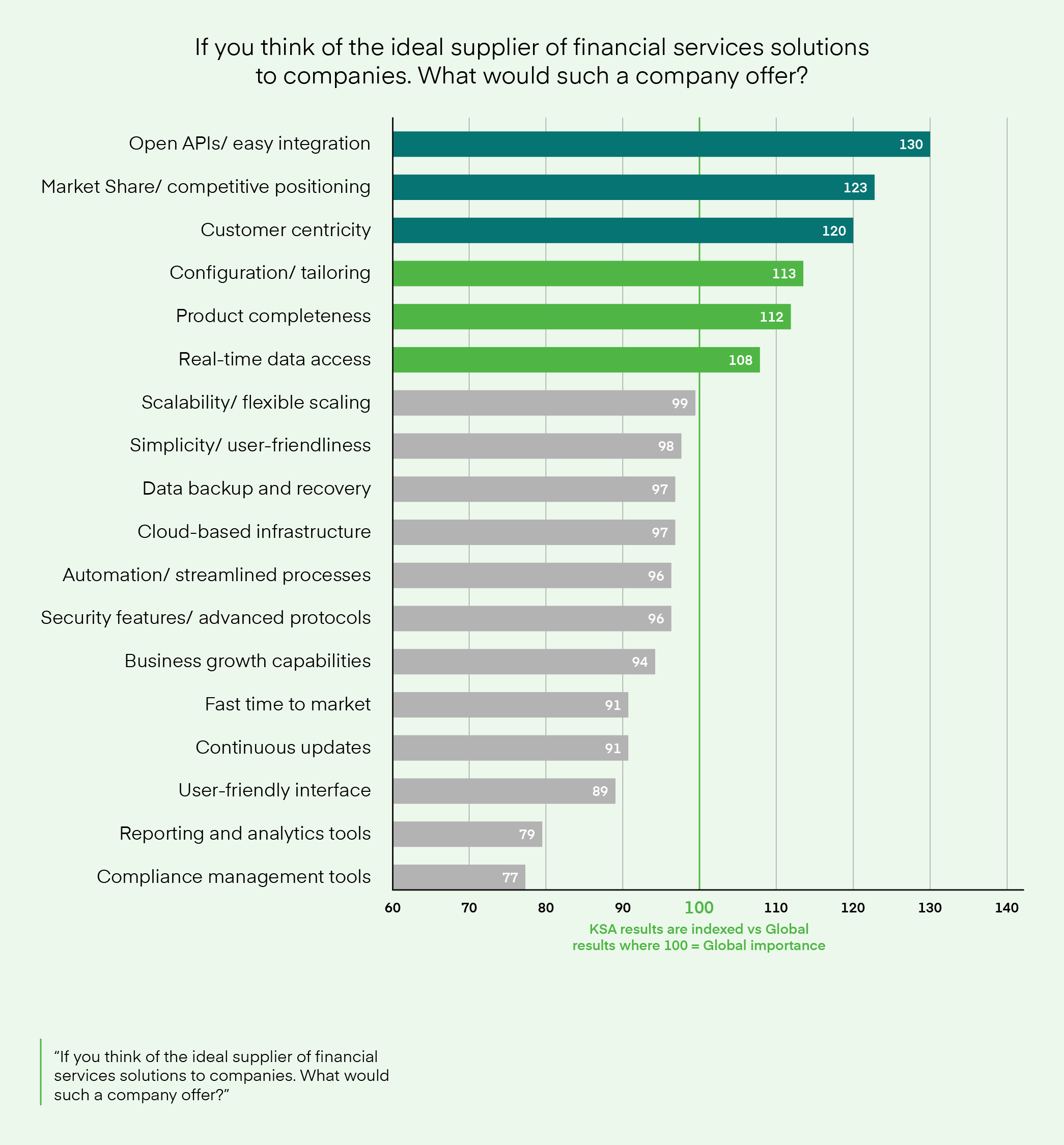
When asked what they value most in a supplier, Saudi respondents highlighted four priorities that stand out well above global benchmarks.
Open APIs and easy integration
Our survey found that Saudi leaders are 30% more likely than their global peers to prioritise open integration.
This is no surprise in a market where open banking regulations are already shaping how institutions operate. Banks need the ability to connect seamlessly with a growing ecosystem of platforms, partners, and payment networks. Without that level of flexibility, compliance becomes harder and opportunities to innovate are quickly lost.
Enhancing competitive positioning
In Saudi Arabia, partnerships are not formed with the goal of merely keeping the lights on but are entered into with the aim of winning market share.
Respondents told us they expect suppliers to actively strengthen their competitive position by helping them launch products faster, reach underserved SME segments, and build stronger digital reputations.
With digital challengers already in the market, established institutions cannot rely on legacy strength. They need partners who can help them move faster than the competition.
Deep customer centricity
Saudi institutions placed greater importance on customer experience than their global peers.
With electronic payments now the norm, customers expect more than basic functionality. They want seamless digital journeys and services that feel tailored to them. For many, that also means products designed in line with local values and expectations.
Why Mambu is the right partner for Saudi Arabia
Against this backdrop, Mambu stands as a partner for Saudi institutions, offering a true SaaS platform built for speed, flexibility, and continuous innovation that helps turn ambition into leadership and shapes the next chapter of financial services in the Kingdom.
Compliance and local partnership
In Saudi Arabia, compliance is never optional and goes beyond simply meeting technical requirements. Institutions need partners who understand local frameworks and who can also support the cultural and religious context that defines the market. That’s why Mambu has built flexibility into the heart of our platform.
Our cloud-native core is secure, auditable, and aligned with regulatory expectations around outsourcing and cloud adoption. At the same time, we give institutions the tools to configure Shariah-compliant products with ease, whether it’s Islamic financing structures or personalised offerings that reflect local values.
The result is a platform that balances innovation with trust, ensuring banks can move forward confidently while staying true to the principles their customers expect.
True composable agility
Saudi leaders have been clear that open integration is a top priority. Mambu’s cloud banking platform was founded with exactly that in mind: a composable core designed to connect rather than confine.
With Mambu, financial institutions can plug into the wider ecosystem, respond quickly to new regulations or market shifts, and bring new products to market at unparalleled speeds without waiting years for upgrades. Whether it’s SME financing or personalised customer journeys, composability gives institutions the freedom to build and innovate at their own pace.
Investment alignment and scalability
The Kingdom’s financial sector isn’t slowing down, and neither are its institutions. As they expand, they need technology that can scale just as quickly.
With Mambu’s true SaaS model, growth never means starting from scratch or overhauling core systems. Capacity can be integrated seamlessly, new business lines can be supported without disruption, and institutions can scale from thousands of customers to millions with the same underlying platform.
By aligning investment with real usage, financial institutions avoid the burden of heavy upfront spend while ensuring their systems grow in lockstep with their ambitions.
The Saudi model of transformation
Saudi Arabia is making it very clear that it is not here simply following global trends, it is amplifying them.
Its financial institutions are informed, well-funded, and focused on the future. Regulators are building one of the world’s most advanced ecosystems, while consumers expect digital-first and highly personalised services at scale.
Success in this environment will belong to the institutions that choose partners capable of matching their speed, flexibility, and ambition.
At Mambu, we see the Saudi market as the future of financial services in action. With composable technology, regulatory alignment, and proven local expertise, we are ready to help institutions not only meet the goals of Vision 2030 but also set the pace for the next chapter of global banking.
Curious to learn more about our composable architecture and how it can benefit your institution? Contact us for any questions you may have. We’re happy to assist.
Alternatively, if you would like to see the Mambu platform in action, please register for our next live demo.
Transform banking with us.
Ready to build the next generation of financial experiences? Fill out the form to connect with our team.
Loading Form

© Mambu 2026