
Australia’s financial services:
where regulation underpins innovation
25 March 2026
As open finance expands under the Consumer Data Right (CDR), Australia’s financial sector is demonstrating that strong regulation and innovation can reinforce one another. Instead of hindering digital progress, governance has guided its development.
Few markets balance trust, technology and supervisory discipline as deliberately as Australia. Rather than pursuing disruption for its own sake, financial institutions have focused on building digital capability within clear governance frameworks. Compliance is treated as infrastructure, not as an obstacle.
To provide context on Australia’s approach, we surveyed more than 300 senior financial decision makers across the country as part of the Mambu Insights Series. We then benchmarked their responses against over 1,500 global peers from other markets, including the UK, Indonesia, Mexico and Saudi Arabia.
The findings point to a market advancing with precision. Australian institutions are strengthening AI deployment, cybersecurity resilience and cloud transformation, but within clearly defined guardrails. The emphasis is not on acceleration at any cost. It is on progress that can withstand scrutiny and scale without destabilising established systems.
How Australian financial institutions see the future taking shape
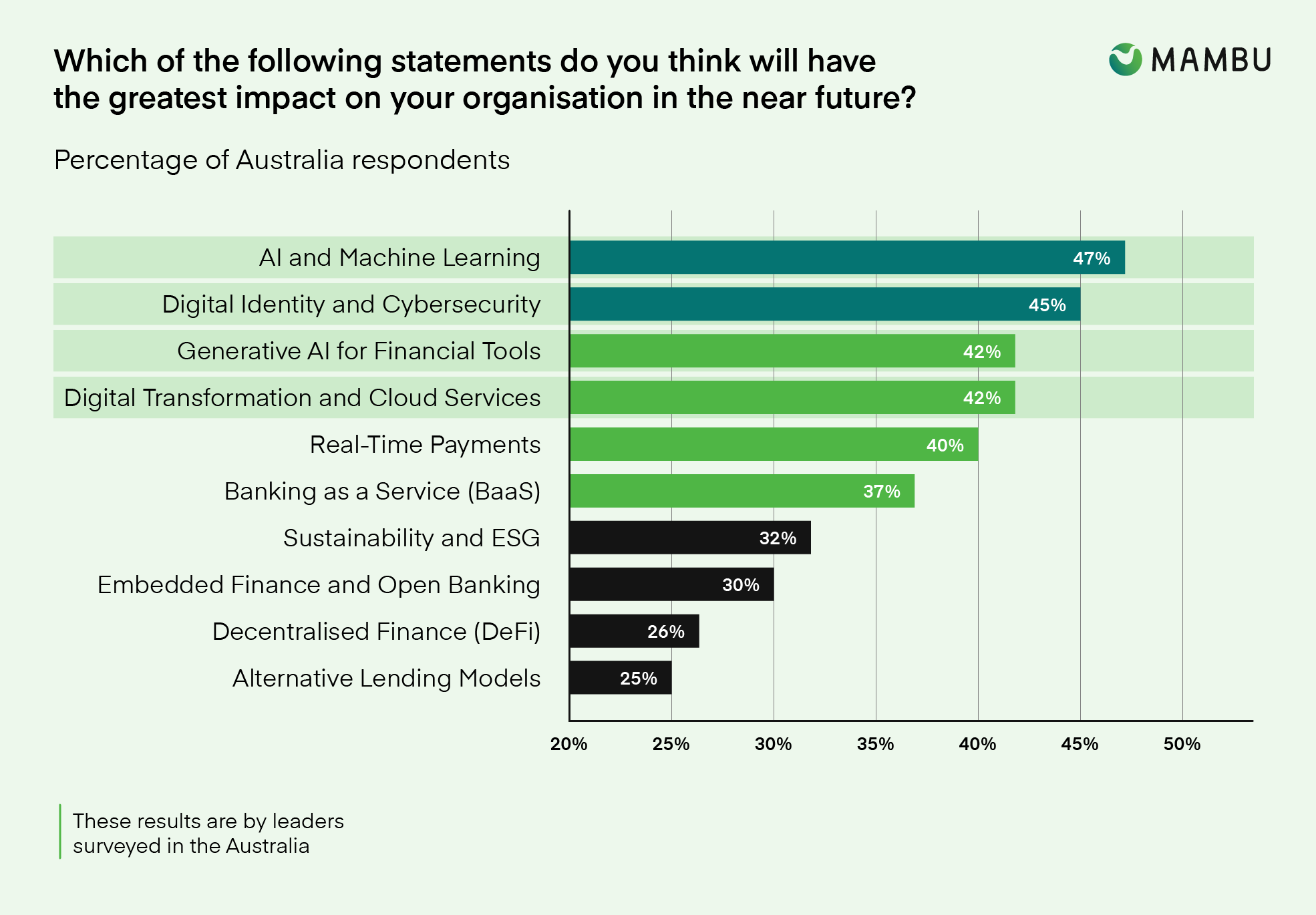
With regulatory frameworks firmly embedded and digital foundations already in place, Australian financial institutions are focusing less on expansion for its own sake and more on strengthening the systems that underpin day-to-day performance. The forces they identify reflect a market intent on refining capability within clearly defined boundaries.
Artificial intelligence as operational infrastructure
Artificial intelligence and machine learning sit at the top of Australia’s near-term agenda. Nearly half of respondents cite AI as a force that will have the greatest impact on their organisation in the coming years, slightly above the global benchmark.
This is not speculative positioning. AI is being embedded into fraud detection, credit analytics and customer insight workflows. In a mortgage-heavy, process-driven market, incremental improvements in decision quality and risk calibration compound quickly. The emphasis is on measurable operational gains rather than experimentation.
Generative AI follows closely. Adoption levels sit just above global norms, suggesting cautious but active deployment. Institutions are exploring generative tools to enhance financial planning interfaces, automate documentation and deliver more personalised digital experiences. The discussion centres on responsible integration within existing compliance frameworks.
Security and identity under sustained scrutiny
Cybersecurity and digital identity rank alongside AI as enduring priorities. Following several high-profile breaches in recent years, resilience has become embedded into strategic planning rather than treated as a reactive concern.
Investment in advanced verification systems, encryption protocols and resilience-by-design architecture continues steadily. In Australia’s regulatory environment, security is not framed as differentiation. It is the foundation of trust.
Cloud modernisation within supervisory guardrails
Cloud transformation ranks prominently in Australia’s near-term priorities because infrastructure resilience is no longer a back-office concern. It sits squarely within board-level accountability.
Prudential standards around operational risk, outsourcing and data governance require institutions to demonstrate continuity, transparency and control across increasingly complex technology estates. Legacy systems can struggle to meet those expectations efficiently. As a result, modernisation is tied closely to resilience, oversight and traceability.
Institutions are investing in cloud architectures that improve system visibility, simplify governance and enable predictable release management. Continuous improvement is favoured over disruptive overhaul. Change must be auditable, performance stable and third-party dependencies controlled.
In Australia’s market, cloud matters because it strengthens institutional footing. It supports sustainable digital capability within an environment where scrutiny is constant and operational discipline is expected.
What Australian institutions prioritise in suppliers
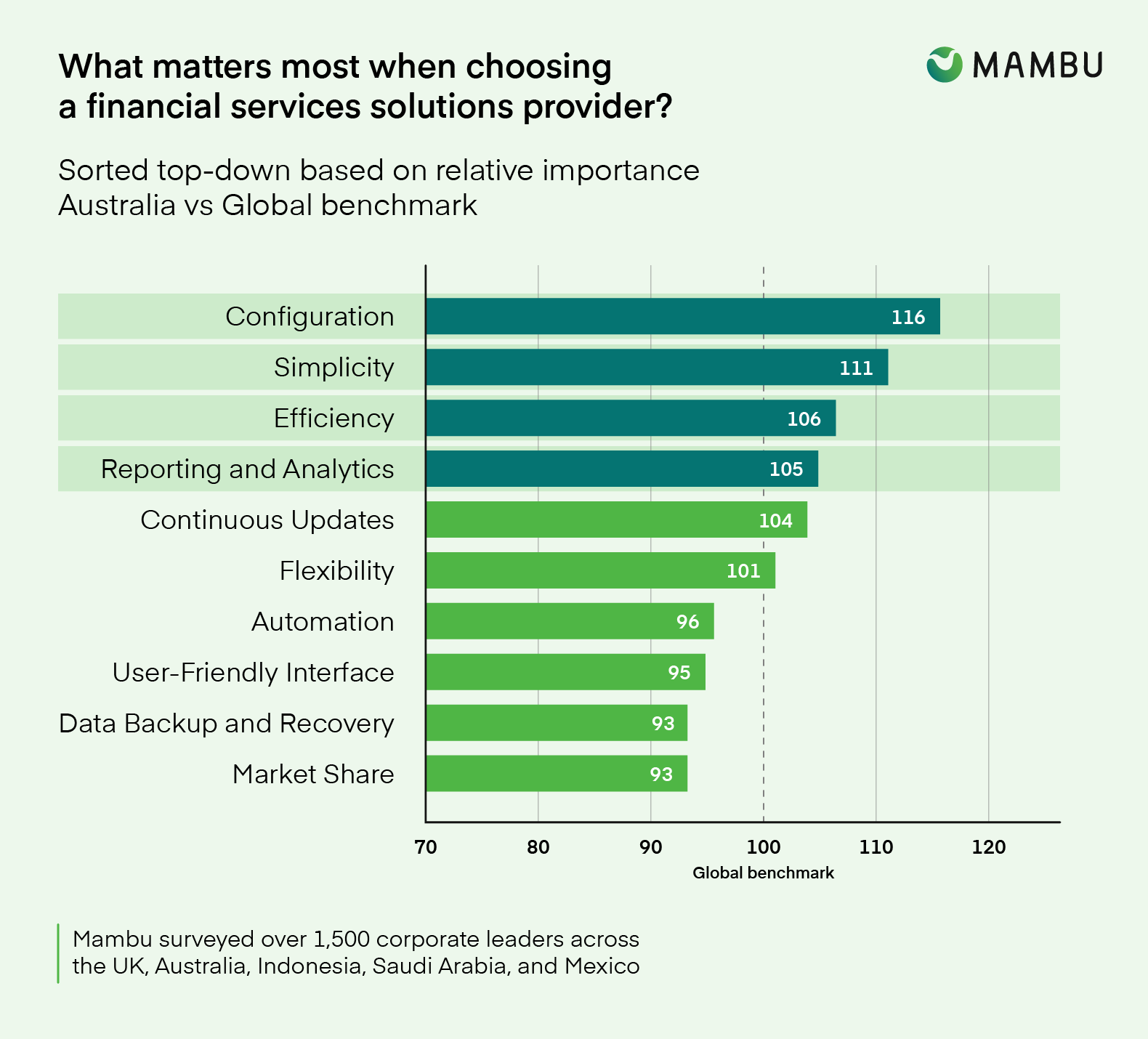
If the future outlook reflects disciplined modernisation, supplier expectations reveal how that discipline is enforced in practice.
Australian decision makers are clear about what defines an ideal partner. The strongest signals cluster around configuration, simplicity, efficiency, and reporting and analytics. Together, they describe a market that values control, clarity and operational accountability over spectacle.
Configuration as controlled flexibility
Configuration ranks highest. This is a decisive signal.
Australian institutions operate within complex regulatory and reporting frameworks, particularly in areas such as mortgages, credit risk and consumer protection. They do not want rigid platforms that require code-heavy intervention every time a product parameter changes or compliance rules evolve.
Configuration, in this context, means the ability to adjust product structures, pricing logic, workflows and controls within defined governance boundaries. It allows institutions to adapt without destabilising the system beneath them. In a market that favours incremental improvement over radical overhaul, configurable architecture becomes a practical advantage.
Simplicity across teams and systems
Simplicity follows closely behind. This does not imply limited capability. It reflects the need for systems that can be adopted and operated cleanly across business, risk and technology functions.
In mature institutions, complexity accumulates quickly. Solutions that reduce operational friction, shorten onboarding cycles and streamline cross-team collaboration are valued highly. Simplicity becomes a multiplier for efficiency and governance alignment.
Efficiency as operational discipline
Efficiency ranks third, reinforcing Australia’s pragmatic character. Institutions favour partners who deliver reliably, integrate cleanly and minimise wasted effort across implementation and ongoing operations.
Efficiency here is less about cost-cutting and more about execution quality. Projects that stay predictable, minimise rework and maintain performance standards align closely with Australia’s measured investment profile.
Reporting and analytics as accountability engine
Australian financial services: capability, control and capital
Australia’s survey responses reveal as much about mindset as they do about priorities. Capability, procurement and capital allocation follow a consistent pattern: measured, criteria-driven and structurally disciplined.
Calibrated confidence in capability
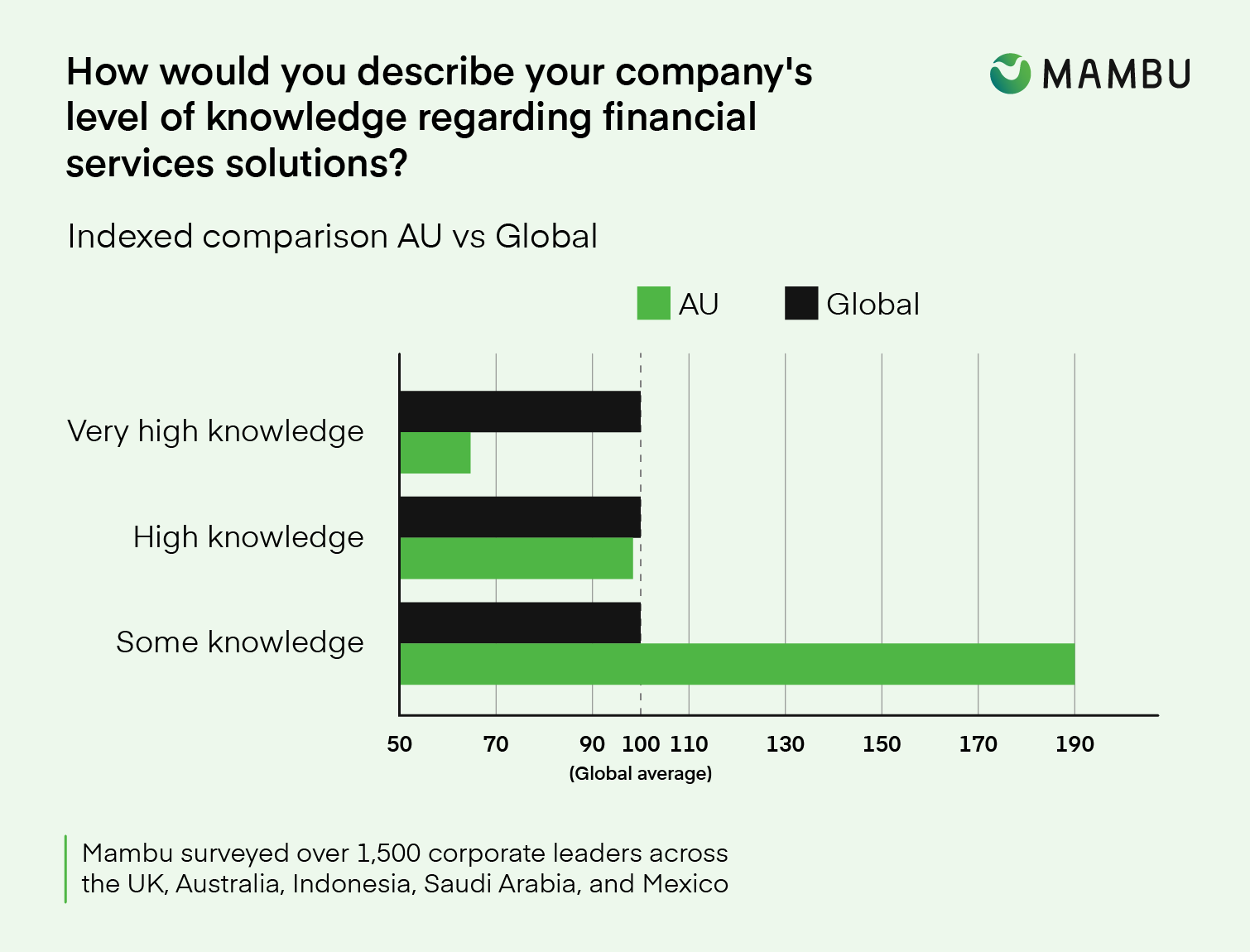
Australian decision makers demonstrate broad and grounded confidence in their understanding of financial services technology. The largest share of respondents place their organisations in the middle band of expertise, with a sizeable group selecting “high.” Fewer than the global average choose the “very high” category.
This middle-weight distribution is telling. It suggests capable teams that understand the terrain but avoid overstating specialism. Rather than positioning themselves at the frontier of technical experimentation, institutions signal competence anchored in practical delivery.
That tone aligns closely with the broader market character. Confidence is present, but it is calibrated.
Supplier choice as structured governance
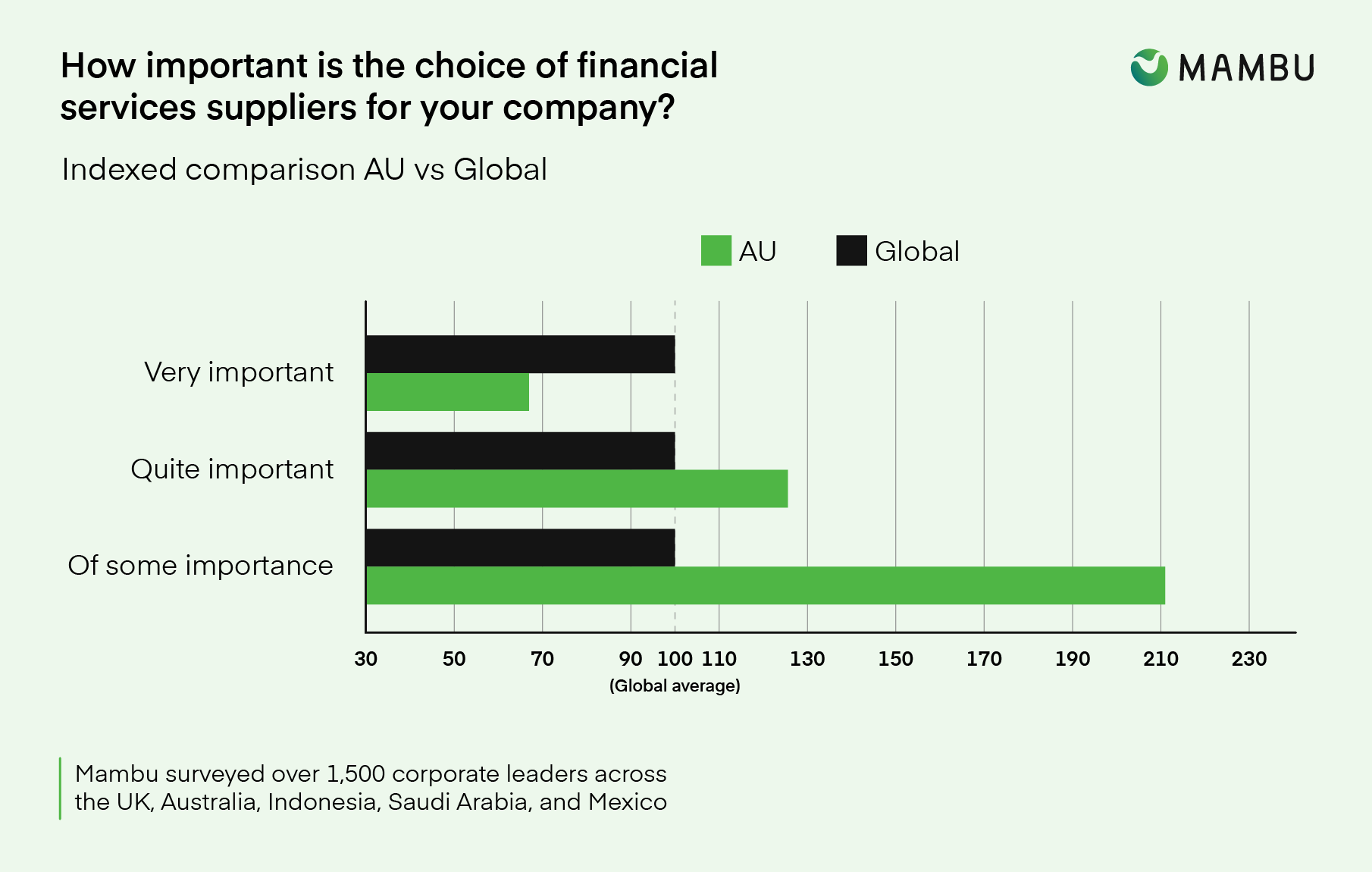
That calibrated confidence flows directly into how institutions approach vendor selection. Most Australian decision makers rate supplier choice as important, while fewer than global peers elevate it to the “very important” extreme.
This does not indicate complacency. It reflects maturity. Supplier selection is embedded within governance processes rather than treated as a high-drama strategic gamble. Fit with regulatory expectations, integration capability and operational alignment matter more than brand narrative.
Procurement operates as a structured filter, not a battleground.
Capital deployed incrementally
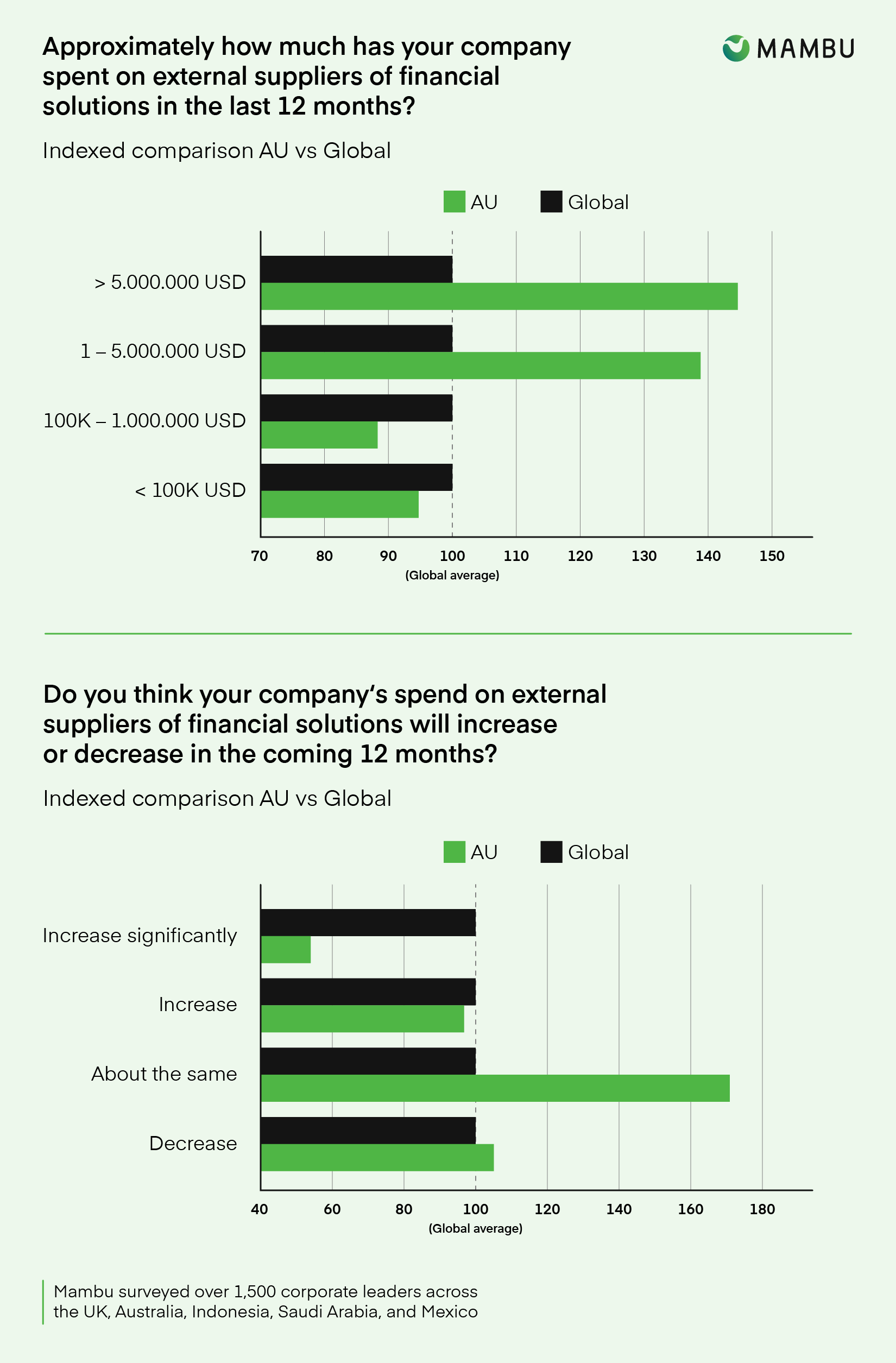
Spending behaviour reinforces the same theme. Australia shows a larger-than-global share of smaller budget allocations and fewer very large transformation programmes.
Australian financial services: portfolio outlook
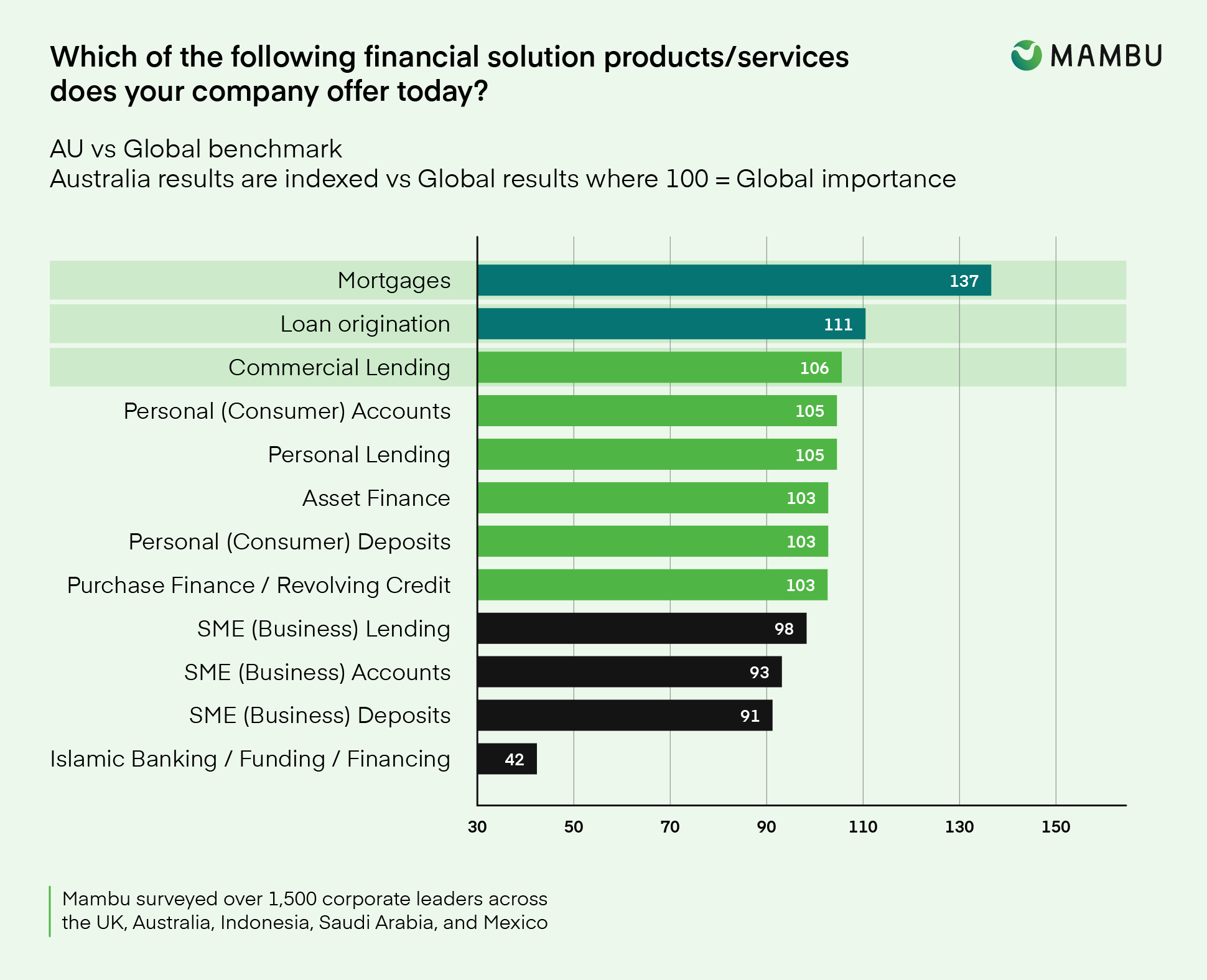
Australia’s product footprint reveals where its financial system is most structurally confident. The data points to a market anchored in secured retail credit and disciplined process control, with more measured emphasis on SME expansion.
Mortgages as the portfolio backbone
Mortgages stand well above global benchmarks and remain a defining feature of Australian portfolios.
The housing market plays a central role in household wealth and bank balance sheets alike. High mortgage penetration reflects deep operational maturity in secured lending, risk modelling and long-duration asset management. Mortgage capability in Australia is embedded and scaled, forming a central component of institutional performance.
The prominence of mortgages also reinforces the importance of process reliability. In a market where loan volumes are high and regulatory scrutiny is persistent, the strength of origination and servicing capability matters as much as the product itself.
Process strength in loan origination
Loan origination also over-indexes, underscoring the sector’s investment in end-to-end process control.
This reflects a clear priority around disciplined workflows, credit assessment consistency and operational traceability. In a heavily regulated environment, origination capability functions as both a revenue engine and a governance safeguard. Strong process control reduces compliance risk and supports capital efficiency across large retail books.
Retail depth, structured commercial strength, measured SME exposure
Beyond mortgages, Australia shows strong coverage across commercial lending, personal lending, transactional accounts, deposits, asset finance and purchase finance. Together, these products reinforce a system anchored in secured retail credit and structured business lending.
Commercial lending stands out within the business segment. Its prominence suggests a market comfortable with structured facilities, negotiated terms and relationship-led credit. These portfolios typically involve bespoke repayment schedules, covenant frameworks and more tailored risk assessment. That profile aligns with a system built on disciplined underwriting and regulatory clarity.
By contrast, SME transactional accounts, deposits and SME lending sit below global averages. SME capability is present, but it is not as dominant within the overall mix. This distinction matters. SME lending often requires higher-volume credit processes, faster decision cycles and more product standardisation. Australia’s current weighting suggests that structured commercial lending remains more central than scaled SME expansion.
The forward outlook, however, signals change. Decision makers anticipate meaningful expansion in SME offerings over the next three years. That growth is likely to develop within the same structured operating model observed elsewhere in the market, scaling capability progressively while maintaining credit discipline and governance integrity.
Why Mambu is the perfect partner for Australia’s financial services market
Australia’s financial institutions have defined what they expect from technology partners: configuration, simplicity, efficiency and robust reporting within a disciplined regulatory framework. Those expectations shape how modernisation unfolds.Mambu aligns directly with that operating model.
As the founder of the composable banking model and a truly cloud-native SaaS core banking platform, Mambu enables institutions to configure lending products with precision.
This is particularly relevant in a market where commercial lending plays a central role. Structured facilities, tailored repayment schedules, pricing logic and fee models can be configured without heavy redevelopment, allowing institutions to support complex business lending requirements while maintaining reporting integrity and regulatory alignment.
The same configurable architecture supports retail lending and purchase finance, both of which form a significant part of Australia’s product footprint. Institutions can manage personal lending, secured credit and point-of-sale finance within a unified core, reducing fragmentation across origination, servicing and portfolio oversight.
Loan origination strength is equally important in this market. Mambu supports end-to-end loan origination and servicing within the same core environment, enabling consistent credit workflows, auditability and portfolio transparency. In a system shaped by prudential standards and supervisory reporting, traceability across the credit lifecycle is not optional.
Configuration alone is not enough. Simplicity and efficiency matter. Mambu’s unified architecture reduces integration complexity across lending and deposit products, helping business, risk and technology teams operate from a shared product logic. Continuous SaaS updates are delivered in a managed cadence, supporting regulatory alignment and incremental improvement without disruptive upgrade cycles.
Reporting and analytics are embedded within the platform’s data model. Institutions gain visibility across origination, portfolio performance and product structures, strengthening both internal oversight and external reporting requirements.Security and regulatory alignment are foundational to the platform’s design. Mambu’s security and compliance framework supports data protection, resilience standards and audit requirements, helping institutions operate confidently within Australia’s supervisory environment.
Looking ahead, Australia’s anticipated SME expansion adds another dimension. As SME offerings grow, institutions will require product flexibility and scalable credit frameworks that can be introduced progressively. Mambu’s configurable core supports this measured expansion without requiring foundational rebuilds.
What makes this alignment relevant in Australia is structural fit. Mambu supports commercial lending depth, retail credit scale and incremental SME growth within a single, configurable core. Institutions can modernise deliberately, strengthen governance and refine portfolios without destabilising what already works.
Conclusion
Australia’s financial sector does not pursue transformation through acceleration alone. It advances through calibration. Regulation is not treated as friction but as structure, and innovation is measured by how well it integrates within that structure.
As digital capability deepens, the institutions that succeed will be those that configure precisely, report transparently and modernise without destabilising the systems that underpin trust. In Australia’s market, durability is a competitive advantage.
Curious to learn more about our composable architecture and how it can benefit your institution?
Contact us in the form below for any questions you may have. We’re happy to assist.
Alternatively, if you would like to see our platform in action, register for our next live demo.


© Mambu 2026