
ARTICLE
Clearing and settlement systems in SEPA
27 February 2023
The single euro payment area (SEPA) relies on a four-corner model to process SEPA payments. This model comprises one originator account holder, a payment service provider (PSP), in most cases a bank, one beneficiary account holder, and its PSP.
However, PSPs aren’t directly interconnected. They communicate and process account holders’ payment orders through clearing and settlement mechanisms (CSMs). In this article, we explore what CSMs are and which are the main ones in SEPA, as well as what instant payments changed in the way CSMs work .
What is a CSM
CSMs are an invisible yet essential piece to the SEPA puzzle. To understand how CSMs work and the role that CSMs play in payments, let’s take the example of Jane Doe and TravelCo. To pay for her trip to Greece, Jane Doe wants to transfer money from her account held by PSP A to the account of TravelCo held by PSP B. When Jane instructs a payment, and if Jane holds sufficient funds, the money is moved to the account of TravelCo.
Clearing
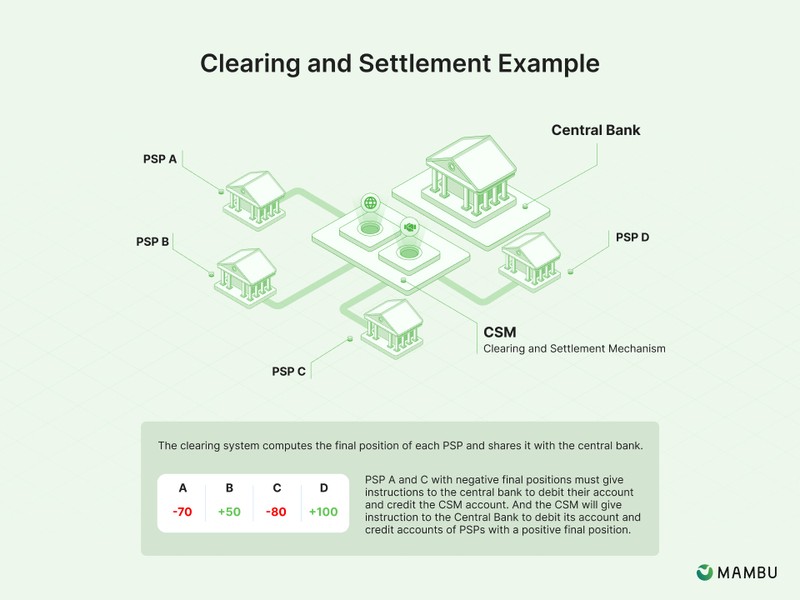
Under the surface, Jane Doe’s bank, Alpha, sends a message to ClearingCo, a local CSM, asking to move the money to TravelCo’s bank Beta. ClearingCo aggregates all the payment instructions from and to banks Alpha and Beta during a given period. At the end of the period, ClearingCo calculates the net amount of all the payment instructions from and to banks Alpha and Beta.
In the example above, we described the clearing process, which includes transmitting, reconciling and confirming transfer orders before settlement, the netting of orders and the establishment of final positions for settlement.
Settlement
After the net amount is calculated as part of the clearing process, it is transferred between banks Alpha and Beta. Jane Doe’s account at bank Alpha is debited, and TravelCo’s account at bank Beta is credited.
That’s the settlement process, which describes the completion of transactions through transferring funds between SEPA participants.
Types of CSMs across SEPA
There are two distinct types of CSMs across SEPA: retail systems (for individuals and companies) and large-value payment systems or LVPS (for financial institutions).
Retail payment systems
Retail payment systems handle payment transactions for consumers and businesses. They usually process large volumes of low-value payments. These “retail” payments include credit transfers, direct debits initiated by consumers and businesses, cheque payments and card payments. Eventually, all the funds corresponding to these transactions must be transferred between financial institutions.
Retail payment systems manage the clearing part of the process, as the settlement between financial institutions is done via a LVPS.
There are 25 reported retail payment systems within the euro area in 2021. Around 50 billion payments were processed through retail payment systems in 2021, with a combined value of €41.1 trillion.
STEP2-T is the only pan-european retail payment system, operated by EBA clearing. All other retail payment systems are local ones, such as the French CSM CORE which is owned and operated by STET, a group of 6 major French banks, and is used for payments between banks in France.
The three largest systems in terms of number of payments (STEP2-T, CORE in France and RPS in Germany) processed 69% of the volume and 72% of the value of all payments processed by euro area retail payment systems.
Large-value payment systems
As discussed above, after netting payments sent by member banks during the day, retail payment systems settle the payments with accounts held at the ECB through a large-value payment system (LVPS), which can be either the Eurosystem’s Real-Time Gross-Settlement system (RTGS) TARGET2 or the EBA Clearing’s equivalent EURO1.
Note that LVPS are also used for interbank payments not related to retail payments.
LVPS payments are ECB money movements between bank ledgers. The ECB debits one bank account and credits another one with the netted amount.
While TARGET2 is a unique IT platform, to which all payment orders are submitted for processing, it is legally structured as a multiplicity of local RTGS systems, specifically TARGET2 component systems, such as TARGET2-FR for France, TARGET2-RO for Romania, or TARGET2-ES for Spain.
In 2021, the EURO1 settled 45 million payments with a total value of €37 trillion, while TARGET2 settled 97 million payments with a total value of €494 trillion.
Looking at the TARGET2 component systems, the ones that processed the most payments were TARGET2-DE and TARGET2-FR, with 49 million and 11 million payments, respectively, in 2021.
Impact of instant payments on CSMs
Since 2017, the introduction of instant payments has challenged the established payment infrastructures. Instant payments offer final and irrevocable settlement of payments in euro, at any time of day and on any day of the year — a significant change from once-a-day settlement.
Clearing and settling SEPA instant payments therefore requires a modern technical infrastructure developed specifically for the purpose of settling instant payments. It needs to be designed to:
- Secure an end-to-end processing time of 10 seconds or less, as required by the SEPA Instant Credit Transfer scheme. As a comparison, existing RTGS systems like TARGET2 process 99.9% of their transactions under 1 minute
- Support the expected large volumes of payments and meet scalability requirements
- Secure availability around the clock without maintenance windows, contrary to RTGS systems which have been historically closed over week-ends and certain public holidays
- Enable a deployment process with no interruption of service
This has led to the introduction of two payment systems dedicated to instant payments. Launched in 2017, Real-Time 1 (RT1) is a modern, 24 / 7 instant payment CSM used by 80 members against an annual fee to process SEPA instant credit transfers. In 2018, the Eurosystem launched the TARGET Instant Payment Settlement (or TIPS) payment infrastructure to process instant payments. Instant payments are settled in ECB money. The biggest differentiator of TIPS versus RT1 is that it can be used by both direct and indirect SEPA participants. As a result, TIPS provides a more open system to PSPs and other financial institutions.
Connecting to CSMs: SEPA direct and indirect participant
As we described, CSMs are core, critical systems to SEPA, enabling businesses and individuals to exchange payments in the area via various methods, without having to think about interoperability.
This is made possible by the fact that all financial institutions are interconnected via CSMs. However, only credit institutions (i.e. banks) can connect directly to CSMs to participate in SEPA.
Other financial institutions like payment institutions or electronic money institutions still have the possibility to participate in SEPA by becoming a SEPA indirect participant.
SEPA indirect participants partner with a bank, which is itself a SEPA direct participant and becomes their sponsor bank.
On a high level, SEPA direct participants will have lower running costs on payments because connecting directly to the CSMs requires no middleman (the sponsor bank) that usually takes a fee on each payment. In addition, they can themselves become sponsor banks and generate revenue from this activity.
On the other hand, being an indirect participant only requires connecting to a sponsor bank, which is quicker and less expensive than developing and validating an integration with one or several CSMs.
The regulatory process is however not very different. While the sponsor bank bears some responsibility on behalf of the indirect participant, it does require robust and transparent compliance processes from its indirect participant in order to decrease its risks. The sponsor bank will assess these elements to onboard an indirect participant.
Mambu Payments has helped successful fintech companies like Spendesk in the SEPA indirect participant project. Do not hesitate to contact us for more information.

© Mambu 2026