
How Bank Muamalat is scaling Malaysia’s first homegrown Islamic digital bank with Mambu
27 May 2026
Executive summary
To modernise its legacy infrastructure without the risk of a full core replacement, Bank Muamalat launched ATLAS, a standalone digital banking platform built on Mambu’s cloud-native composable core.
Using a speedboat strategy, the bank was able to accelerate customer onboarding, launch new digital experiences in nine months, and gradually transition toward a more agile core architecture while maintaining regulatory and Shariah compliance.
—————————
For large incumbent banks core banking modernisation has traditionally felt like trying to change the engines on a commercial airliner while mid-flight.
Legacy infrastructure, rigid governance structures, and long transformation cycles have historically turned digital initiatives into multi-year programmes.
In Malaysia’s Islamic banking sector, where institutions account for 46.6% of the overall banking market, the pressure to modernise their offerings in order to remain competitive is reaching critical.
Customers increasingly expect the same speed, accessibility, and digital convenience they experience across the wider digital economy, while banks must still maintain strict regulatory and Shariah compliance.
Rather than pursuing a high-risk, big-bang transformation, Bank Muamalat adopted a different approach. Using a speedboat, or sidecar, strategy powered by Mambu’s cloud-native composable core, Backbase, and Google Cloud, the bank launched ATLAS, an entirely new digital Islamic banking platform, in just nine months.
But ATLAS was never intended to function as a standalone digital experiment.
It now serves as both a customer acquisition engine and a live modernisation environment for the wider bank, allowing Bank Muamalat to test new products, streamline operations, and gradually transition toward a more agile core architecture without disrupting existing operations.
That approach has already produced measurable results. Within its first six months, the platform attracted a significant volume of new-to-bank customers and achieved onboarding capacity comparable to 70 physical branches operating simultaneously. This rapid acquisition momentum was backed by strong deposit velocity, with a vast majority of early capital flowing from completely fresh market funds.
In an interview with Fintech News Network, Hazrizal Hassan, Head of Digital Banking at Bank Muamalat, and Chirag Amla, Principal Solutions Architect for Asia Pacific at Mambu, explained how the bank combined composable architecture, embedded compliance, and tightly controlled MVP governance to accelerate delivery while managing operational risk.
This article explores how Bank Muamalat used the speedboat model to modernise incrementally, rethink the Islamic digital banking experience, and create commercial impact without the disruption typically associated with large-scale core transformation programmes.
How the speedboat approach de-risks core banking replacement
The foundation of Bank Muamalat’s strategy was simple. Avoid turning modernisation into a multi-year transformation programme before customers see any value from it.
For many incumbent banks, that is exactly what happens. Large-scale core replacement projects often become weighed down by governance complexity, vendor dependency, and competing internal priorities long before the technology itself becomes the issue.
Bank Muamalat deliberately chose not to take that route.

"If let's say we decided four years ago that it is going to be a big bang, convert the whole entire bank to a cloud-based model with a composable architecture, we would still be sitting in a committee meeting today. Things would not have moved."
Hazrizal Hassan, Bank Muamalat
Instead, the bank adopted what is often referred to as a speedboat strategy.
While the legacy core continued supporting the wider organisation, ATLAS was launched as an independent digital platform operating on a modern cloud-native architecture powered by Mambu.
That separation gave the team room to move faster without disrupting existing operations. It also allowed Bank Muamalat to test new products, simplify customer journeys, and validate new operating models before extending them across the wider business.
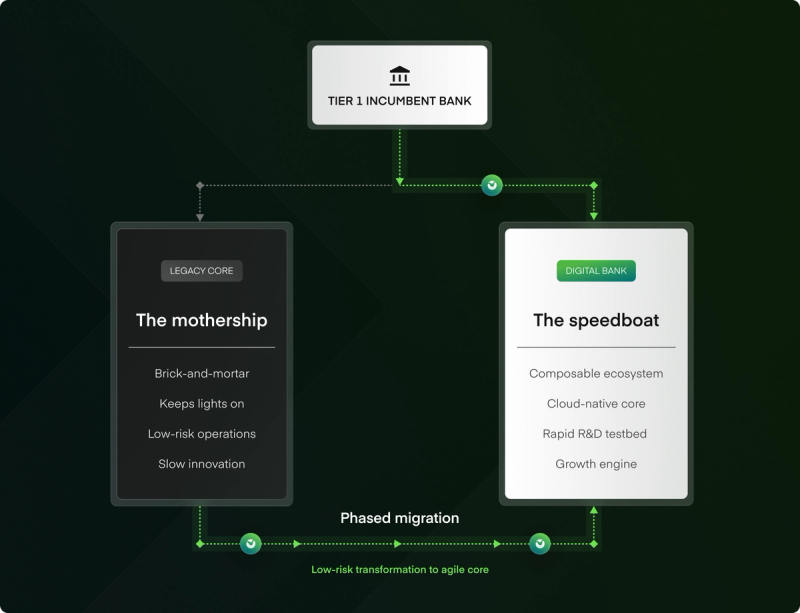
Importantly, ATLAS was never designed to remain isolated from the core bank. The platform now acts as a live modernisation environment, allowing Bank Muamalat to gradually transition toward a more agile architecture over time rather than forcing the organisation through a high-risk enterprise-wide migration.
As Chirag Amla puts it, the success of the model comes from aligning technology decisions with clear business goals.
"At Mambu, we always work with the bank to figure out what they want to achieve. Is the bank intending to look at a new revenue model, or do they need a testbed for their aging legacy stack? If that is the case, then absolutely speedboat is the right approach because you get the innovation and the speed and agility from the speedboat and modern technology, but you get the risk and compliance from the bigger enterprise mothership."
Chirag Amla, Mambu
But technology alone did not enable a nine-month launch. Delivering ATLAS at that speed required Bank Muamalat to rethink how governance, compliance, and product delivery operated across the organisation.
Accelerating digital bank deployment through compliance integration and MVP governance
Launching a digital bank in nine months required more than rapid software delivery. It demanded a fundamental shift in how Bank Muamalat approached governance, compliance, and product development.
According to Hazrizal Hassan, one of the biggest shifts was adopting what he describes as an “unlearning mindset”.
Rather than treating digital transformation as a traditional banking programme shaped by lengthy approval cycles and expanding operational requirements, the ATLAS team focused on simplifying the customer experience and protecting delivery speed.
That approach became particularly visible during onboarding. By reviewing every operational and compliance requirement individually, the bank reduced a legacy onboarding process from 20 steps to just five, enabling users to open an account remotely in roughly two minutes.
Crucially, this did not come at the expense of regulatory or Shariah compliance. Instead of treating governance as a final-stage review process, Bank Muamalat embedded compliance, risk, and Shariah scholars directly into the delivery cycle from the beginning.
"When we launched ATLAS, we made sure the scope was incredibly tight. In a traditional bank, every department head wants their product, their feature, their compliance checklist included on day one. We had to unlearn that. We said, 'No, what does the customer actually need to open an account safely today?' We focused strictly on the absolute minimum required for a beautiful experience, and we protected the team from the gravity of the wider bank's legacy demands.”
Hazrizal Hassan, Bank Muamalat
Maintaining that discipline required strict ring-fencing around the MVP. Rather than allowing internal stakeholders to continuously expand the product scope, the bank prioritised customer needs over internal complexity.
"What ATLAS did really well was they ring-fenced the entire thing. They designated a clear lead in charge of deciding what goes into the MVP and empowered them to say 'no'. They listened to people from a risk and compliance perspective, but they didn't let internal department heads bloat the product features. They listened to the customer rather than listening to internal bank legacy demands.”
Chirag Amla, Mambu
That operating model not only accelerated delivery, but also gave the bank the flexibility to rethink what a modern Islamic digital banking experience could look like.
Driving financial inclusion through lifestyle banking and composable architecture
That flexibility shaped more than just the delivery model behind ATLAS. It also influenced how Bank Muamalat approached the customer experience itself.
Rather than positioning Islamic banking purely around compliance, the bank focused on building a platform that fits naturally into the daily routines of faith-conscious customers.
Alongside core banking services, ATLAS integrates lifestyle-focused features including prayer times, daily duas, a zikir counter, an Islamic calendar, a kiblat finder, and zakat and qurban services directly into the platform experience.
"Our unique value proposition is in terms of lifestyle banking. We infuse all features such as prayer times, alms, zakat, and online Quran into this platform. It is about moving beyond simple compliance checklists and building a rewards-driven loyalty and faith-based ecosystem that makes the bank an active, intuitive companion in a customer’s day-to-day routine.”
Hazrizal Hassan, Bank Muamalat
Using Mambu’s composable architecture, Bank Muamalat was able to integrate these services through modern APIs rather than relying on lengthy development cycles tied to monolithic legacy systems.
The digital-first model also helped expand access for customer groups often underserved by traditional banking structures, including freelancers, gig economy workers, and digital entrepreneurs.
Customers can now open an account remotely in under five minutes using only a smartphone and a national identity card, removing much of the friction associated with branch-based onboarding.
The platform’s appeal has also extended beyond its initial target demographic. While most ATLAS customers are under 45, the bank has also seen strong adoption among non-Muslim users drawn to the platform’s simplicity, convenience, and rewards ecosystem.
That combination of accessibility, lifestyle integration, and digital convenience quickly translated into measurable commercial growth for the bank.
Scaling balance sheet growth through virtual banking operational leverage
The commercial impact of ATLAS became visible quickly.
Rather than expanding physical infrastructure, Bank Muamalat positioned the platform as a scalable digital acquisition engine capable of handling customer growth at significantly lower operational cost.
"The onboarding rate we achieved by having a digital bank right for ATLAS is actually as good as the combined capacity of 70 physical branches that we have today. All of that acquisition efficiency is packed into one single virtual branch.”
Hazrizal Hassan, Bank Muamalat
Within its first six months, 61% of customers onboarded through ATLAS were entirely new to the Bank Muamalat ecosystem, highlighting the platform’s ability to reach customers beyond the bank’s existing base.
That growth also translated into strong deposit performance, with 96% of deposits in the first three months post-launch coming from fresh funds transferred from other institutions rather than rebalanced internal accounts.
The platform also improved operational efficiency. By automating onboarding and reducing reliance on manual processes, the bank lowered acquisition costs while continuing to scale account opening capacity digitally.
For Bank Muamalat, the results reinforced the commercial value of the speedboat strategy. Maintaining that level of growth, however, also required close coordination between the bank, its technology partners, and regulators.
Navigating cloud banking regulatory compliance through strategic partnership
For Bank Muamalat, the biggest challenge in launching ATLAS was not the technology itself. It was aligning a modern cloud-native banking platform with regulatory expectations while still delivering a smooth customer experience.
That required close coordination between product, risk, compliance, and regulatory stakeholders throughout the project.
According to Chirag Amla, the partnership model played a critical role in accelerating that process. Rather than acting purely as a software provider, Mambu worked alongside Bank Muamalat and Google Cloud to support regulatory discussions and demonstrate how customer data would be secured within the cloud environment.
"The technology wasn't really the challenge. Mambu is a proven, regulated SaaS platform available immediately. The real journey was dealing with the regulator on compliance checks and risks. Our role was to help Bank Muamalat facilitate that conversation. We demonstrated exactly how we secure the data on the cloud, both in transit and at rest in the database, ensuring customers' data is completely safe.”
Chirag Amla, Mambu
That collaborative approach gave regulators early visibility into the platform architecture, security controls, and governance framework, helping the bank move faster without compromising oversight.
The cloud-native SaaS model also reduced the operational burden associated with maintaining and upgrading core infrastructure internally. Rather than building every capability in-house, Bank Muamalat can continuously benefit from platform enhancements, security improvements, and regulatory updates delivered across Mambu’s wider ecosystem.
For incumbent financial institutions approaching modernisation, the ATLAS deployment highlights the importance of combining technology delivery with strong regulatory alignment and execution discipline.
Four lessons from the ATLAS deployment for core modernisation
The ATLAS rollout offers a practical example of how banks can modernise core infrastructure without committing to a disruptive enterprise-wide replacement programme from day one.
Tie transformation to commercial outcomes
Bank Muamalat approached modernisation as a business strategy rather than a standalone technology initiative. The focus remained tied to customer acquisition, operational efficiency, and long-term growth rather than transformation for its own sake.
Protect delivery speed through disciplined governance
A major reason ATLAS launched within nine months was the bank’s ability to tightly control scope. Ring-fencing the MVP and empowering teams to say no to unnecessary complexity helped maintain delivery momentum.
Embed compliance early
Rather than treating compliance as a final approval stage, Bank Muamalat integrated risk, compliance, and Shariah stakeholders directly into the delivery process. That allowed the bank to move quickly while maintaining regulatory oversight throughout development.
Modernise incrementally
Perhaps the most important lesson is that meaningful transformation no longer requires a high-risk migration from day one. By using a speedboat strategy, Bank Muamalat is able to modernise gradually, validate new operating models safely, and create measurable business impact early in the journey.
With the foundation now established, the bank is already looking toward the next phase of ATLAS’s evolution.
Future strategic horizons
Bank Muamalat is already focused on the next stage of the ATLAS roadmap.
Future development plans include more advanced personalisation features, customisable app experiences, and tailored product recommendations designed to create a more responsive digital banking journey for customers.
More broadly, the ATLAS deployment demonstrates that large-scale core modernisation no longer needs to begin with a disruptive enterprise-wide replacement programme. By combining a speedboat deployment strategy and Mambu’s composable architecture with disciplined delivery governance, Bank Muamalat was able to modernise incrementally while continuing to scale customer growth and operational efficiency.
The deployment also reflects a wider shift within Islamic banking itself. Competing digitally now requires more than maintaining compliance standards alone. Banks are increasingly expected to deliver fast, intuitive, and accessible experiences that fit naturally into customers’ daily lives.
For Bank Muamalat, ATLAS has become more than a digital banking platform. It now functions as a long-term transformation environment for the wider organisation, allowing the bank to modernise progressively without compromising operational stability.
This milestone also reflects a broader structural shift within the global Islamic financial ecosystem. Competing digitally now requires more than simply translating traditional Shari'ah principles into rigid, legacy architectures; it demands a flexible foundation that can adapt to changing consumer lifestyles in real time. By proving that cloud-native, composable infrastructure can seamlessly support faith-conscious banking at scale, this partnership marks the beginning of a new era for ethical finance across the region.
As Chirag Amla concludes, this successful deployment is just the opening chapter of a much larger industry transformation:
"Islamic banking has just started. You will see a lot more happening in Mambu, and you will see a lot more of those rollouts with our customers in the near future.”
Chirag Amla, Mambu
Watch the full discussion
To learn more about the architectural decisions, regulatory strategy, and operational execution behind ATLAS, watch the full interview below.
Next steps
Ready to accelerate your digital transformation strategy? Speak with one of our experts to explore how a speedboat approach can help de-risk core modernisation while accelerating digital delivery.


© Mambu 2026