
Indonesia’s financial services market:
scaling inclusion at speed
19 February 2026
Few financial services markets are evolving as quickly, or under as much structural pressure, as Indonesia’s. With a population of more than 270 million, a median age just over 30 and digital penetration now exceeding 80 percent, the country represents one of the largest opportunities for financial inclusion anywhere in the APAC (Asia-Pacific) region.
What sets Indonesia apart is not just the scale, but the pace. Rapid adoption of digital wallets, real-time payments and mobile-first financial services has compressed years of market development into a short window. Banks and fintechs are being asked to grow quickly, serve first-time users and meet rising regulatory expectations at the same time.To understand how Indonesia compares with other markets analysed in the Mambu Insights Series, we surveyed more than 300 senior financial decision makers across the country and benchmarked their views against over 1,500 global peers from Saudi Arabia, the UK, Mexico and Australia.
The findings reveal a market that is still expanding at pace, but with a growing emphasis on how that growth is governed, sustained and controlled. Rather than slowing momentum, Indonesian leaders are sharpening their focus on resilience, accountability and execution as scale accelerates.
What financial institutions in Indonesia want from their suppliers
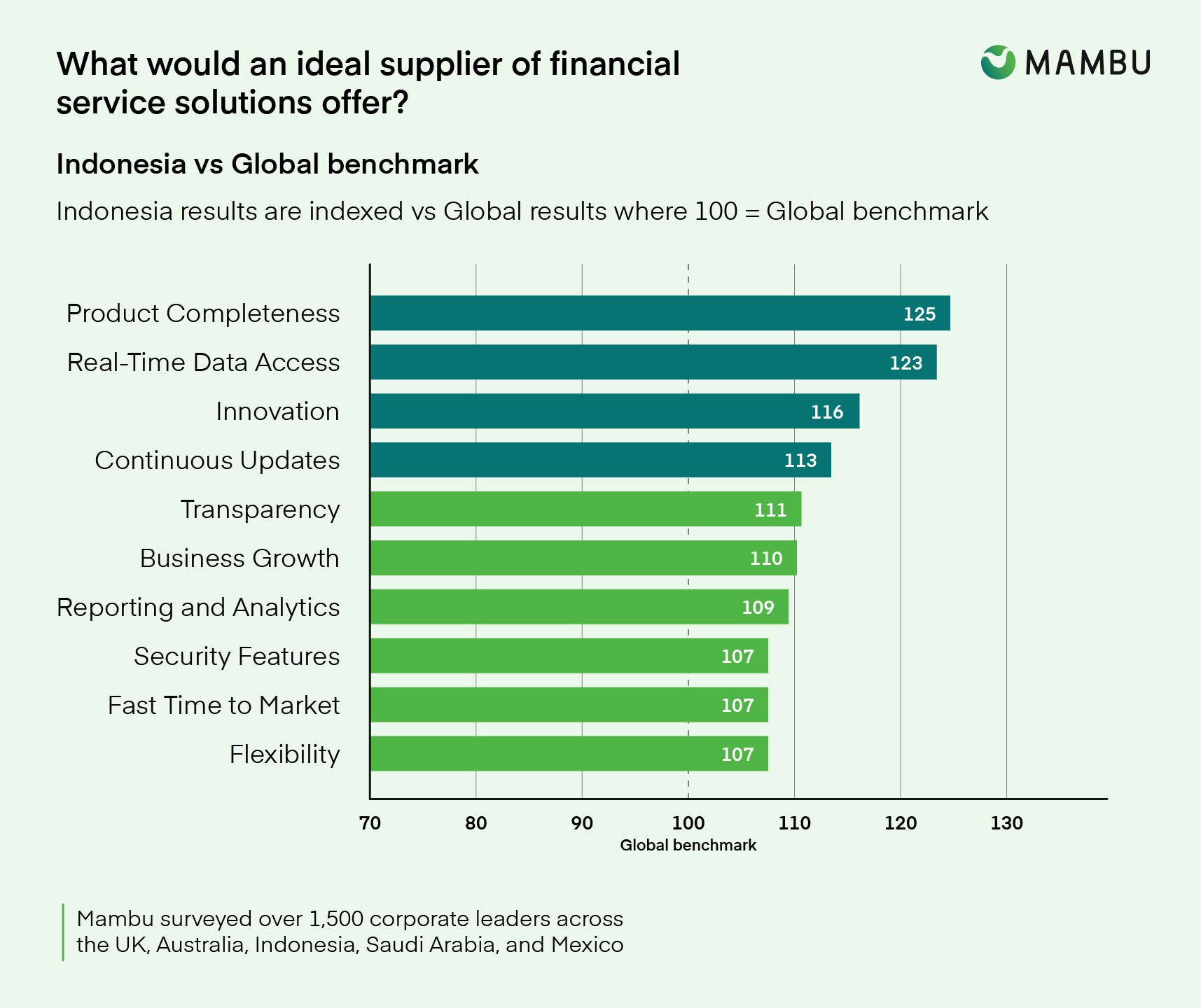
Indonesia’s supplier priorities reflect a market scaling fast, with very little tolerance for friction. When leaders describe what they want from suppliers, the signal is less about “nice-to-have” traits and more about the fundamentals required to run modern financial services at national intensity.
The strongest priorities cluster around four requirements: product completeness, real-time data access, innovation, and continuous updates. Together, they describe institutions that are building at speed, but want to do it on platforms that feel complete, responsive, and always current.
Product completeness
Product completeness ranks highest because many Indonesian institutions are scaling multiple propositions at once. They are building digital-first banking, lending, deposits, payments, and partner-led distribution in parallel. In that environment, fragmented tooling creates operational drag quickly. Teams do not want to stitch together essential capability from scratch every time a new segment or partner opportunity appears.
A “complete” supplier, in this context, is one that reduces the need for constant workarounds. It provides the core building blocks institutions need to launch and run products reliably, so internal teams can spend their energy on differentiation rather than rebuilding foundational components.
Real-time data access
Real-time data access sits near the top because Indonesia is increasingly a real-time market, not only in payments but in customer behaviour. Wallet usage, QR payments, instant transfers, and embedded experiences generate continuous activity, and leaders want operational visibility that matches that pace.
Real-time access matters because it improves decisioning across the board. It enables sharper fraud responses, more responsive credit controls, better liquidity and reconciliation oversight, and faster service resolution. When transaction volumes rise and partner ecosystems expand, institutions cannot afford to operate with delayed insight.
Innovation that delivers outcomes
Innovation ranks highly, but the market is signalling a very specific kind of innovation. Indonesian decision makers are not asking suppliers to experiment for the sake of novelty. They want innovation that reduces time-to-market, opens new distribution routes, and keeps them competitive in a landscape shaped by super-apps, fintech licensing and shifting customer expectations.
In practical terms, innovation is valued when it accelerates execution. It should enable institutions to launch quickly, iterate safely, and respond to change without introducing brittle complexity.
Continuous updates
Continuous updates appear as a top priority because Indonesia’s environment evolves constantly. Regulatory frameworks shift frequently, payment rails continue to expand, and security expectations tighten as digital adoption grows. A platform that updates slowly forces institutions into costly, manual change cycles and increases the risk of falling out of alignment with requirements.
How financial institutions in Indonesia see the next phase taking shape
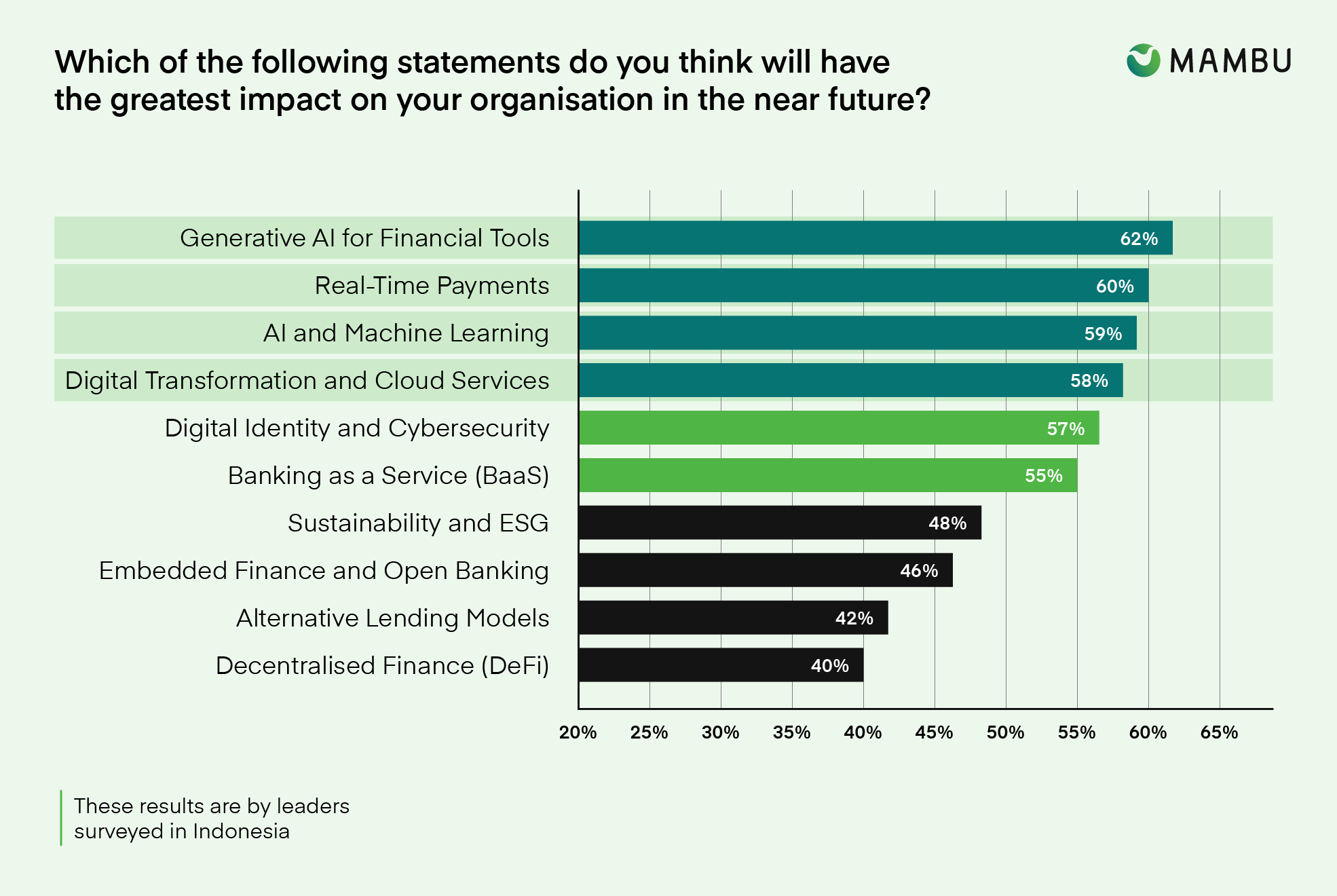
With foundational digital infrastructure largely in place, Indonesian financial institutions are becoming more deliberate about where they focus next. The emphasis is shifting from expanding access alone to strengthening how systems perform under sustained growth. The priorities leaders highlight point to a market intent on making finance smarter, faster and safer, without losing control as scale accelerates.
Intelligence as a growth and risk lever
Artificial intelligence sits firmly at the top of Indonesia’s near-term agenda. Both AI and machine learning, alongside generative AI, are ranked among the most influential forces shaping organisations over the coming years. This is not driven by experimentation, but by outcomes tied directly to commercial performance and risk management.
Institutions are using intelligence to sharpen underwriting, improve fraud detection, prioritise operational workflows and personalise customer journeys. In a market serving millions of first-time and mobile-first users, decision quality matters at speed. AI is valued for its ability to support growth while keeping credit, fraud and operational risk in check.
Real-time payments as core infrastructure
Real-time payments emerge as an equally strong priority. With BI-FAST extending always-on rails nationwide and QRIS driving interoperability, instant money movement has become foundational rather than optional.
The focus is no longer on access to real-time rails, but on reliability at scale. Institutions are investing in the operational discipline required to keep payments available, predictable and resilient as transaction volumes surge. In Indonesia’s context, real-time payments are not a feature; they are a core execution capability that underpins trust in the system.
Cloud transformation with discipline
Digital transformation and cloud services rank close behind. This reflects a market where the question is no longer whether to adopt cloud, but how to do so without introducing instability.
Institutions are under pressure to modernise core workloads, shorten delivery cycles and improve resilience, while remaining compliant in a regulatory environment that continues to evolve. Cloud adoption is therefore tightly linked to governance, security and operational control. Progress depends on architectures that support continual change without weakening oversight.
Security and identity as enablers of scale
Digital identity and cybersecurity remain central, not as a reaction to crisis, but as a prerequisite for sustainable growth. As volumes increase and ecosystems expand, exposure rises alongside opportunity.
Institutions recognise that trust underpins financial inclusion. Identity, authentication and data protection must scale in step with payments, lending and partner integrations. Security is not treated as a layer added after innovation, but as something that has to move with it.
Indonesian financial services: portfolio outlook
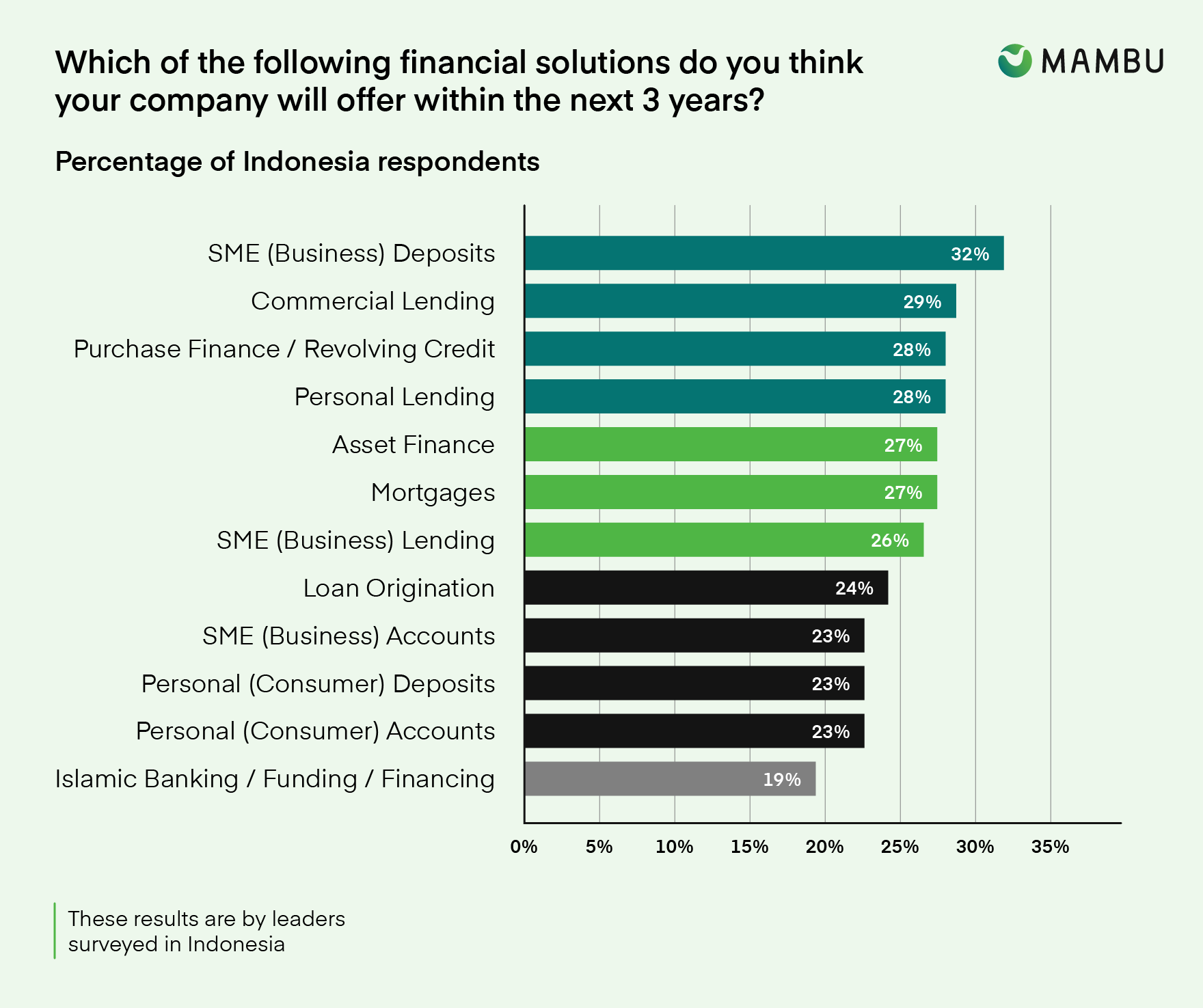
Indonesia’s forward product pipeline reflects a market that is expanding access while becoming more selective about where growth is anchored. Rather than chasing breadth for its own sake, institutions are prioritising products that deepen everyday usage, generate repeatable revenue and fund further expansion reliably.
SME deposits as a foundation
At the top of the three-year outlook sit SME deposits, highlighted by nearly a third of respondents. This is a telling signal. Institutions are looking to anchor relationships with small and medium-sized businesses through operating accounts and stable balances before layering on credit and value-added services.
In a market where SMEs play a critical role in employment and economic activity, deposits offer more than funding. They provide daily engagement, transaction data and long-term relationship potential. For banks and fintechs alike, winning SME deposits is a way to build durable franchises rather than transactional lending books.
Commercial and retail credit with discipline
Close behind are commercial lending, personal lending and purchase finance or revolving credit. Together, these priorities show appetite to monetise rising consumer and business activity, but with an emphasis on control rather than indiscriminate expansion.
Institutions are targeting segments where demand is strong and data signals are improving, allowing credit growth to be paired with tighter underwriting and monitoring. The presence of purchase finance alongside personal lending also reflects the role of digital commerce and point-of-sale journeys in shaping modern credit distribution.
Secured lending and origination at scale
A second cluster of priorities points to balance-sheet depth and operational readiness. Mortgages and asset finance indicate continued expansion in secured lending, while SME lending and loan origination highlight investment in the machinery required to scale credit safely.
This combination suggests that institutions are not only adding products, but also industrialising the processes behind them. Origination capability matters in a real-time environment where speed, compliance and consistency must coexist.
A portfolio built for Indonesia’s scale
Taken together, the portfolio outlook describes a clear strategy. Institutions are using high-frequency products to capture activity, deposit franchises to fund growth and disciplined lending to monetise demand where risk controls are ready.
It is a model designed for Indonesia’s scale and demographics: inclusive by reach, but grounded in economics that can hold as volumes rise. That approach carries direct implications for how institutions think about partners, investment and the technology foundations required to support this next phase of growth.
Supplier spending and choice: investing for scale
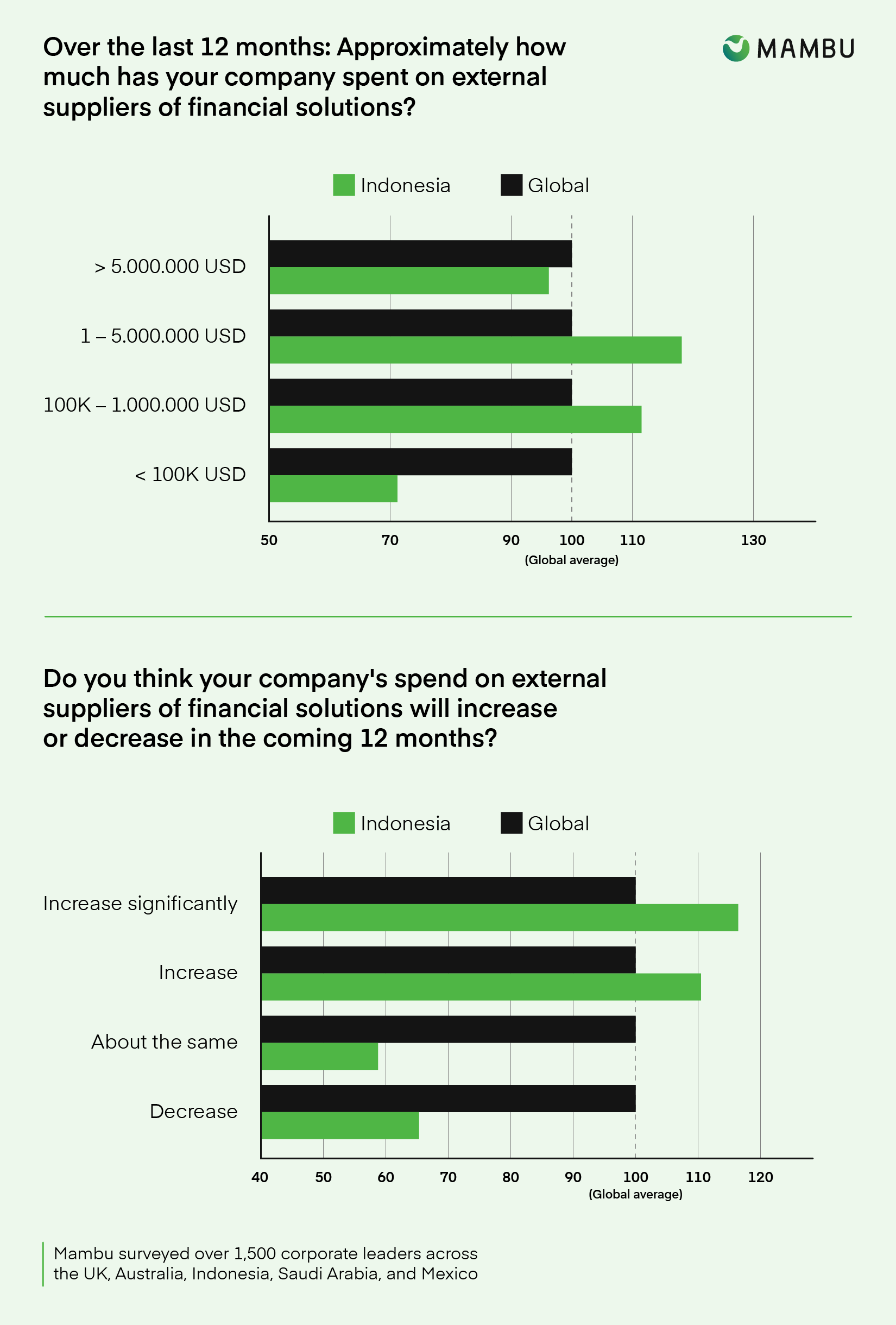
As portfolio ambitions expand, Indonesian institutions are backing them with rising investment in external technology. The pattern that emerges is not one of cautious testing, but of sustained commitment to capabilities that can support national-scale growth.
Spending momentum reflects confidence
Supplier spending over the past 12 months sits close to global norms at the mid-range, with a large share of institutions allocating between USD 100,000 and USD 1 million to external partners. What stands out, however, is the forward-looking signal. More than half of Indonesian respondents expect their spending to increase, and roughly one third anticipate a significant rise, well above global sentiment.
This momentum reflects a shift in how institutions source capability. After several years of building in-house teams to launch digital banking and payments, many are now turning outward to accelerate progress. Specialist partners are increasingly brought in to support cloud migration, API management, fraud analytics and customer-experience automation, areas where speed and depth matter more than ownership.
From internal build to external leverage
The nature of this spending matters. Indonesian institutions are not simply adding headcount through vendors. They are investing in platforms and services that shorten delivery cycles, absorb regulatory change and scale reliably as transaction volumes surge.
This aligns with the broader market reality. Regulation evolves frequently, customer behaviour changes quickly and competition now comes from banks, fintechs and large consumer platforms alike. In that environment, the ability to integrate and adapt fast becomes as important as the underlying product set.
Supplier choice as a strategic decision
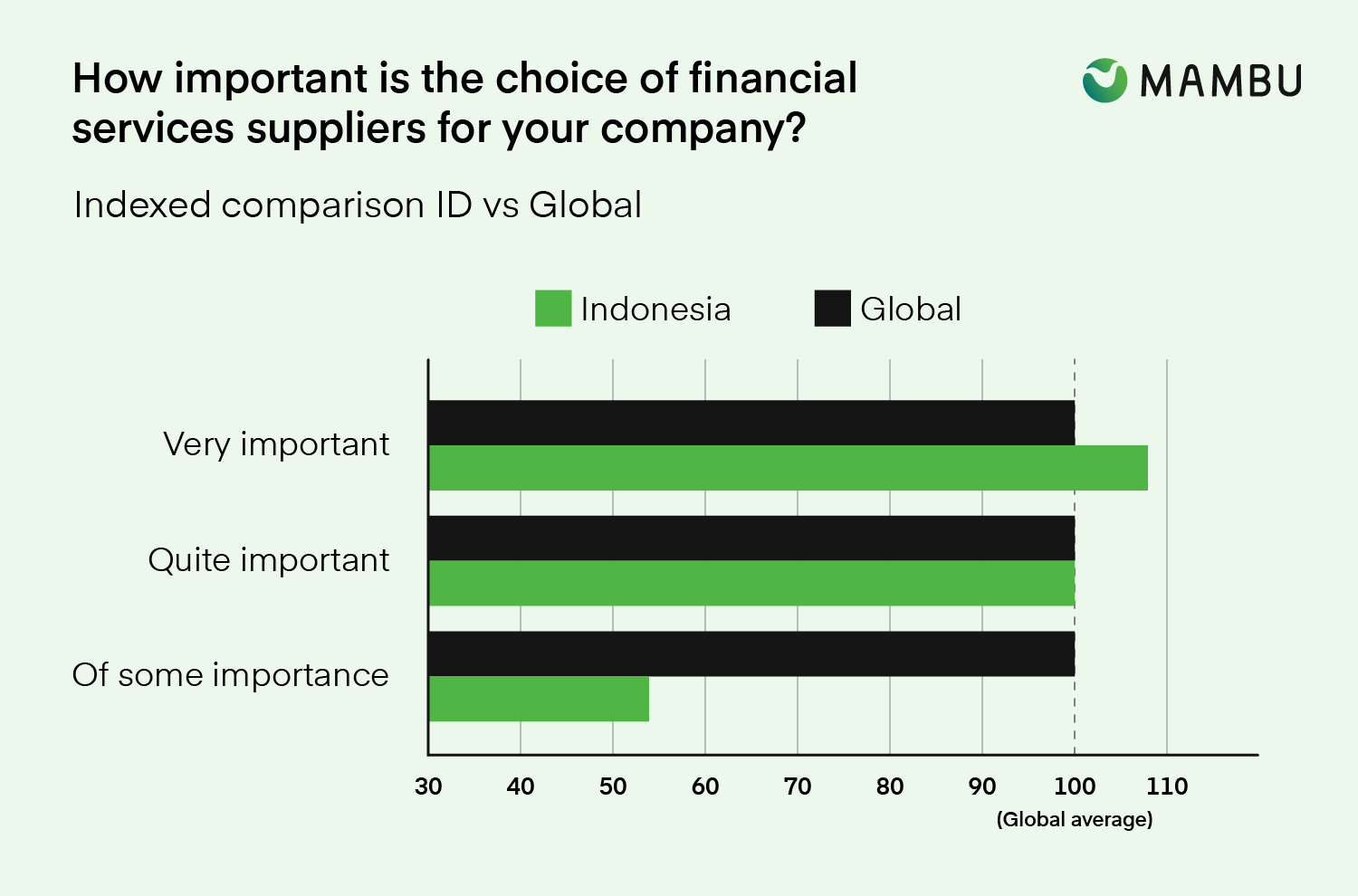
Against this backdrop, supplier selection has taken on heightened importance. A larger-than-global share of Indonesian leaders describe vendor choice as “very important”, reflecting the long-term consequences of getting it wrong.
Decision makers are asking practical questions. Can a partner handle high transaction volumes on real-time rails? Will the technology support open APIs, automation and fast deployment without compromising compliance? Can the supplier demonstrate data integrity, security controls and operational resilience across complex partner ecosystems?
The answers to these questions determine whether growth compounds smoothly or introduces friction and risk.
Investing with intent
Why Mambu is the perfect partner for Indonesia’s next phase
Indonesia’s financial sector is scaling under conditions that few markets face simultaneously: national reach, real-time expectations, frequent regulatory change and a strong mandate for financial inclusion. Growth is essential, but so is control. That balance defines the environment Mambu is built for.
Mambu is the founder of the composable banking model and the world’s only truly cloud-native, SaaS core banking platform. For Indonesian financial institutions, this provides a practical alternative to rigid monolithic systems and high-risk transformation cycles.
Instead of forcing every requirement into a single core, institutions can assemble best-in-class capabilities around a modern foundation. Through APIs, they can integrate specialist partners and proven services while maintaining governance, compliance and operational clarity across the stack. This is what product completeness looks like in practice: the ability to run lending, deposits, and payments from a unified core without rebuilding infrastructure each time growth accelerates.
This approach aligns closely with Indonesia’s market realities. As BI-FAST expands real-time account transfers and QRIS standardises QR-initiated payments nationwide, institutions must support always-on transaction volumes without compromising reliability.
Mambu Payments provides a unified payments layer that enables institutions to connect to payment schemes and partner banks through a single API, with orchestration, compliance and reliability built in as volumes scale.
The same principles extend to Indonesia’s rapidly growing digital wallet ecosystem. As wallets become the primary interface for millions of consumers and SMEs, institutions need to embed payments, balances and value-added services directly into mobile-first journeys.
Mambu enables wallet-based propositions to run on a unified core, connecting real-time payments, deposits and lending through APIs while preserving consistent reconciliation, risk controls and compliance across channels and partners.
As cloud adoption deepens, Mambu’s SaaS delivery model ensures continuous improvement without operational disruption. Regulatory updates, performance enhancements and security improvements are delivered transparently, allowing institutions to stay current as frameworks evolve. Continuous updates become part of the operating model, not a periodic transformation event.
As intelligence becomes operational, Mambu integrates cleanly with data, analytics and AI services, helping institutions improve underwriting, fraud detection and customer experience without introducing brittle complexity. Innovation, in this context, supports execution rather than destabilising it.
Composability also reflects Indonesia’s portfolio priorities. With institutions focusing on SME deposits, commercial lending and embedded or high-frequency retail credit, competitive advantage increasingly comes from refinement rather than reinvention.
Mambu allows teams to launch, adjust and scale business lending, personal lending, business banking and deposits, and stored value or wallet-based accounts quickly, respond to market signals with precision and partner across ecosystems without repeated platform rebuilds.
There is also a cultural dimension. Indonesia’s large Muslim population continues to drive demand for values-driven financial products. Mambu supports Islamic banking alongside conventional offerings on the same platform, enabling institutions to expand inclusion while maintaining operational consistency.
What makes Mambu relevant in Indonesia is not speed alone, but resilience at speed. It helps institutions grow without losing control, integrate without sacrificing oversight and innovate while staying aligned with regulators. In a market scaling at national intensity, that balance is what turns momentum into sustainable progress.
Conclusion
Indonesia is no longer merely proving that digital finance can scale, but that scale itself has consequences. As real-time infrastructure becomes the norm and ecosystem models take hold, the differentiator is no longer ambition, but architecture.
Institutions that succeed will be those that can grow quickly without losing control, adapt continuously without fragmenting operations, and meet rising regulatory and customer expectations without slowing down. In Indonesia’s market, confidence in scale is built long before volume arrives.
Curious to learn more about our composable architecture and how it can benefit your institution?Contact us in the form below for any questions you may have. We’re happy to assist.
Alternatively, if you would like to see our platform in action, register for our next live demo.


© Mambu 2026