
Hear form our experts:
The growing Islamic finance opportunity
06 October 2025
From ancient trade routes to digital highways
Imagine Baghdad in the 9th century. A merchant preparing a valuable shipment for the Silk Road visits a local money changer and draws up a sakk—a written order of payment. Weeks later, his agent presents this document in Canton, China, and receives full payment, completing a secure, cross-continental transaction without a single coin changing hands over the treacherous route. The modern word "cheque" is a direct descendant of this ancient instrument.
This testament to the sophisticated financial ecosystem flourished during the Islamic Golden Age (8th-14th centuries). Concepts like risk-sharing partnerships (mudaraba), trusts (waqf), and value transfer systems (hawala) were practical solutions that underpinned a dynamic economic system stretching from Spain to China. Such history frames modern Islamic finance not as a niche, but as the evolution of a commerce-driven tradition with a millennium-long track record.
The contemporary landscape: an underserved market primed for growth
The global Islamic finance market is forecasted to expand to $9.75 trillion by 2029, at a Compound Annual Growth Rate of 10%.
This expansion is driven by a powerful "triple-helix" of forces:
- Demographic tailwinds: The global Muslim population, numbering 2 billion in 2020, is the fastest-growing major religious group and is projected to constitute over 30% of the world's population by 2050, creating a massive, structurally expanding customer base.
- The rise of ethical and ESG investing: The core tenets of Islamic finance—avoiding harmful industries, prohibiting speculation, and tying financing to real economic activity—resonate with the global shift toward Environmental, Social, and Governance (ESG) criteria, attracting capital from ethically-minded investors worldwide. The emergence of "green sukuk" (Islamic bonds) is a prime example of this convergence.
- Supportive government policies: Governments in core markets like the Gulf Cooperation Council (GCC) and Southeast Asia are actively fostering the industry's development through favorable regulatory frameworks and strategic initiatives.
Beyond overall growth, strategic value lies in addressing untapped segments. Vast regions with large Muslim populations, particularly in Sub-Saharan Africa and Central Asia, remain significantly underserved. Furthermore, a large market of Small and Medium Enterprises (SMEs) in Muslim-majority nations actively avoids conventional debt for religious reasons, creating a clear demand for Sharia-compliant financing.
Navigating the terrain: core principles and operational realities
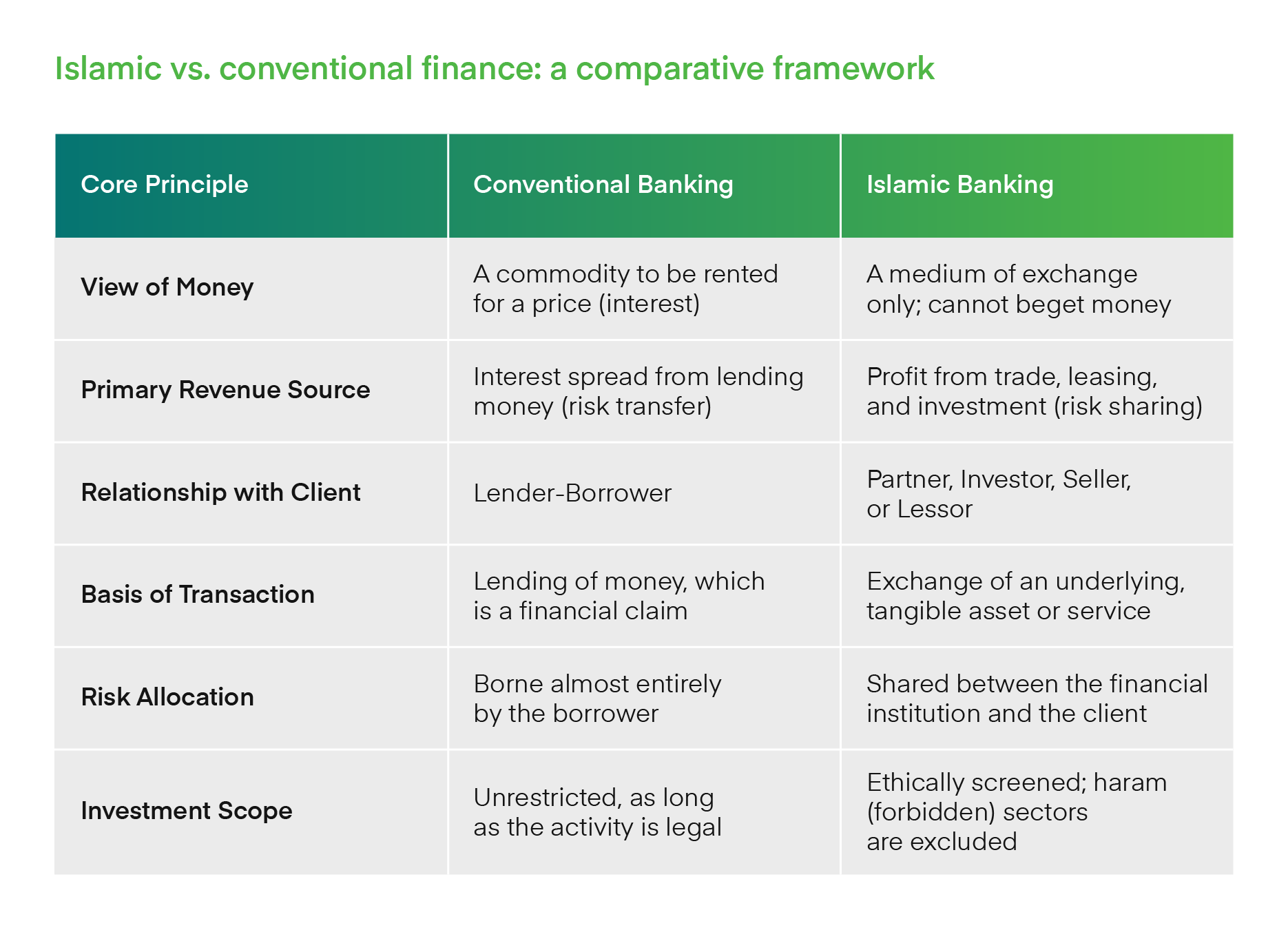
To capitalise on this opportunity, it is essential to understand the fundamental paradigm shift that Islamic finance represents. The difference is not merely the absence of interest; it is a move from a debt-based system of risk transfer to an equity-based system of risk sharing.
Islamic vs. conventional finance
The core operational differences can be distilled into a clear comparative framework.
Overcoming key challenges to global expansion
A successful market entry strategy requires understanding the industry's primary operational challenges.
- Regulatory and Sharia fragmentation: The lack of a unified regulatory framework and standardised interpretation of Sharia law across jurisdictions is the single greatest impediment to global expansion. This fragmentation leads to product inconsistencies, raises compliance costs, and creates hurdles for cross-border transactions.
- Liquidity management: The prohibition of interest cuts Islamic banks off from conventional interbank lending markets and most central bank liquidity facilities. This, combined with a scarcity of Sharia-compliant High-Quality Liquid Assets (HQLA), makes managing short-term liquidity and meeting Basel III requirements a critical challenge.
The talent gap: The industry faces a pronounced shortage of professionals with integrated expertise in both modern finance and Islamic commercial jurisprudence, constraining innovation and risk management.
Debunking the myths: separating perception from opportunity
For many executives, the decision to explore Islamic finance is clouded by persistent myths. Understanding the reality behind them reveals a significant opportunity.
Myth 1: A niche market for muslims only
Reality: While founded on Islamic principles, the system's focus on ethical investing and transparency has universal appeal. Products are available to and actively used by non-Muslims and institutions globally, with major financial centers like London and Hong Kong becoming hubs for sukuk trading that attracts a diverse investor base.
Myth 2: Conventional banking in disguise
Reality: This stems from a superficial comparison. In an Islamic home financing (Murabaha) transaction, the bank must first purchase and take title to the property, assuming ownership risks, before selling it to the client at a pre-agreed profit. This is fundamentally different from a conventional mortgage, which is simply a loan of money. This distinction between a trade in a real asset versus a loan of money is a foundational legal and economic difference.
Myth 3: Inherently more expensive
Reality: While this may have been true in the industry's infancy, today's market maturity and scale have made Islamic financial products highly price-competitive. Transparent, fixed-pricing structures, with no compounding interest or hidden fees, can often result in a lower total cost of financing.
Myth 4: Unprofitable and overly restrictive
Reality: The market's multi-trillion-dollar valuation and consistent double-digit growth refute this claim. The ethical screens function as a disciplined risk management framework, prohibiting speculation and encouraging a focus on the real economy, which can lead to more stable, sustainable returns.
Myth 5: Incompatible with Modern Finance
Reality: The industry is a vibrant ecosystem for fintech development, pioneering Sharia-compliant solutions in digital banking, robo-advisory, and wealth management. Innovators are actively using blockchain and AI to enhance transparency and automate compliance, demonstrating that the system is helping to shape the future of finance.
The future is digital: technology as the catalyst for growth
Technology is not just an incremental improvement for Islamic finance; it is a transformational catalyst. Fintech and modern core banking platforms are providing direct solutions to the industry's most profound structural challenges.
The rise of Islamic fintech
The global Islamic fintech ecosystem, with over 500 companies, is addressing core issues of access, compliance, and innovation. Digital-first platforms are extending Sharia-compliant services to previously unbanked populations at a lower cost. Regulatory Technology (RegTech) powered by AI can automate compliance checks, while blockchain-based smart contracts can execute transactions according to pre-defined Sharia rules, enhancing trust and transparency.
The engine room: The critical role of modern core banking systems
While fintech provides innovative solutions, the engine enabling this transformation is the core banking system. For decades, Islamic banks have been constrained by legacy technology or conventional platforms requiring costly workarounds.
Adopting a modern, purpose-built core banking platform with Shari’ah-based capabilities, is the pivotal strategic inflection point. Key capabilities include embedded Sharia logic to automate compliance, an agile product factory to launch new offerings in days instead of months, and a cloud-native, API-first architecture for scalability and seamless integration.
Real-world case studies provide evidence to this effect.
Strategic recommendations and outlook
Islamic finance presents a core growth opportunity. Its alignment with powerful demographic and ethical trends, supercharged by technology, positions it to outperform the broader financial market.
Actionable recommendations include:
- Adopt a phased market entry: Consider an "Islamic window" within an existing structure to test the market with lower initial investment, focusing on high-potential segments.
- Prioritize technology investment: Frame the investment in a modern core banking platform with Shari’ah-based capabilities, not as an IT expense, but as the primary strategic enabler of growth, agility, and profitability.
- Cultivate hybrid talent: Create cross-functional teams that pair financial experts with Sharia scholars. Invest in training to build a sustainable pipeline of dually-qualified professionals.
- Navigate regulation strategically: Begin by engaging with regulators in jurisdictions with mature frameworks, such as Malaysia, the UAE, or the UK, as a launchpad for expansion into high-growth frontiers.
The question for forward-thinking leaders is no longer if they should engage with this multi-trillion-dollar market, but how and how quickly. The window for establishing a first-mover advantage is open, but it will not remain open indefinitely.
The technological imperative for capturing the Islamic finance market
Islamic finance is a core growth opportunity that demands strategic engagement. However, success is not guaranteed by market entry alone. The industry's primary challenges—regulatory fragmentation, liquidity constraints, and a scarcity of talent—are not merely operational hurdles; they are technological barriers that legacy systems are incapable of overcoming. Winning in this multi-trillion-dollar market requires a definitive technological advantage.
This is where a composable banking architecture, powered by a cloud-native core like Mambu, becomes the central pillar of a successful strategy. This approach directly dismantles the industry's most profound impediments.
Mambu annihilates regulatory complexity:
A monolithic core system is a liability in the fragmented Islamic finance landscape. Mambu’s composable, API-first architecture is the solution, enabling banks to rapidly configure and launch products tailored to specific jurisdictional requirements. An institution can design a Murabaha financing product for SME asset purchases in one country and, using different parameters, deploy a compliant variation in another without a costly, time-consuming overhaul. This agility transforms a key barrier into a competitive advantage, slashing time-to-market from years to weeks.
Mambu solves the liquidity and talent deficit through automation:
Mambu’s platform directly mitigates the talent gap and liquidity management challenges by embedding Sharia logic at its core. Our purpose-built Islamic Profit Sharing (IPS) engine automates the complex calculation and distribution of profits for deposit accounts held by individuals and businesses, ensuring transparency and reducing operational risk. This powerful automation frees scarce Sharia experts from routine oversight to focus on high-value product innovation.
Furthermore, the low-code configuration empowers finance professionals to design and launch sophisticated products—from personal auto financing to corporate working capital solutions—without deep technical expertise, effectively bridging the talent gap.
Institutions like Bank Islam Malaysia Berhad are already leveraging Mambu’s composable approach to build fully digital, Sharia-compliant banks from the ground up, proving the model's effectiveness. For forward-thinking leaders, the question is no longer if they should engage with Islamic finance, but how to build the technological foundation to lead it. Investing in a modern, composable core like Mambu is not an IT decision; it is the definitive business strategy for capturing a dominant share of this rapidly expanding global market.
Curious for more insights into the current challenges and opportunities in the world of Islamic banking? Read our latest report.
For more information on Mambu’s product, read our new Islamic banking product brochure or contact our team directly.
Written by Sofiane Sahir, Mambu Mambu

© Mambu 2026