

What are virtual IBANs and how do they help reconciliation
18 January 2023
Due to their simplicity, reliability, and low cost, SEPA payments represent 97% of the total value of payments in the eurozone. A major contributor to this high usage is B2B payments, as most companies pay their invoices using bank transfers. However, reconciling these payments, which is mandatory for accurate bookkeeping and cash management, is not always easy.
Why virtual IBANs? How virtual IBANs help treasurers to face their challenges
Cash flow management is at the heart of each company's success, which makes treasury management a central and strategic activity. Managing incoming and outgoing flows while monitoring costs and margins, debt, and exchange rates, and providing companies with cash flow forecasts can quickly become very challenging, especially if you are not equipped with the right tools.
For companies managing high payment volumes (incoming and outgoing), it is vital to be able to automatise payment reconciliations. It means identifying incoming and outgoing payments by associating them with an invoice, a credit instalment, or any type of service that would be provided in exchange for a payment.
Let’s take as an example a BNPL (Buy Now, Pay Later) company that offers its clients the possibility to pay in instalments. When providing thousands of small credits, they face many challenges:
- Improve visibility: the company needs to have clear visibility over its cash flows by reconciling everyday outgoing payments to merchants using their BNPL services, and incoming payments from the merchants’ clients who are paying the purchased goods or services in instalments. Every payment (incoming or outgoing) should automatically be linked to a specific deal, its conditions, and the current deal status.
- Optimise working capital: quickly identifying unpaid invoices to merchants, or instalments from customers, allows to take action to correct the situation rapidly. It reduces the time to cash and thus improves companies’ working capital.
- Reduce manual tasks: automating reconciliations reduces manual tasks and their risk.
- Preserve banking confidentiality: when dealing with hundreds or thousands of customers, company account coordinates are circulating a lot, and therefore the possibilities of fraud are increased. Monitoring and identifying account misuse by potential fraudsters can be challenging.
Enter virtual IBANs.
Virtual IBANs address the challenges described above as follows:
- Improve visibility: by allocating one IBAN per counterparty, you can instantly identify where the payment comes from or to whom the payments are made.
- Optimise working capital: identify the missing payments automatically and take action without losing time.
- Reduce manual tasks: allocating one IBAN per counterparty allows you to automatize payment reconciliation instead of doing it manually, which reduces mistakes linked to manual tasks.
- Preserve banking confidentiality: virtual IBANs are linked to real IBANs and can be easily closed and replaced by other virtual IBANs. If frauds are detected, the impacted virtual IBAN can be quickly replaced without any action on the real IBAN, which remains active and safe as it is never communicated outside your entity.
What are virtual IBANs?
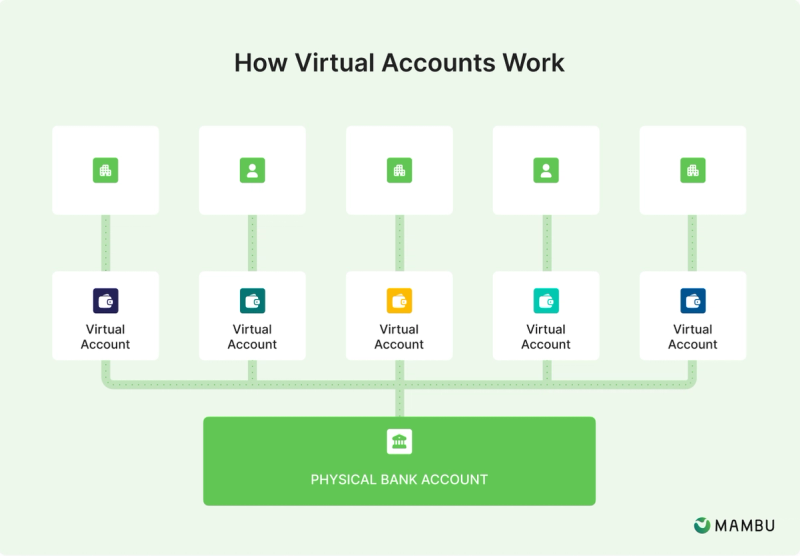
Virtual IBANs are references that take the form of standard IBANs and are linked to real bank accounts or “physical” bank accounts.
You may have heard about virtual accounts. Virtual IBANs are the same as virtual accounts: additional account numbers (IBANs) that are assigned to a main bank account.
They are created by the banks holding bank accounts. They can be used to send and receive money from and to the physical account, where the funds are ultimately held. One bank account can have several virtual IBANs, but one virtual IBAN is assigned to only one main bank account. Virtual accounts do not have balances themselves.
Virtual IBANs can be used for credits or debits as classical IBANs, but the booking is done on the main physical account. The virtual IBAN reference will be transmitted during the whole payment lifecycle, from the payment order to the account statement. It allows identifying of the used virtual IBAN, and therefore the counterparty linked to it.
What are the advantages of virtual IBANs?
Automatic reconciliations
Virtual accounts’ first use case is the reconciliation automation of the incoming flows. The first step is to require your bank to generate a range of virtual IBANs linked to your real account: the master account.
Then, you need to communicate these virtual IBANs to your payers, who will use them to send you payments. Each virtual IBAN will correspond to one payer. By allocating these virtual IBANs to single payers, you are able to automatically identify them every time they send you payments.
The incoming amounts will be booked on your master account, but the virtual IBAN reference will be transmitted in the account statement.
The identification of this reference allows you to automatically identify the payer, and automate its reconciliation.
Advanced treasury management
To allow their clients to optimise their treasury management further, banks improved their virtual IBAN solutions and developed additional features.
Today, most of the virtual accounts’ solutions provided by banks also allow to:
- Initiate payments from virtual IBANs
- Collect account statements from virtual IBANs
- Connect virtual IBANs to various currency accounts
- Manage the creation and closing of virtual IBANs via a single platform
- Create different levels of virtual IBANs
- Personalise virtual IBANs to match internal references
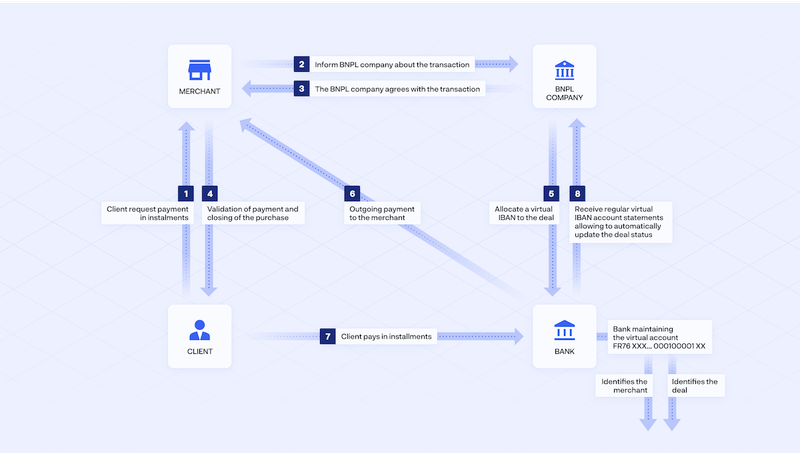
Such a setup would also allow the BNPL to make analytical accounting based on sales volumes per merchant and, for instance, help them adapt their pricing.
It also allows all the funds to be instantaneously consolidated in one master account and thus to have a consolidated vision on the available cash. This is a powerful tool to help the treasurer to anticipate potential cash flows and banking investments.
How to leverage virtual IBANs?
As we discussed above, first, companies that want to benefit from virtual accounts must ask their bank to create them. Banks usually provide a range of virtual IBANs that companies can use as they wish.
But to benefit from the advantages of virtual accounts, companies need to manage the virtual IBANs generated by their bank. Managing virtual accounts first means assigning them to specific counterparties or specific expected payments.
As we covered in this article, virtual IBANs are used to automate reconciliations. However, not all reconciliation solutions natively support virtual IBANs.
Finally, banks charge for virtual IBANs, which can get expensive with large volumes. So companies can only count on a limited number of virtual IBANs. They need to be able to recycle virtual IBANs, which means reassigning the virtual accounts to new counterparties or new expected payments.
To manage all those processes required to benefit from virtual IBANs fully, companies have few choices.
They can manage virtual IBANs manually, using spreadsheets, for instance. Still, it just moves the manual tasks and potential errors from the reconciliation workflow to this new virtual account management workflow.
Another option is to build a virtual account management software in-house, but it can require precious engineering resources for the initial design and development and maintenance instead of using these resources to improve their core products.
Mambu Payments' payment operations platform enables companies to send, receive, and reconcile payments through their banks with a single API and dashboard and natively manages virtual accounts.

© Mambu 2026