
Mambu Insights Series:
The key trends reshaping financial services
13 October 2025
The financial service industry is riding a new wave of change, reshaping how institutions operate, serve customers, and manage risk. Customers expect more speed and personalisation than ever before, regulators are tightening their grip, and new technologies are transforming what it means to compete.
For leaders, the defining challenge that separates the winners from the watchers will be manifesting awareness of change into rapid, effective action. To begin with, they’ll first need to gather insights and data to understand where the industry is heading. Mambu surveyed more than 1,500 corporate leaders across five countries: the UK, Australia, Indonesia, Saudi Arabia, and Mexico.
The findings, published as part of the Mambu Insight Series, highlight three trends leaders believe will have the greatest near-term impact over the coming three years.
What emerges is a picture of the global forces now shaping finance, deep shifts that are changing how institutions think about growth, resilience, and customer experience.
The global imperative: three trends reshaping finance
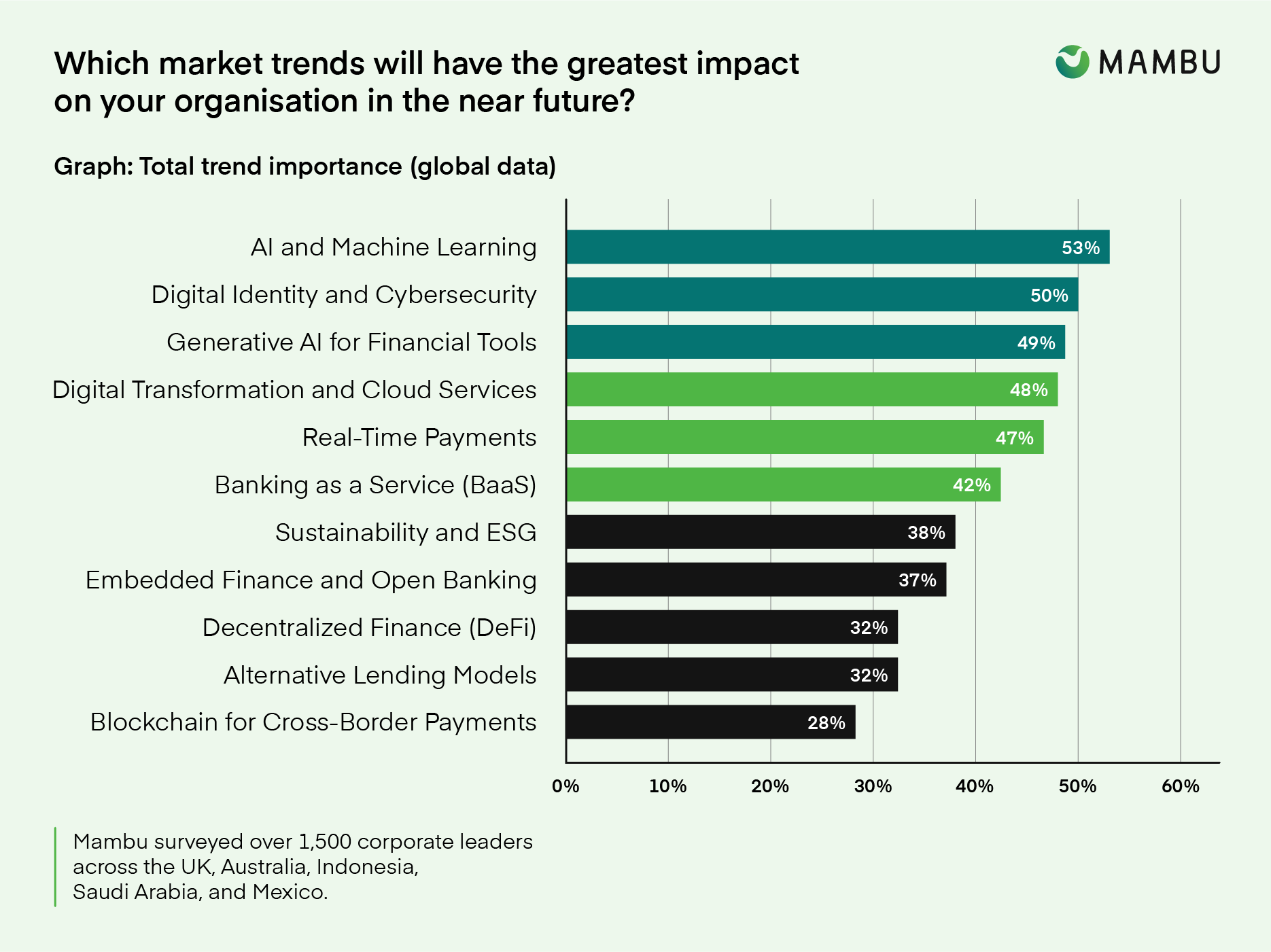
Across every market surveyed, three priorities came through with striking consistency. Leaders may face nuanced local challenges, but the same themes are shaping strategy everywhere: how to use technology more intelligently, how to safeguard trust in a digital-first world, and how to engage customers in new, more personalised ways.
These are the areas drawing the most investment and attention, and they set the stage for how financial services will evolve in the years ahead.
AI and machine learning: from experiment to core strategy (53%)
Artificial intelligence is no longer an experiment or a side project. It now sits at the centre of financial strategy, with more than half of global leaders identifying it as the most significant trend shaping the industry.
AI brings speed and precision to personalisation and risk management at a scale that manual processes cannot sustain. Institutions are already putting this into practice, from fraud detection that identifies anomalies in real-time, to service desks that resolve queries around the clock, to hyper-personalised products and advice tailored to individual needs.
For customers, this means faster onboarding, more relevant recommendations, and seamless support. For financial institutions, it opens the door to lower costs, stronger risk management, and new avenues for growth. The question is no longer whether to use AI, but how to embed it across the organisation, moving from pilots to strategies that influence every part of the value chain.
Digital identity and cybersecurity: building trust in a borderless world (50%)
As financial services become increasingly digital and borderless, security has emerged as a critical boardroom priority, with half of the leaders surveyed identifying digital identity verification and cybersecurity as essential to their future strategy.
With rising fraud and identity theft, the demand for stronger safeguards, combined with regulatory pressure to tighten requirements around data protection and breach prevention, places trust as strategic currency.
Tools such as biometric authentication and multi-factor verification are becoming standard features of the digital experience, woven directly into customer journeys rather than being bolted on clumsily as an afterthought.
Institutions that can combine strong protection with seamless user experiences will not only meet regulatory expectations but also strengthen their position and brand integrity within an increasingly competitive market.
Generative AI: delivering new levels of engagement (49%)
Generative AI has moved from an emerging technology into a set of tools with clear applications across financial services. Nearly half of the leaders surveyed see its potential to reshape how institutions interact with customers and manage their own operations.
On the customer side, banks and fintechs are beginning to roll out tools that help people budget, plan investments, and receive personalised advice powered by generative models. Such services make financial decisions more accessible while strengthening engagement and loyalty.
Internally, generative AI is being applied to tasks such as financial analysis, reporting, and customer communication, giving employees faster insights and more effective tools at their disposal.
With opportunity, however, certainly comes its share of risk. Without careful oversight, hallucinations, bias, and misinformation have the potential to erode customer trust, distort decision-making, and expose institutions to regulatory or reputational damage. Institutions that establish strong governance and focus on responsible deployment will be best positioned to capture the benefits at scale.
These global forces set the direction of travel for the industry as a whole. Yet when we look more closely at smaller providers, a different picture emerges. SMEs face the same trends, but they filter them through the realities of limited resources, leaner teams, and the need to deliver immediate value to customers.

© Mambu 2026