

Core banking transformation
Five routes to a modern core
10 November 2026 • 9 min read
Executive summary
Core banking transformation doesn't follow a single path. The right approach depends on where a financial institution is starting, what it needs to achieve and how much of its existing technology it needs to retain.
From building a new bank from scratch to replacing a legacy core completely, there are five approaches to modernisation. Each offers a different way forward, depending on an institution's starting point and business objectives.
Understanding the differences can help institutions find a route that balances speed, independence, continuity and transformation risk.

Introduction
There is no single way to modernise a core because not every financial institution is starting from the same place.
A new digital bank with no legacy technology has a very different challenge from an established institution running millions of customer accounts on infrastructure built decades ago. One may need to get to market as quickly as possible. Another may need to modernise without disrupting the business. A third may be ready to replace its legacy core completely.
That's why core banking transformation isn't one decision. There are different routes, each designed for a different starting point and business objective.
This guide explores five approaches to core transformation, how they differ and what financial institutions should consider when deciding which route makes sense for them.
What are the five approaches to core banking transformation?
The five approaches cover a spectrum of starting points and transformation needs, from building a new bank to replacing an existing core.
Greenfield: Neo-bank
Build a new bank from scratch with fresh technology and a new team. With no existing customers or legacy infrastructure to migrate, the institution starts with a clean slate.
Dual core: Shared legacy
Launch a new fintech sponsored by an existing bank, using its technology and integrations. The core remains tied to the sponsor bank, which can limit flexibility.
Dual core: On the edge
Introduce a modern composable core alongside an existing legacy system. Share legacy functions where needed while developing new features, with lower risk through phased, long-term migration.
Speedboat: Spin-off
Create a legally and operationally independent business with shared ownership and funding from an established institution. This allows the new business to launch quickly and capture new market segments with differentiated offerings.
Migration: Legacy replaced
Replace the existing core system completely. This is a high-complexity transformation requiring rigorous planning and continuous C-level governance.
These aren't simply five technical architectures. They represent five different answers to a more fundamental question: where are you starting, and what are you trying to achieve?
How do the five approaches to core transformation compare?
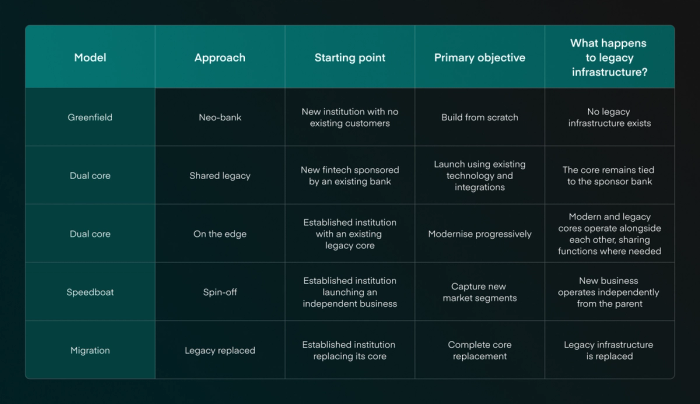
The differences matter because the most comprehensive transformation isn't automatically the right transformation.
The right model depends on the problem the institution is trying to solve.
Greenfield
When you're starting from scratch
A greenfield core banking build starts with a genuine clean slate. There is no existing core to migrate, no customer base to move and no inherited technology stack to work around. That makes greenfield particularly relevant for new banking licence holders, neo-banks and digital-first entrants building their first proposition.
The advantage is freedom. Architecture, technology partners and products can be chosen for the business being built rather than negotiated around systems inherited from the past.
But a clean slate doesn't remove complexity. A greenfield institution still needs to stand up its core, connect payments and other ecosystem partners, embed compliance and KYC processes, design products and meet regulatory requirements before it can serve customers.
The decisions made at launch also matter long after launch. Building a new monolithic stack may remove yesterday's legacy problem only to create another one for the future. A composable, API-first foundation gives new institutions greater freedom to add, replace and evolve capabilities as they grow.
Wio Bank demonstrates the potential. The UAE platform bank used a composable core and ecosystem of specialist partners to build a new banking proposition from the ground up, launching Wio Business first and expanding into personal banking.
Best suited to: New licence holders, neo-banks and new financial propositions with no existing core to protect.
Dual core - shared legacy
When speed to market comes first
Shared legacy is one of two approaches within dual core. Not every new financial proposition needs to build everything independently from day one.
The shared legacy approach allows a new fintech to launch using the technology and integrations of an established sponsor bank. This provides a route to market without building everything independently, although the core remains tied to the sponsor bank, which can limit flexibility.
The trade-off is independence.
When a business depends on another institution's infrastructure, its ability to launch products, scale or enter new markets can eventually depend on what that infrastructure allows.
N26's early journey illustrates both sides of that trade-off. Partner-provided banking infrastructure helped the fintech get started quickly.
But as its ambitions grew, the same setup began limiting its ability to scale and expand. N26 eventually secured its own banking licence and moved to a cloud-native core to gain greater control over its next stage of growth.
Shared infrastructure can therefore be an effective starting point without necessarily being the permanent destination.
Best suited to: New propositions where speed to market matters more initially than complete technological or regulatory independence.
Dual core - on the edge
When you need to modernise without disrupting the existing bank
For an established institution, the biggest barrier to modernisation is often not ambition. It's the risk of changing technology that already supports live customers and critical operations.
On the edge is the second approach within dual core.
It introduces a modern composable core alongside the existing legacy system, sharing legacy functions where needed while developing new features.
Rather than moving everything at once, the institution can modernise progressively through a phased, long-term migration, reducing the risk of disruption to existing operations.
This gives teams a live environment in which to test products, simplify processes and prove the new architecture before extending it further across the organisation.
Bank Muamalat used this approach with ATLAS, its standalone digital Islamic banking platform. ATLAS launched on Mambu while the bank's existing core continued supporting the wider organisation. The platform went from development to launch in nine months and now provides an environment through which Bank Muamalat can modernise progressively.
The result is a different way to think about transformation: value doesn't have to wait until the entire modernisation programme is complete.
Best suited to: Established banks, building societies and lenders that need to modernise incrementally while keeping existing operations running.
Speedboat spin-off
When an established bank wants to build something independent
Sometimes an established institution wants to enter a new market without forcing the new business to move at the pace of the existing organisation.
A speedboat spin-off creates a separate entity with shared ownership but legal and operational independence from its parent. The parent provides funding and credibility, while the new business gets the freedom to build its own technology, product and operating model.
That distinction separates a speedboat from shared legacy.
A shared legacy proposition gains speed by using existing infrastructure. A speedboat gains speed by being free from it.
It also differs from greenfield. While both can build from a clean technology slate, a speedboat starts with the backing of an established parent rather than as a completely new independent entrant.
ABN AMRO took this approach with New10, its SME lending spin-off. New10 used a modern core and specialist ecosystem to go from concept to a fully digital lender in ten months, without having to build around the parent bank's existing technology.
Best suited to: Established institutions that want to target a new customer segment or market through a genuinely independent digital business.
Full legacy replacement
When the old core needs to go
At the other end of the transformation spectrum is migration, where the existing core system is replaced completely, allowing the legacy infrastructure to be retired.
That makes it the highest-complexity route. The transformation can reach far beyond the core itself, affecting data, digital channels, reporting, integrations and operational processes.
But full replacement doesn't necessarily mean changing everything in one big-bang event.
The destination may be complete migration while the journey remains carefully sequenced. Rigorous planning, governance and phased execution can break the programme into manageable stages while keeping the ultimate objective unchanged.
OYAK ANKER Bank took this route when its existing core reached its limits. Rather than replace one ageing monolithic platform with another, the bank rebuilt its technology ecosystem around a cloud-native core. The transformation included its core, mobile banking, data warehouse and supporting applications and was completed without business disruption.
For institutions whose legacy technology has genuinely reached the end of its useful life, full replacement offers something the other models don't: the opportunity to remove the dependency entirely.
Best suited to: Established institutions whose existing core can no longer support the business and where complete migration is the desired end state.
How do you choose the right core transformation approach?
The starting point is not the technology, it's the business objective.
If there is no legacy environment, the question may be how to build the right foundation from day one. If speed to market is the immediate priority, shared legacy offers a route through an established sponsor bank. If an established institution wants to pursue a new opportunity independently, a speedboat can create separation without transforming the parent bank first.
For institutions that need to modernise an existing core, on the edge introduces a modern composable core alongside existing infrastructure, allowing change to happen progressively. Full legacy replacement provides a route to complete retirement of the legacy environment.
Four questions can help narrow the choice:
What are you starting with?
A new institution with no legacy infrastructure has different options from an established bank supporting millions of existing accounts.
What needs to change now?
Be clear about the immediate business problem. It might be launching a new proposition, entering a new market, improving time to market, reducing dependency on legacy technology or replacing an existing core completely.
What needs to keep running?
For established institutions, continuity can determine the transformation approach. The more existing customers, products and operations depend on the current core, the more important sequencing becomes.
Where do you ultimately want to end up?
The architecture that solves today's problem should not become tomorrow's constraint.
Institutions need to consider not only how they start the transformation, but what the model allows them to do next.
The common foundation: architecture designed for change
The five approaches begin in different places, but they share one important requirement: the technology chosen today needs to support what happens next.
A composable architecture separates banking capabilities rather than locking them into a single monolithic stack. APIs connect the core to payments, digital channels, data and specialist ecosystem partners, allowing individual capabilities to evolve without rebuilding everything around them.
- For a greenfield bank, that can mean designing for scale from day one.
- For a shared legacy proposition, it can make a future move towards independence easier.
- For a speedboat, it creates the freedom to choose technology around the market it wants to serve.
- For an on the edge transformation, it allows new capabilities to develop alongside existing infrastructure.
- For a full replacement, it avoids solving an old monolith problem by simply creating a new one.
The transformation approach determines how an institution gets there, the architecture determines what it can do once it arrives.
Conclusion
There is no single route to a modern core.
A greenfield institution can build from scratch. A new fintech can launch using a sponsor bank's existing infrastructure through shared legacy. An established bank can create an independent speedboat, introduce a modern core alongside existing infrastructure through on the edge, or replace its legacy environment completely.
These five approaches give financial institutions different ways to launch, modernise and transform.
The right approach depends on where the institution is starting, what it needs to achieve and how much change the existing business can absorb.
What matters is choosing an approach that solves the immediate problem without limiting what comes next.

Find your route to a modern core
Explore how Mambu's composable core gives financial institutions the flexibility to launch, modernise and transform on their own terms.
FAQs
Find quick answers to the most commonly asked questions about this topic below.
What is core banking transformation?
What are the five approaches to core banking transformation?
Does core banking modernisation require replacing the existing core?
What is the difference between dual core and full legacy replacement?
How should a financial institution choose a core transformation approach?

© Mambu 2026