
Product update
June 2025
09 June 2025
June 2025
Payments continue to evolve at a fast pace — from regulatory deadlines like the Instant Payments Regulation to new requirements introduced by the latest EPC SEPA rulebook updates. At Mambu Payments, our teams have been focused on delivering features and integrations that help financial institutions meet these demands with confidence.
Here’s a look at what we have shipped recently:
Expanding our bank and scheme coverage through new integrations
More financial institutions are expanding their geographic coverage and adapting to evolving scheme requirements. This calls for greater flexibility in how they access payment systems across regions — and faster onboarding when they do. That’s why we’ve focused on expanding our network of bank partners and reducing time-to-production for our joint clients.
Powering Australian payments through Citi integration
While we initially focused on European payment schemes, we are committed to supporting our customers globally. Mambu Payments now supports Australian payment schemes through our integration with Citi Australia.
Through Citi's infrastructure and global payment capabilities, Mambu Payments’ customers can now send and receive payments via Osko (instant payments), BECS (bulk direct credit transfers), and RITS (RTGS high-value transactions). This integration helps institutions operating or expanding into Australia streamline local payment flows.
Strengthening reach with Iberpay
Mambu Payments is now integrated with Iberpay, Spain’s national clearing system. Iberpay processes over 3 billion transactions annually, including 1 billion SEPA Instant transfers. Our first customer is already live, using Mambu Payments’ API-first platform to automate payments with Iberpay. This partnership helps institutions in Spain and Portugal access local clearing through a modern, resilient architecture.
Accelerating access to FPS, Bacs and CHAPS with ClearBank
Our integration with ClearBank is also live, with our first customer already processing payments. ClearBank is the UK’s first new clearing bank in over 250 years, offering API-first access to the UK’s domestic schemes: FPS, Bacs, and CHAPS. Through Mambu Payments, financial institutions can quickly connect to ClearBank, access their accounts, and process payments with reduced time to market.
Going live with multiple banks through Société Générale
Using Société Générale’s infrastructure for indirect SEPA participants, we have also taken more than three banks live on SEPA Instant Credit Transfers. The go-live was completed in under four months, aligned with the first requirements of the Instant Payments Regulation. This integration offers institutions a fast and compliant path to SEPA Instant.
Integrating with Memo Bank
Finally, we’ve also gone live with Memo Bank, enabling its clients to access account data, initiate SEPA Credit and Instant Credit Transfers, and manage SEPA Direct Debits — all through Mambu Payments’ platform. Memo Bank is the first independent French bank in over 50 years, built on a modern core that supports fast lending and business growth. This integration allows Memo Bank to deliver more efficient and automated payment operations to its corporate customers.
To see what’s live and what’s next, visit our bank coverage page.
Preparing for VOP: opening our sandbox for early testing
With the Verification of Payee (VOP) scheme going live on October 5, 2025, financial institutions must soon be able to verify a payee’s name and IBAN before sending SEPA payments.
We started the certification process for our VOP inter-PSP API with the European Payments Council’s VoP Scheme Sandbox, known as the VoP API Reference Toolkit (ART). This ensures that we’re on track to support a timely go-live for all our customers.
In addition, we decided to open our own VoP sandbox environment to all customers impacted by the regulation. This gives teams an opportunity to begin testing early, and build confidence ahead of the deadline.
With Mambu Payments’ VOP sandbox, financial institutions can:
- Send and receive simulated VOP requests via API or dashboard
- Simulate incoming VOP requests and test their matching algorithms using test or internal account data
- View audit trails and reporting for all sent and received VOP requests in the dashboard
Live VOP requests and access to the EPC’s Directory Service will be supported once EPC systems go live. Learn more about our VOP solution here:
- Numeral VOP overview
- API reference
Improving control and visibility across payment operations
Operational readiness and efficiency continue to drive priorities for payment teams in 2025. From VOP preparation to real-time visibility, our latest releases focus on automation, controls, and meeting regulatory requirements.
Flexible approval workflows for better compliance and security
Businesses often need controls to prevent fraud and human errors, especially for sensitive or high-value payments. That's why we've introduced payment approval workflows – robust, flexible, and auditable processes that adapt to your needs.
When a payment requires approval, it will enter a pending_approval status until all required approvers validate the operation. You can customise the rules and track progress from the dashboard.
Payment approval workflows are available via the dashboard and support multi-step, auditable approvals.
Seamless migration when switching to Mambu Payments
Migrating to a new system can be complicated and risky, especially when payment history and R transactions need to be preserved. Our migration process supports importing:
- Outgoing SCT, SCT Instant, SDD, and Bacs payments
- Incoming SCT, SCT Instant, SDD, and Bacs payments
- Return requests: recalls and originator requests for recalls by the originator (RFRO)
- SEPA and Bacs direct debit mandates
Since R transactions can be received up to 13 months, we ensure coverage of at least that period. Payments migration is part of the implementation process – contact our team for more information.
To get a detailed description of our migration process, read the changelog entry or follow our step-by-step migration guide.
Improving the dashboard experience for developers and ops teams
We’ve made improvements to the dashboard experience to help operations and developer teams move faster with more autonomy.
One-click payment order duplication
You can now duplicate any payment order with a single click. This helps reduce errors and speed up recurring or similar payments – from bills and salaries to manual payments between safeguarding and settlement accounts. Duplicates go through full validation, just like new orders. Head over to changelog for a detailed description.
Simpler account holder management
You can now create and manage account holders in the dashboard. These can be linked to internal or external accounts and used in payment orders. This simplifies account relationship management and gives business teams more control. Learn more in our changelog.
Easier event delivery tracking
The dashboard is also a key tool for developers to accelerate implementation and maintain integration visibility — so we’ve enhanced event delivery tracking.
Previously, it was hard to track the actual delivery status of events in the dashboard. Users had no overview of which channels received what, and no quick way to retry or debug issues.
To improve the developer experience in the dashboard, we’ve added delivery tracking to the Events view in the Developers section:
- Delivery status now shown on the events list and detailed views
- Visual indicators for successful, pending, or failed deliveries
- Dedicated tab for child events, with retry options
Check the in-depth description in our changelog.
September 2024
Our product and engineering team has been busy this summer to bring you 8 new bank integrations, new features, and multiple improvements.
Highlights include:
- New account verification capabilities for increased payment success rate and lower fraud
- Multi-currency accounts: manage all your accounts, including multi-currency accounts, from a central dashboard and API
- Many improvements to the dashboard and the Mambu Payments developer experience
- 8 new bank integrations including Citi, HSBC
Learn more about these capabilities below, and do not hesitate to contact us for more information.
An ever-expanding, pan-European bank coverage
This summer, we’ve integrated with 8 new banks: Citi, HSBC, Vitesse, Swedbank, Mano Bank, Belfius, and Arion Banki.
Citi’s integration opens endless possibilities for our current and future customers, thanks to Citi’s global footprint and extensive payment offerings. We are glad to now support a bank trusted by many of the world’s largest companies across all industries.
Combined with existing and new integrations and our support for multi-currency accounts (more below), building a cross-border payment infrastructure has never been easier with Mambu Payments.
Our integration with Vitesse enables us to better support insurance companies. From premium collections to claim funds management and delegated claims operations, insurance companies of all sizes have specific payments and accounts needs. They can now access Vitesse specialised payments and accounts services through Mambu Payments’ API and dashboard.
Easier management of multi-currency accounts
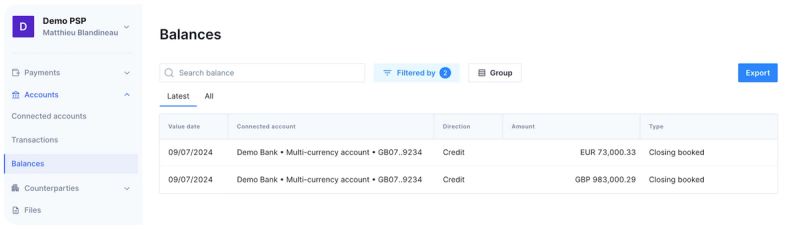
Monitoring and managing multi-currency accounts is time-consuming. With multi-currency accounts, customers can monitor and manage all their accounts, including multi-currency accounts, from a central dashboard and API.
Customers can now retrieve the balances for each supported currency of a connected account from the dashboard and the API.
Multi-currency accounts are available for free for customers who have access to Cash visibility.
Increase payment success rate and decrease fraud with new account verification capabilities
Company registration number verification
Customers can now check, for external accounts recorded in Mambu Payments that represent legal entities, the correspondence of the provided account number and company registration number.
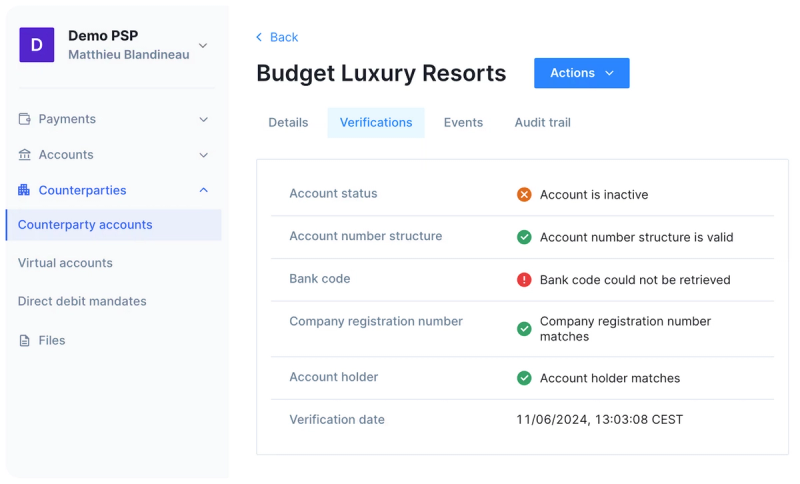
Supported company registration numbers are SIREN, SIRET, and Intracommunity VAT for France and Intracommunity VAT for the Netherlands.
You can find more information about account verification here:
Company registration number is available to Account verification subscribers. If you are interested in Account verification, please contact us.
Bank code lookup: ensure account numbers and bank codes match
Using incorrect BICs can lead to payment failures.
With Bank code lookup, customers can easily retrieve the BIC associated with an IBAN to improve payment success rate and prevent potential fraud.
Bank code lookup is available:
- Using the API, through which customers can submit an IBAN and obtain the corresponding BIC in response
- In the dashboard when creating a payment order or an external account. Clicking on the “Lookup” button will automatically populate the Bank code field based on the IBAN
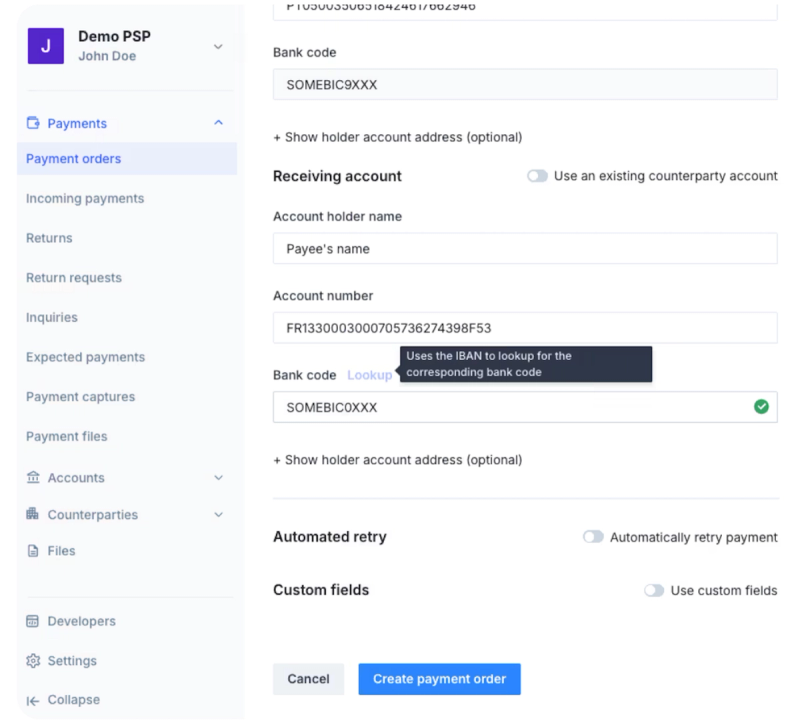
Bank code lookup is available to all customers and currently supports IBANs of the countries listed here.
You can find more information about bank code lookup accounts here:
Improving our dashboard experience for payment and finance teams
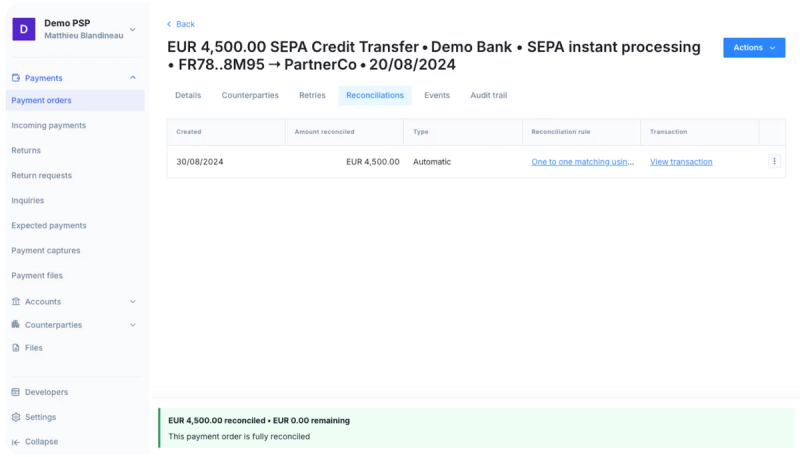
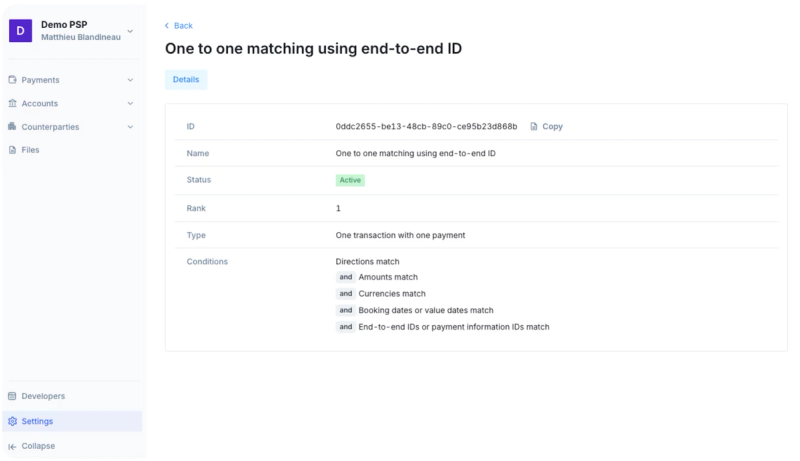
Mambu Payments customers can now visualise, for each reconciled payment or transaction, the reconciliation rule used by our automated reconciliation engine to reconcile said payment or transaction.
Mambu Payments customers can access the details of each reconciliation rule configured in their environment.
This feature is available to customers who subscribe to Mambu Payments’ automated reconciliations.
Improved webhooks management for developers
Better webhook events visibility in the dashboard
Mambu Payments customers now can visualise in the dashboard, for each configured webhook, all the events sent to said webhook.
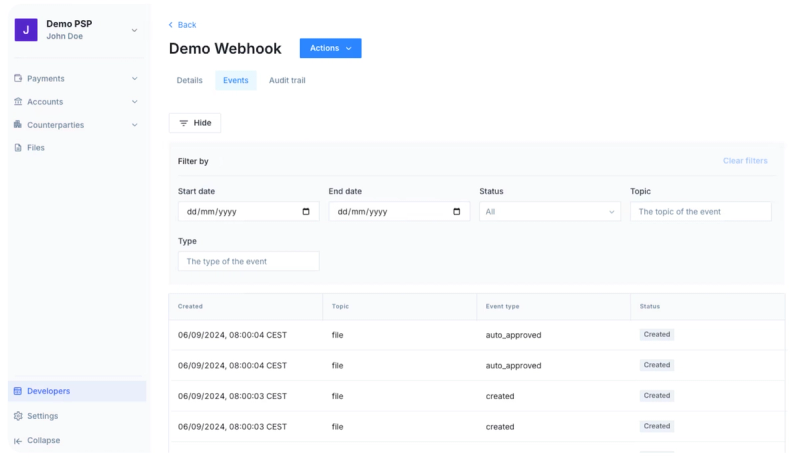
This improvement is available to all customers who have access to the dashboard.
Learn more:
Choose the right event delivery mode for your needs
Customers with large payment volumes might want to increase the webhook event delivery throughput.
To accommodate these use cases, customers can now choose between four event delivery modes on webhooks:
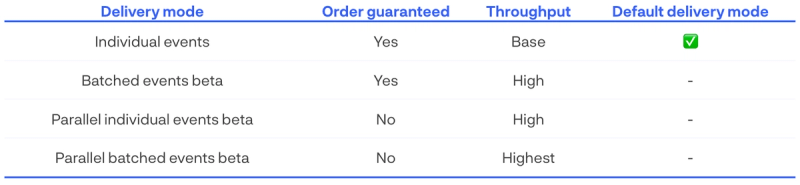
The default delivery mode is individual events. Contact us at if you would like to change your event delivery mode.
Learn more in the documentation.

© Mambu 2026