

Verification Of Payee rulebook digest: what to pay attention to
Last update: November 2026 • 12 min read
Executive summary
The EPC’s VOP rulebook turns the payee check required by the Instant Payments Regulation (IPR) into a common scheme: PSPs exchange individual requests, look up each other’s endpoints in the EPC Directory Service and answer within 5 seconds. PSPs in euro-area Member States have had to offer VOP since 9 October 2025, and those in EU Member States outside the euro area must comply by 9 July 2027.

Introduction
What is the VOP rulebook and why does it matter?
On 10 October 2024, the European Payments Council (EPC) published its highly anticipated Verification Of Payee (VOP) rulebook. The rulebook entered into force on 5 October 2025. Payment Service Providers (PSPs) in euro-area Member States have had to offer VOP since 9 October 2025, and PSPs in EU Member States whose currency is not the euro must comply by 9 July 2027.
The rulebook turned the VOP requirement of the IPR into a common scheme, so that any participating PSP can exchange VOP requests with any other. This digest reflects version 1.1, which took effect on 20 September 2026.
In this blog, based on the VOP rulebook, we explore how the scheme works, who can participate in it and what the main complexities are for PSPs adhering to it, or for the solution providers that help them adhere.
What changes on 9 July 2027
The first VOP deadline, on 9 October 2025, applied to PSPs located in euro-area Member States. On 9 July 2027, the requirement extends to PSPs located in EU Member States whose currency is not the euro, such as Sweden, Poland, Czechia, Hungary and Romania.
These PSPs must be able to send a VOP request before their customers authorise a euro credit transfer, and to answer VOP requests for the accounts they hold. The consequences are the same as in the first wave: refund obligations towards payers when the verification fails, and penalties set by each Member State.
A reminder on Verification Of Payee regulatory requirements
Verification Of Payee is a concept introduced by the Instant Payments Regulation, which entered into force on 8 April 2024.
Verification Of Payee is the process by which a payer can confirm the name of a payee before sending a payment to a specific account number, or IBAN.
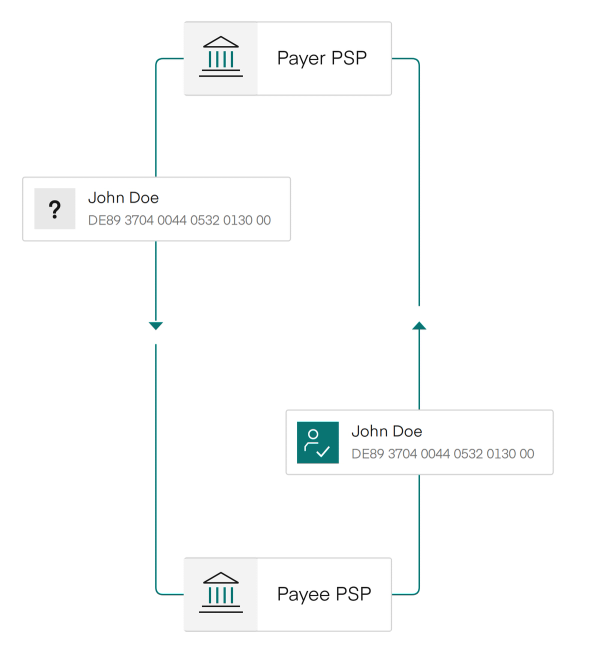
It aims to reduce some forms of payment fraud, in which fraudsters trick payers into sending payments to the wrong account numbers.
Per the IPR, PSPs in euro-area Member States have had to offer this service to their customers since 9 October 2025. PSPs in EU Member States whose currency is not the euro must offer it from 9 July 2027.
Failing to comply with this requirement results in:
- Obligations to refund payers for payments where the PSP did not properly provide payee verification. The liability can lie with the payer’s or the payee’s PSP, depending on who’s responsible for the failure to comply.
- Penalties that each Member State defines.
To help PSPs comply on time with the regulation and to ensure interoperability between all potential solutions developed to provide VOP services, the EPC developed the VOP scheme and its associated rulebook.
The EPC rulebook defines the scheme as follows: “The EPC Verification Of Payee (VOP) Scheme (‘Scheme’) is a set of rules, practices and standards to achieve interoperability for the provision and operation of verifying Payment Account Numbers and Names of the Payment Counterparties, between Participants of the Scheme prior to initiating a Payment Account-based Payment within SEPA.”
Verification Of Payee scheme model
The VOP scheme involves the following actors:
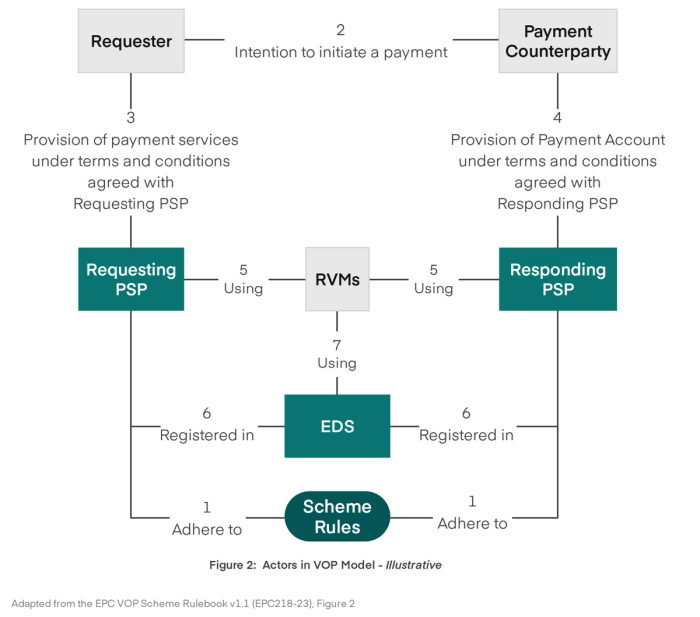
The Requester
The Requester is the payer. It can be a natural or a legal person.
The Payment Counterparty
The Payment Counterparty is the payee. It can be a natural or a legal person.
The Requesting PSP
The Requesting PSP is the PSP of the payer, or Requester, which sends a VOP request and provides the result to its Requester.
The Responding PSP
The Responding PSP is the PSP of the payee, or Payment Counterparty, which responds to VOP requests.
The EPC Directory Service (EDS)
The EPC Directory Service is a central directory that stores all the required data for Requesting PSPs to send VOP requests to Responding PSPs. At a high level, the EDS provides the right URL to call to send a VOP request for a given IBAN.
Who can participate in the Verification Of Payee scheme?
Only Requesting PSPs and Responding PSPs are scheme participants.
Scheme participants can be credit institutions, central banks and payment and electronic money institutions.
Participation in the EPC Verification Of Payee scheme isn’t mandatory per the Instant Payments Regulation. However, the EPC requires all current and future SEPA Credit Transfer (SCT) and SEPA Instant Credit Transfer (SCT Inst) scheme participants affected by the VOP provisions of the amended SEPA Regulation to adhere to the scheme, to guarantee reachability and interoperability across SEPA. In practice, PSPs offering SEPA credit transfers join the VOP scheme.
Verification Of Payee scheme technical details
In this section, we highlight the points in the rulebook that deserve particular attention.
The following diagram from the EPC rulebook shows the flows involved in VOP requests.
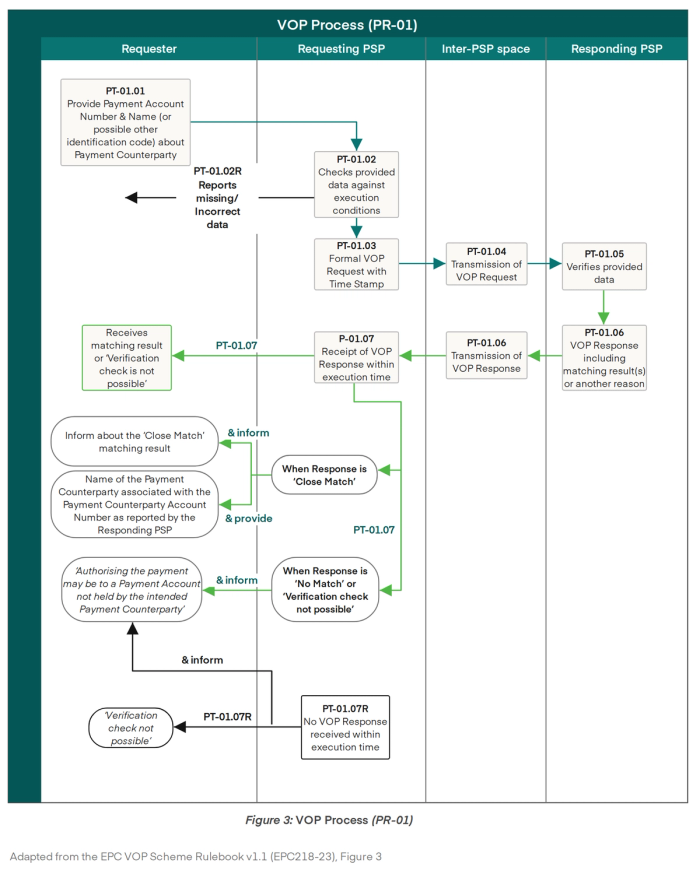
The diagram shows seven steps, from the Requester’s first input to the result it receives:
Step 1: The Requester provides the details
The Requester gives its Requesting PSP the Payment Counterparty’s IBAN and name, or an identification code.
Step 2: The Requesting PSP checks the data
If anything is missing or incorrect, the Requesting PSP tells the Requester straight away.
Step 3: The Requesting PSP creates the request
The Requesting PSP creates the VOP request and adds a timestamp.
Step 4: The request reaches the Responding PSP
Verification Of Payee message attributes
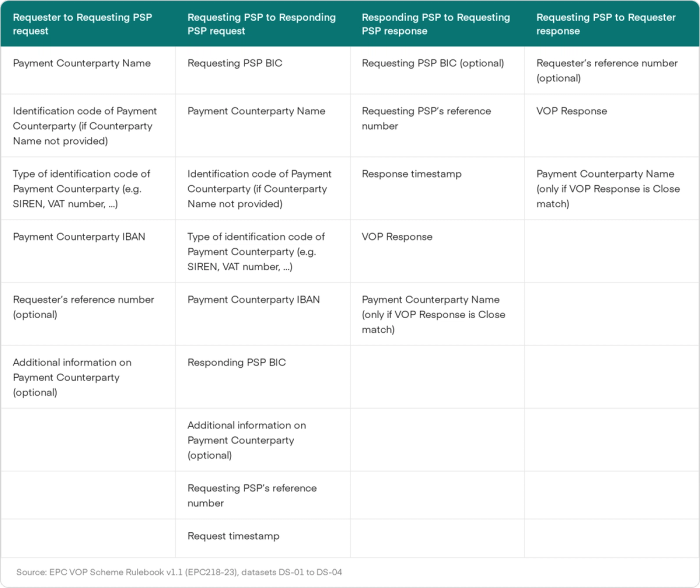
In its “happy path”, VOP involves four main messages exchanged between the Requester, the Requesting PSP and the Responding PSP, at steps 1, 4, 6 and 7 above.
The table below presents the attributes that the rulebook requires for each message.
The precise format and accepted values for each attribute appear in the “Verification Of Payee (VOP) Scheme Inter-PSP Application Programming Interface (API) Specifications” document. Our digest of the API specifications covers the details.
Verification Of Payee requests on names vs identification codes
The VOP rulebook supports VOP requests on two types of account holders, or Payment Counterparties:
- Natural persons
- Legal entities: companies, administrations, etc.
For natural persons, the Requester simply provides its Requesting PSP with a Payment Counterparty Name and IBAN.
For a legal entity, the Requester can provide a name or an identification code (VAT number, SIREN, SIRET, LEI or another identification code).
This leads to two types of possible VOP requests with different attributes:
Name-based request:
- Payment Counterparty Name
- Payment Counterparty IBAN
Identification code-based request:
- Payment Counterparty IBAN
- Payment Counterparty Identification Code
In the case of an identification code-based request, the IBAN comes first in the dataset because the scheme enables checking what identification code can be used for a given IBAN before sending the VOP request.
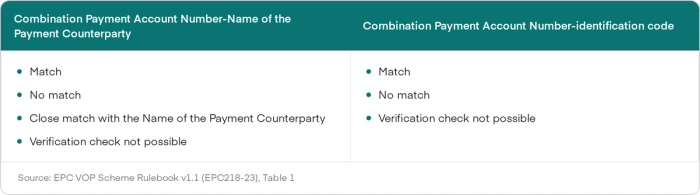
Verification Of Payee responses
The scheme supports the following responses, depending on the type of request:
Calculating the Verification Of Payee responses: the matching process
The VOP rulebook doesn’t mandate any algorithm or methodology for the Responding PSPs to decide how to respond to a VOP request.
It is up to the Responding PSP to decide how to respond to ensure that it:
- Complies with the IPR requirements and avoids fines or penalties.
- Prevents abusive use of VOP by Requesters to collect data such as Payment Counterparty Names, for instance through too lax “Close match” responses.
However, to support the industry in complying on time with the regulation, prevent too many false “No match” results and harmonise VOP responses between PSPs, the EPC has published its Recommendations for the Matching Processes under the VOP Scheme Rulebook. The document is guidance and sits outside the rulebook.
The document provides recommendations for the cleaning and formatting of Payment Counterparty Name data.
It also details which scenarios count as “Close match” results, for instance:
- Two letters in the Payment Counterparty Name are inverted
- A letter is replaced by another with the same phonetics
- Typos do not exceed a certain level, as calculated by industry-standard algorithms such as the Levenshtein distance. However, it is up to the PSPs to choose the algorithm and set the level.
It also clarifies how to treat the names of legal entities:
- Legal names
- Commercial names
Timing of a Verification Of Payee response
The rulebook defines a 5-second limit to answer a VOP request and specifies that a VOP request should preferably be executed in 1 second or less.
This timing starts when the Requesting PSP, having verified the information provided by the Requester (especially that the IBAN structure is correct), adds a timestamp to the VOP request and sends it.
The timing stops when the Requesting PSP receives the VOP response from the Responding PSP.
If the Requesting PSP doesn’t receive a VOP response within 5 seconds, it must give the Requester a “Verification check not possible” response.
Processing bulk Verification Of Payee requests
The VOP scheme doesn’t support bulk VOP requests between PSPs. Any VOP request exchanged between PSPs is individual, although a Requester and its Requesting PSP can agree to exchange bulk requests between them.
It means that PSPs that want to allow their users to submit bulk VOP requests must debatch them before sending them to each Responding PSP.
PSPs that serve corporate customers and offer them batch payment capabilities will most likely have to support this flow, to avoid breaking their customers’ batch payment flows.
Note that payers who are not consumers, such as corporates, can opt out of VOP when they submit multiple payment orders as a package, and can opt back in at any time. PSPs must still be able to offer VOP to them.
Getting ready for VOP compliance
The rulebook is one of several EPC documents a PSP needs. The others are the VOP Inter-PSP API specifications, the API Security Framework, the EPC Directory Service documentation and the EPC recommendations for the matching process. Check the EPC website for the current version of each, as the EPC updates them over time.
Mambu Payments has run VOP as an EPC-qualified RVM since October 2025, with more than 30 customers on both the requesting and the responding side, including Swan, Wamo, Flowe and Western Union. Swan reported a near-zero rate of “Verification check not possible” responses against a market average of about 12%, and Wamo completed its VOP onboarding in less than a week.
Conclusion
The rulebook sets the common rules, and each PSP decides how to apply them
The VOP rulebook gives every PSP the same set of rules: who takes part, which messages they exchange and the 5-second limit for a response. What it leaves open is how each Responding PSP calculates its answers, and how each PSP handles bulk payments, and those choices decide how smoothly VOP works in practice. PSPs in EU Member States outside the euro area have until 9 July 2027, and for them the path forward starts with understanding these rules and the choices behind them.

Questions about the VOP rulebook?
Talk to an expert about what it means for your PSP and how to prepare.
Frequently asked questions
Find quick answers to the most commonly asked questions about this topic below.
What is the VOP rulebook?
Who has to comply with VOP, and by when?
How long does a Responding PSP have to answer a VOP request?
What responses can a Responding PSP return?
Does the VOP scheme support bulk requests?
Does the VOP rulebook dictate the matching algorithm?

© Mambu 2026