

Verification Of Payee API specifications: all you need to know
Last update: November 2026 • 15 min read
Executive summary
The EPC’s VOP API specifications define three request flows (a name and IBAN check, an identification code and IBAN check or either check with an additional attribute), the messages PSPs exchange and the security checks that protect them. The flows are the same whether a PSP runs VOP itself or through an RVM, and PSPs in EU Member States outside the euro area have until 9 July 2027 to put them in place.

Introduction
What are the VOP API specifications, and what do they cover?
Three weeks after the publication of its Verification Of Payee (VOP) rulebook, the European Payments Council kept its word and published the Verification Of Payee API specifications on 31 October 2024.
The industry had been waiting for these specifications so that payment service providers (PSPs) and their providers, known as Routing and Verification Mechanisms (RVMs), could refine the design of their VOP solutions, and they answered key questions.
These API specifications enable all parties to develop their VOP APIs while ensuring scheme compliance and therefore interoperability across all PSPs. This digest reflects version 1.1.1, which took effect on 20 September 2026. PSPs in euro-area Member States have had to offer VOP since 9 October 2025, and PSPs in EU Member States whose currency is not the euro must comply by 9 July 2027.
In this blog, we explore the main API flows involved in VOP and their payloads, how the scheme secures the critical data involved in VOP and how VOP works when either Requesting or Responding PSPs use RVMs.
A quick reminder on the Verification Of Payee scheme model
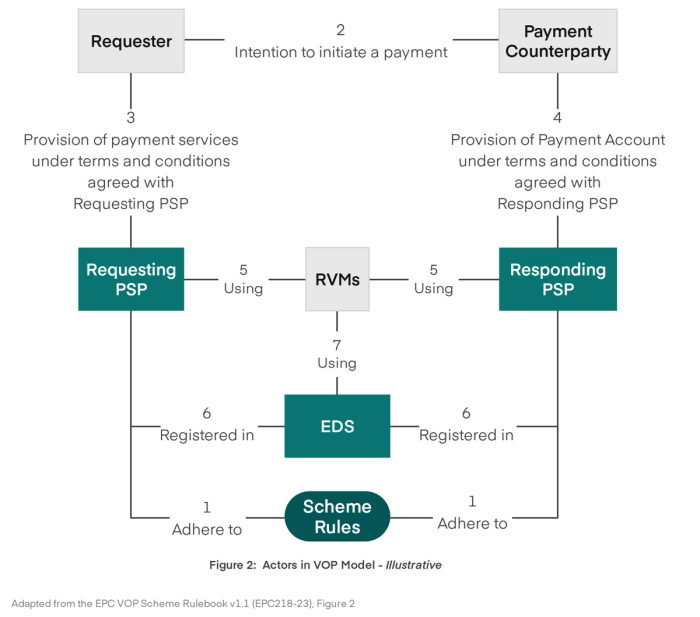
Before jumping into the API specifications, we need to understand the different actors involved in VOP and their interactions. Our VOP rulebook digest covers them in more detail.
The Requester
The Requester is the payer. It can be a natural or a legal person.
The Payment Counterparty
The Payment Counterparty is the payee. It can be a natural or a legal person.
The Requesting PSP
The Requesting PSP is the PSP of the payer, or Requester, which sends a VOP request and provides the result to its Requester.
The Responding PSP
The Responding PSP is the PSP of the payee, or Payment Counterparty, which responds to VOP requests.
The EPC Directory Service (EDS)
Verification Of Payee API sequences, requests and responses
While the VOP rulebook defines what attributes should be included in all VOP messages, including those between Requesters and Requesting PSP, the Verification Of Payee API specifications are specifically “inter-PSP” API specifications.
They don’t specify how APIs should be designed between PSPs and their RVMs, or PSPs and their customers who would benefit from programmatic VOP requests and responses. But we expect the structure and content of such APIs to be close, if not similar, to the inter-PSP ones.
The VOP API specifications cover the API sequences for three different use cases:
- Name / IBAN check: the “classic” Verification Of Payee for a natural person, which also works for a legal entity
- Identification code / IBAN check: the verification of a legal entity payee leveraging an identification code.
- Name (or identification code) / IBAN + additional attribute check: the verification of a natural person or legal entity payee when the payee is a customer of a payment or electronic money institution
We will first cover the sequence for the first use case, then break down the main differences between the sequences of the second and third use cases and the first one.
Natural or legal person’s name-based Verification Of Payee
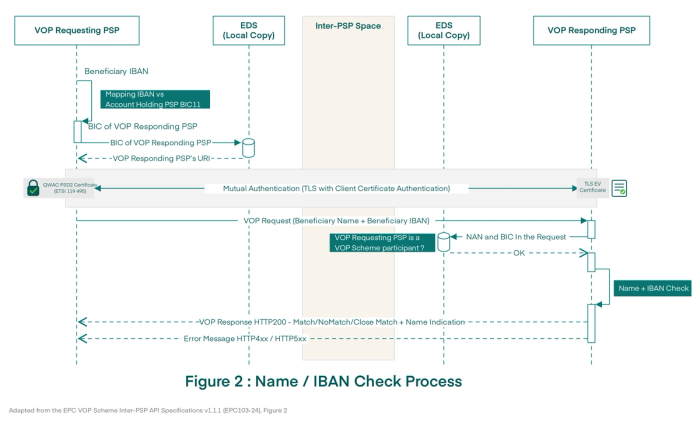
The sequence diagram below shows the different steps of a VOP workflow using a natural or legal person’s name.
In this section, we highlight the main tasks Requesting and Responding PSPs have to perform for this workflow to take place.
Preparing Requesting PSP to Responding PSP request
The table below describes the different elements required in a Requesting PSP to Responding PSP API request for a name-based Verification Of Payee request.
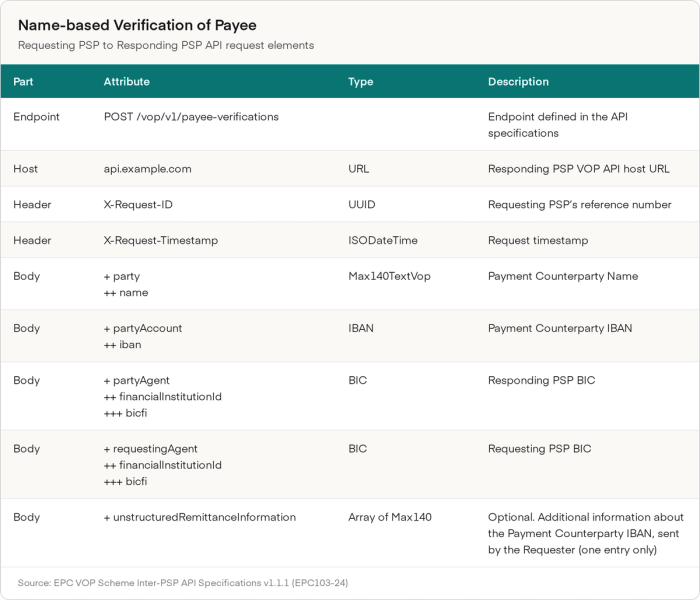
In addition to the attributes the Payer provides when initiating a VOP request (Payment Counterparty Name and Payment Counterparty IBAN), and to trivial attributes (Request timestamp, Requesting PSP’s reference number, …), the Requesting PSP must perform some processing to complete a Requesting PSP to Responding PSP API request.
Responding PSP BIC
Sending Requesting PSP to Responding PSP request
Sending the request takes two steps: the two PSPs authenticate each other, then the Requesting PSP formats and sends the API request.
Mutual authentication
Before the Requesting PSP can send the VOP request to the Responding PSP, both Requesting and Responding PSPs need to mutually authenticate. We cover why the scheme requires this mutual authentication and how it works in a section below.
Formatting and sending the API request
Once both PSPs have authenticated each other and the Requesting PSP holds all the data required in a Requesting PSP to Responding PSP API request, it can send the request in the JSON format defined in the API specifications document.
POST /vop/v1/payee-verifications
Host: api.example.com
Content-Type: application/json
Accept: application/json
User-Agent: MyApp/1.0
Content-Length: 312
Date: Mon, 12 Aug 2024 15:19:21 GMT
X-Request-ID: 123e4567-e89b-12d3-a456-426614174000
X-Request-Timestamp: 2024-08-12T15:19:21.123Z
{
"party": {
"name": "Dupont Jean"
},
"partyAccount": {
"iban": "BE12345678901234"
},
"partyAgent": {
"financialInstitutionId": {
"bicfi": "ABCDBEBBXXX"
}
},
"requestingAgent": {
"financialInstitutionId": {
"bicfi": "ABCDBEB0XXX"
}
}
}
Processing Requesting PSP to Responding PSP request
The Responding PSP then has four tasks to complete: verifying the Requesting PSP, cleaning up the request data, calculating the VOP response and preparing the API response.
Verifying Requesting PSP scheme participation
As part of the VOP scheme security mechanisms, the Responding PSP must ensure that the Requesting PSP is a legitimate VOP scheme participant.
We cover this flow in detail below.
Request data clean-up
Before the verification response calculation itself starts, the Responding PSPs can, as recommended by the EPC Recommendations for the Matching Processes under the VOP Scheme Rulebook, clean up the name provided in the Payment Counterparty Name attribute of the VOP API request.
Cleaning means preparing the name strings so that the calculation workflow can process them, for instance by ignoring casing, removing accents or removing honorifics and titles when the Responding PSP doesn’t record them in its account holder database.
Calculating VOP response
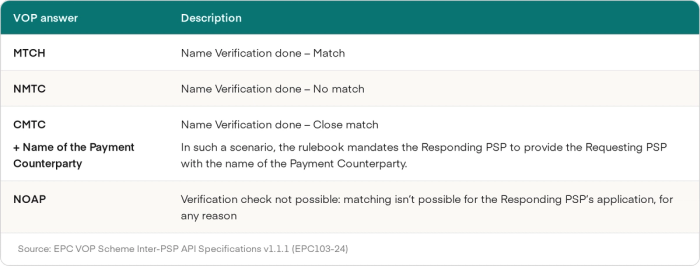
Once it has cleaned up the request data, the Responding PSP must calculate the VOP response, meaning assessing the correspondence of the provided Payment Counterparty Name with its account holder name for the provided IBAN.
Based on the result of this analysis, the Responding PSP can answer with one of the following responses:
Preparing the Responding PSP to Requesting PSP API response
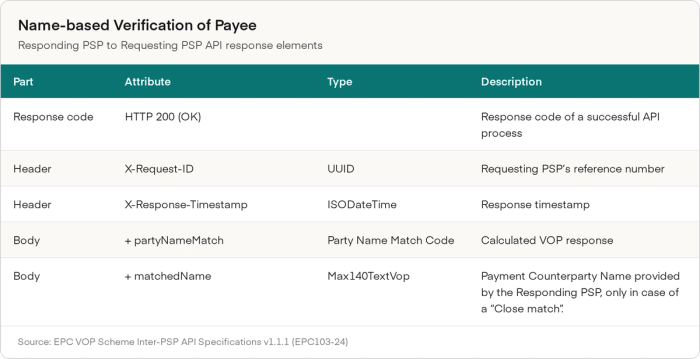
With the calculated VOP answer, the Responding PSP has all the elements to prepare the Responding PSP to Requesting PSP API response.
Sending Responding PSP to Requesting PSP response
The Responding PSP needs no further authentication to send the response to the Requesting PSP. The Responding PSP can send the response following the JSON format defined in the API specifications document.
Below is an example of a “Match” response:
HTTP/1.1 200 OK
Content-Type: application/json
X-Request-ID: 123e4567-e89b-12d3-a456-426614174000
X-Response-Timestamp: 2024-08-12T15:19:22.678Z
Content-Length: 37
{
"partyNameMatch": "MTCH"
}
And below is an example of a “Close match” response:
HTTP/1.1 200 OK
Content-Type: application/json
X-Request-ID: 123e4567-e89b-12d3-a456-426614174000
X-Response-Timestamp: 2024-08-12T15:19:22.678Z
Content-Length: 72
{
"partyNameMatch": "CMTC",
"matchedName": "Dupond Jean"
}
Processing Responding PSP to Requesting PSP response
This step isn’t specified in the EPC API specifications, but PSPs have to manage it properly to comply with the VOP rulebook and the IPR.
Timeout
Whenever a Requesting PSP sends a Requesting PSP to Responding PSP request, the execution time starts at the request timestamp. It is up to the Requesting PSP to decide how to measure it, for instance from the times at which its own systems sent the request and received the response.
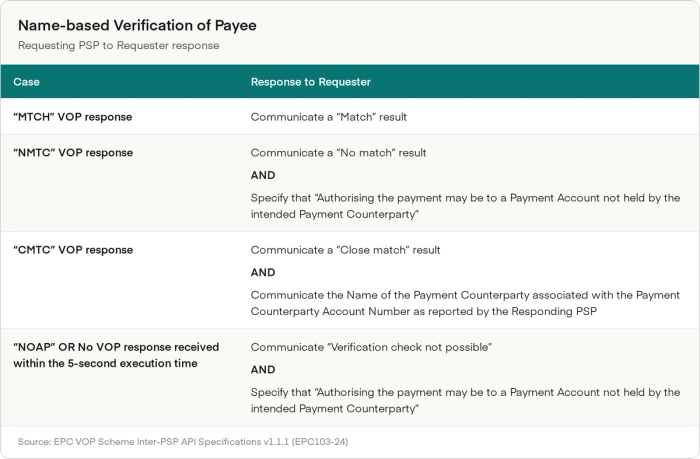
If this time reaches 5 seconds, the Requesting PSP considers the VOP request timed out and must give the Requester a “Verification check not possible” response.
Response to Requester
Requesting PSPs must inform their Requesters of the VOP response, meaning extracting the relevant information from the received VOP response and either:
- displaying it in the UI the Requester uses to initiate a VOP request, before initiating a payment
- passing the VOP responses on programmatically via API or files, most likely for corporates
The possible responses to Requesters are the following, although the rulebook leaves the exact wording and presentation to each Requesting PSP:
Legal entity’s identification code-based Verification Of Payee
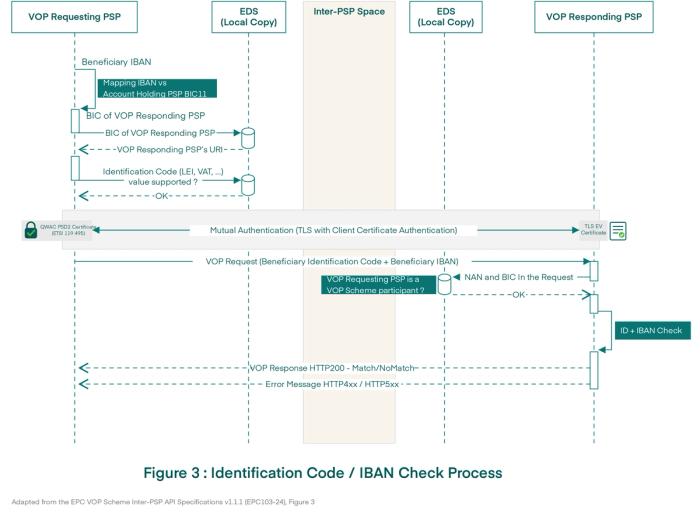
The sequence diagram below shows the steps of a VOP workflow for a legal entity payee leveraging an identification code. As defined in the VOP rulebook, this identification code can be a VAT number, a SIREN, a SIRET or any other valid identifier.
In this section, we highlight the main differences between the VOP workflow with a name and the VOP workflow with a legal entity’s identification code.
Preparing Requesting PSP to Responding PSP request
The main difference to highlight versus a name-based VOP request is the need to populate the identification code in the API request.
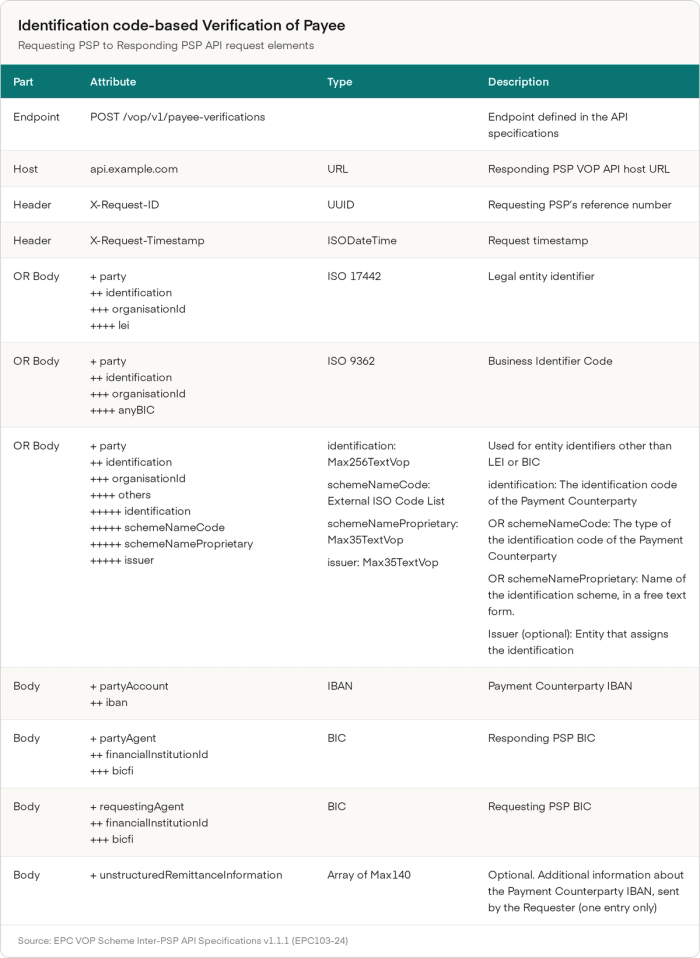
The Requester provides this identification code when they initiate their VOP request, but the API specifications add a step to help identification code-based VOP requests succeed.
Checking Responding PSP-supported identification codes
Before sending an identification code-based VOP request, the Requesting PSP must check, in its local copy of the EDS, which types of identification codes the Responding PSP supports.
The Requesting PSP can, therefore, leverage this information to dynamically suggest to the Requester the different VOP methods available to verify a legal entity payee: whether with name only or with an identification code and, in this case, which type of identification code.
Processing Requesting PSP to Responding PSP request
Compared with name-based VOP, this step is simpler for the Responding PSP with identification code-based VOP.
No request data clean-up
There is no request data clean-up required, as identification codes should follow standardised formats and a Responding PSP should not receive identification codes it doesn’t support.
Easier VOP response calculation
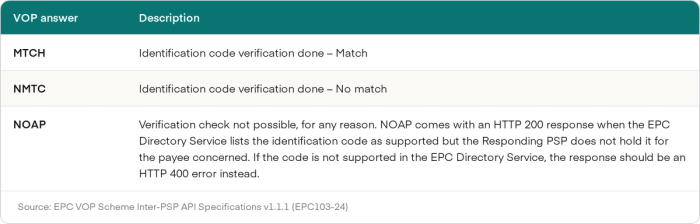
The identification code-based method only allows a perfect match between the provided and recorded identification, or no match at all, leading to the following possible responses:
Preparing the Responding PSP to Requesting PSP API response
Here again, this step is simpler as it only involves answering with the VOP answer.
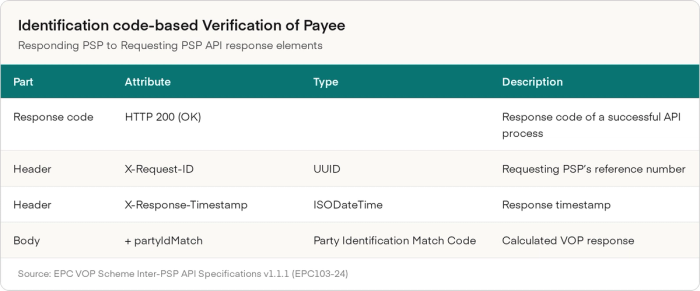
Sending Responding PSP to Requesting PSP response
Verification Of Payee on PI/EMI-held payment accounts
The VOP requirement stated in the IPR applies equally to banks and payment and electronic money institutions (PIs and EMIs). Therefore, so does the Verification of Payee rulebook.
However, PIs and EMIs don’t always have their own BIC, which is the routing key used by the VOP scheme. PIs and EMIs can operate as SEPA indirect participants, in which case they have their own BIC, or as their banks’ corporate customers, in which case their payment accounts sit under their partner banks’ BIC.
In the SEPA indirect participant setup, VOP works the same way for PIs and EMIs as for banks.
In the corporate customer setup, the API specifications provide for VOP requests to go to the PI/EMI’s bank, which can then use an “unstructuredRemittanceInformation” additional attribute to identify the right payee and calculate the VOP response accordingly.
The sequence diagram below describes this workflow.
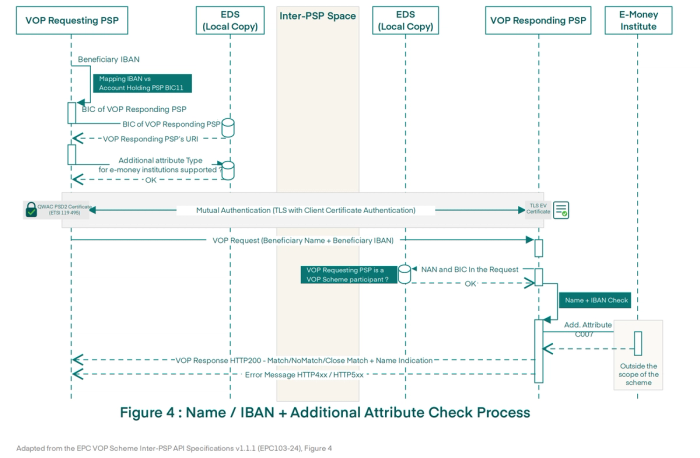
In practice, VOP requests for accounts that a PI or EMI holds under its sponsor bank’s BIC go to the sponsor bank. The bank can answer them in two ways: the PI or EMI shares its customer list with the bank, which then treats those customers as account holders, or the request carries the additional attribute so that the bank can match it to the right end customer.
Mambu Payments supports the additional information field in its VOP API for this case, whether the PSP uses Mambu Payments to send or to answer VOP requests.
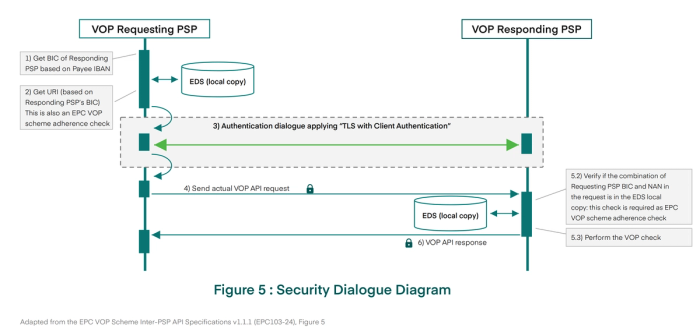
Verification Of Payee protection mechanisms
VOP allows the exchange and verification of potentially sensitive information between PSPs. In this section, we explore the risks that VOP introduces and how the scheme mitigates them.
The risk of leaking sensitive information
VOP enables any customer of a European PSP to query the correspondence of any account holder and an account number, and in the case of the “Close match” scenario, receive from the Responding PSP the actual name of the account holder.
Without the right protections, it is theoretically possible, even though very unlikely, for a malevolent party to brute-force the scheme to obtain the account numbers of European citizens or companies.
The most likely threat comes from the “Close match” scenario, where malevolent parties could exploit a PSP’s misconfigured, overly loose matching algorithm to easily leak its account holders.
VOP protection mechanisms
To prevent these potential leaks, the scheme provides several mechanisms.
EDS-based routing
The first layer of protection comes from how PSPs obtain the VOP API host URLs to query. These host URLs are only available in the EDS, which only PSPs participating in the VOP scheme can access.
Mutual authentication
The EPC API Security Framework document further specifies how Requesting and Responding PSPs should authenticate each other before exchanging VOP messages.
Verification Of Payee when relying on Routing and Verification Mechanisms (RVMs)
PSPs can rely on third-party providers to perform all or part of the Verification of Payee workflows. The VOP scheme calls these third-party providers Routing and Verification Mechanisms (RVMs). Our article on what to look for in an RVM explains how to compare providers.
RVMs must perform these tasks on behalf of PSPs according to the rulebook, and therefore following these API specifications. So the use of RVMs doesn’t introduce any change in the inter-PSP workflows described above: they simply send or receive answers on behalf of PSPs.
The only differences are in the VOP request URLs and in the management of EV and QWAC PSD2 certificates.
Responding PSP leveraging an RVM
In the case of a Responding PSP leveraging an RVM, the RVM can expose one request URL per PSP customer, or one common URL for all PSP customers. The RVM must record these URLs in the EDS to ensure proper routing of VOP requests.
The RVM can then use either its PSP customers’ EV certificates or its own EV certificate to authenticate itself to the Requesting PSP.
Requesting PSP leveraging an RVM
In the case of a Requesting PSP leveraging an RVM, the Requesting PSP has to provide the RVM with its QWAC PSD2 so that the RVM can authenticate the VOP request as coming from the PSP to the Responding PSP.
Getting compliance-ready
The API specifications, the API Security Framework and the EPC Directory Service documentation give PSPs and RVMs what they need to build and run a compliant VOP API. Check the EPC website for the current version, as the EPC updates the specifications over time.
Mambu Payments has run VOP as an EPC-qualified RVM since October 2025, with more than 30 customers on both the requesting and the responding side, including Western Union, BCB Group, Swan, Flowe and Wamo. Swan reported a near-zero rate of “Verification check not possible” responses against a market average of about 12%, and Wamo completed its VOP onboarding in less than a week.
Conclusion
The API specifications set the common flows, and each PSP decides how to implement them
The EPC’s API specifications give every PSP the same three inter-PSP flows, the same message formats and the same security checks, whether a PSP runs VOP itself or through an RVM. What they leave open is how each PSP retrieves BICs, calculates its responses and informs its Requesters, and those choices decide how smoothly VOP works in practice.
PSPs in EU Member States outside the euro area have until 9 July 2027, and for them the path forward starts with building to these specifications.

Building to the VOP API specifications?
Talk to a payments expert about connecting to the VOP scheme and getting your integration right.
Frequently asked questions
Find quick answers to the most commonly asked questions about this topic below.
What are the VOP API specifications?
What use cases do the VOP API specifications cover?
Which responses can the VOP API return?
How do PSPs authenticate each other in VOP?
Does using an RVM change the VOP API flows?
What happens when a VOP request times out?

© Mambu 2026